


So as the nation — and strangely, much of the world — focuses on America’s attempts to undo four years of rampant illegal immigration, another drama is playing out on the other side of the world. And the protestors there are fighting genuine autocrats. The situation feels like it’s hitting a tipping point.
So what happens when an American nuclear-powered aircraft carrier is inserted into the Iranian mix?

Chris is off this week, so I’ve got the Desk. Let’s start off by acknowledging that nobody knows what’s in store for Iran in the coming weeks. In fact, we’re not sure Donald Trump does. Arab allies in the Gulf recently visited Washington to try to get some clarity themselves, but came away empty-handed; perhaps their refusal to allow the U.S. to use their airspace didn’t go over well.
But now comes word of twin explosions in Iran, including one apparently targeting IRGC headquarters, which houses Iran’s elite palace guards. America and Israel both deny involvement.
The point is: it’s getting very close to decision time.
The Lincoln had been in the Asian Pacific previously (think: China). Moving something of that size is a big step; there’s a theory of geopolitics that one can track the true intentions of great powers by the positioning of their navies. It’s certainly a pointer.
But that said: strategic ambiguity remains. Note that the Lincoln is not actually inside the Persian Gulf, which is relatively shallow, heavily surveilled, and subject to mines. Most of the armada is south of that, in the more open Arabian Sea, which allows for greater maneuverability.
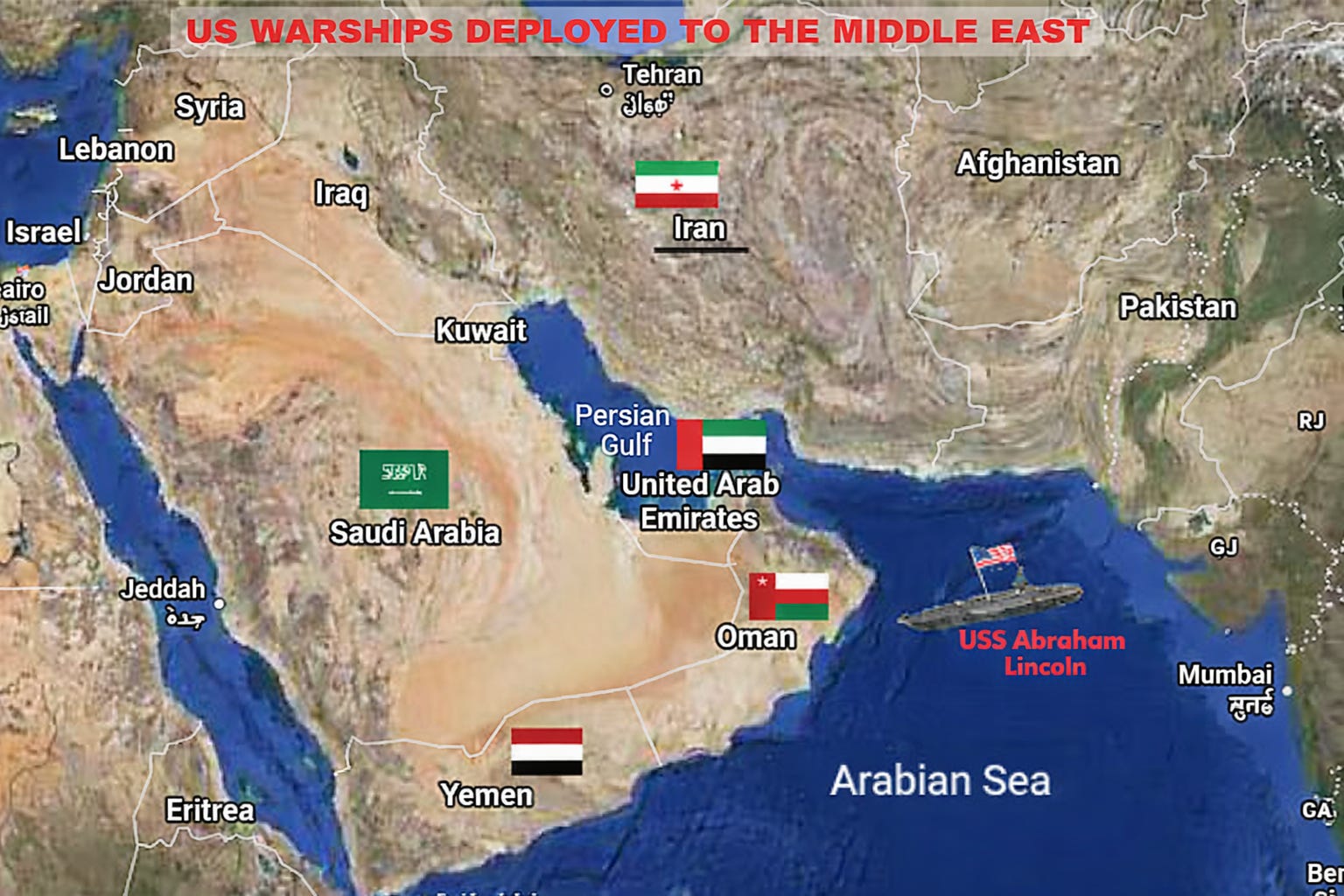
Iranian targets, however, remain well-within reach.
President Trump himself has reinforced this uncertainty, talking about negotiations and threats in the same sentence. Meanwhile, on the Iranian side, Tehran’s announced live-fire naval drills in nearby waters and warns that any U.S. attack will meet immediate retaliation.
So: what’s coming?
In this writer’s estimation, the Trump administration will be unwilling to come away from the current crisis without taking some action. There’s been too much attention paid, too much posturing, too much history in play.
Further, there is no nation on earth with more American blood on its hands in the modern era than Iran, through terrorism, arming of proxies, and the fomenting global instability. The administration gets that.
And there is one more factor: Trump undoubtedly recalls Obama’s lack of action the last time Iran looked primed for change — and the criticism that resulted. For a guy clearly concerned with his legacy — think Nobel Peace Prize — it is doubtful Donald Trump wants to be lumped into the same category.
So our assessment is that a limited strike of some sort — perhaps on Iran’s brutal paramilitaries (the thuggish Basij), perhaps on limited military targets, perhaps on their navy and what’s left of their air force — is next. The administration doesn’t want to “own” another mideast nation, as in Iraq — and the Gulf nations clearly fear local chaos, however much they hate the mullahs. And it’s no secret that MAGA-world wants no more of foreign adventurism.
So: Is it worth it?
We’re decidedly skeptical. We refer back to this piece from The Ops Desk, written some months ago. If the mullahs are left in place: Why bother? They’ll just rebuild.
And if the mullahs go… who then will run the nation with the second largest oil reserves in the world?
The unfortunate truth here seems to be the following: go big or go home. A cosmetic strike to save face seems gratuitous-at-best. Either force change… or stay out of it.
Recall, we’ve got other national security problems, closer to home. For instance, we currently “own” Venezuela’s future. We just kinda/sorta bought Greenland. Do we really need to add Iran to our “you broke it, you own it” portfolio?
And if we sound like the only ones who are skeptical… see below.
The Sunday Pod: A Conversation With Captain Morgan Murphy
Gang, this week join us for a great conversation with Morgan Murphy, U.S. Navy Captain (now Reserves), former Trump White House official, former Pentagon spokesman, and current candidate for the U.S. Senate from Alabama.
When a guy like this speaks… we should listen.
Sure, the USS Lincoln carrier group has, as the Captain lays out for us, “more firepower than most European nations.” But does that mean we should use it?
The good Captain lays out some things the country may not have fully wrapped its head around yet: what it would actually look like if the United States does strike Iran—and what happens the moment that first decision is made.
This is real security talk: second-order effects, regional blowback, and the uncomfortable truth that once you move pieces on that board, they don’t snap back into place. Reality, not posturing.
History is on the horizon, folks… we’ve got it here.
So click above for the sizzle… or HERE for the full pod.
Join us!
Maine, The Little Minnesota
So now comes word that Maine’s Secretary of State, Shenna Bellows, has decided that Maine will no longer issue vehicle registrations for undercover federal vehicles. This, after ICE confirmed that it was launching an operation to apprehend criminal illegal aliens.
So apparently, if any federal agency wants to conduct covert operations in Maine, they have to run the case past Bellows (who — shocker — is running for Maine Governor).
Now, in practical terms, the risk here isn’t legal — the feds can put fake plates on their u/c cars and tell Bellows to go pound sand. The problem is the risk to an operation during which a Maine cop runs a plate that comes back as bogus. At that point, the list of things that could go wrong is legion.
If you don’t recall Shenna Bellows, she’s the Maine Secretary of State who ruled that Donald Trump was ineligible for the Republican primary ballot in the run-up to the 2024 election, due to Trump’s role in J6. That decision was swiftly overturned by the Supreme Court.
More background on what goes on in Maine: Earlier this month in Lewiston — yes, another area with a heavy Somali population — police executed a search warrant at the “Mogadishu Store” as part of a fraud investigation, with help from the USDA. Officials were quick to clarify it wasn’t immigration enforcement, after speculation filled the void online. The store remains open but is taking cash only while equipment is held by investigators (I’m sure the storeowners will be quite exacting in paying the taxes on these untraceable transactions).
This isn’t an isolated incident. Federal prosecutors have already charged individuals in tax-fraud cases tied to MaineCare, Maine’s low-income healthcare plan. And state auditors recently flagged over-billing and pulled payments from at least one provider after audits showing suspicious billing patterns from a Maine provider, Gateway Community Services, founded by Somali-American Abdullahi Ali. Over-billing cases continue to surface, from home-health agencies to other MaineCare providers.
You know the pattern. Minnesota had Feeding Our Future, one of the largest public-assistance fraud schemes in U.S. history. State audits flagged irregular claims as early as 2020, but Minnesota state officials did nothing; Minnesota’s “top law enforcement officer,” Keith Ellison, actually supported the fraudsters rather than look into the obvious signs. Some cop.
Now, we know Minnesota’s fraud exposure didn’t stop at food programs — it spread like wildfire, with DOJ indictments and investigations ongoing.
So here’s Maine, doing what it can to impede federal law enforcement, as Somali fraud scandals surface.
Why does that landscape sound familiar?
Suicidal Empathy — Or Just Commerce?
So we’ve all heard plenty recently about the vast Democrat-NGO-activist network malforming our politics. A major, under-the-radar theater for this has been refugee resettlement, which has been operating on a kind of bureaucratic autopilot, with large NGOs paid by the federal government, people placed in communities, and no one asking questions.
Meet a major player.
Catholic Charities and its affiliates are not simply volunteers welcoming strangers — they’ve been embedded in the federally funded resettlement apparatus for decades. Under the United States Refugee Admissions Program (USRAP), the State Department awards contracts to 10 national resettlement agencies — including Catholic Charities through the U.S. Conference of Catholic Bishops’ Migration and Refugee Services (MRS) — to place and assist people arriving as refugees.
Federal contracts typically provide roughly $2,300 per refugee for initial reception and placement costs; local Catholic Charities offices use these funds for housing setup, furnishings, food, transportation, and early case management.
In total, the bishops’ refugee apparatus received about $122.6 million in federal funding in 2022 and about $129.6 million in 2023 for refugee-related services, most of which is distributed to local Catholic Charities affiliates around the country.
Catholic Charities has long been part of resettling refugees from around the world — including being a major player in Somalia, where resettlement agencies like Catholic Charities (and the non-Catholic Lutheran Social Services) have helped establish the large Somali diaspora in states like Minnesota.
But federal money covers only the first months of assistance; refugees must then access employment, language training, and other programs funded by separate government grants.
So if you’re doing the math: Catholic Charities’ refugee work — including with Somali arrivals — is significantly underwritten by taxpayer dollars.
To be clear, Catholic Charities denies any monetary interest for this resettlement work. Recently, after Vice President J.D. Vance (who is Catholic) questioned if the U.S. Conference of Bishops’ criticism of Donald Trump’s immigration policies was based on bishops’ concern for “their bottom line,” U.S. Bishops Migration Director William Canny stated that that was “just wrong.”
Perhaps. But whether Catholic Charities benefits monetarily or not is only part of the equation. Because once resettled, Somali refugees in particular continue to be a burden to the system; as famously discovered in Minnesota, over 80% remain on some form of public assistance, even if they’ve been here for decades.
And maybe the real point: Why is Catholic Charities involved in the resettlement business at all? Isn’t that sort of… political?
Roasted Lemon?
When the federal magistrate refused to sign off on the complaint against Don Lemon, he forced the prosecutors to go to the grand jury, and so they went. And last week, we got the indictment.
Surprising at first glance, coming out of a jury pool of any nature in the Twin Cities, but remember this: indictments do not need to be unanimous. Only 12 out of a pool of between 16–23 jurors are required to return an indictment. So there certainly could have been, and very likely were, some holdouts that were on the same page as the magistrate there.
But what comes next is a very different animal.
A conviction from the trial jury, of course, must be unanimous. And those 12 jurors will hear both sides. So what of this jury pool?
The good news for the prosecution is that the St. Paul federal jury pool does not pull from just the city. It spans Ramsey, Washington, Dakota, and a wide arc of southern Minnesota counties. Yes, Ramsey County (the Twin Cities) is heavily Democratic. But Washington and Dakota are competitive, and many of the outlying counties lean Republican.
So when you aggregate the counties feeding this courthouse, roughly 42% of voters supported Donald Trump in the last presidential election. That is not a one-party jury pool. It is mixed, politically and demographically. It’s urban, suburban, and rural.

The bad news for the prosecution however is that 42% is not inspiring when it only takes one juror to set the Defendant free.
While the conviction rate of federal prosecutors is famously high, Don Lemon is famous, full stop. He can get in front of the cameras. And the opening arguments to the jury are already underway, in the public sphere.
Don Lemon clearly does not have a First Amendment right to break the law, and ultimately there will likely be a jury instruction from the judge that tells the jurors that. But that instruction will come long after the jurors have already decided whether Don Lemon should have a First Amendment right to do what he did.
Right after being released on bond, Lemon arrogantly told the jury pool that he “will not stop, will not stop ever” – easily heard as, “It’s my First Amendment right and I’ll do it again.”
Should it reach to a conviction: The judge, who decides Lemon’s sentence if convicted, would likely not be impressed by that pronouncement.
Remember Tren de Aragua?
Well, we do. This space was among the first public outlets to identify and publicize the threat of the Venezuelan prison gang, Tren de Aragua — another threat we were told was overstated.
Now comes word of this:

Great work by DOJ Nebraska — 87 arrests. Wow. And also the first TdA case we’ve seen that isn’t just street-level thuggery. This was a sophisticated hacking case.
This is how the traditional Cosa Nostra started. We all know how that went, as J. Edgar Hoover told America there was no such thing as “the mafia.”
We ignore this new group at our peril. Kudos to Nebraska DOJ.
And finally…

Hmm. Something must’ve changed… we can’t quite put our finger on it.

Iran is the real test of seriousness. Parking a carrier group off the coast isn’t symbolism—it’s a loaded sentence waiting for a verb. Trump understands what Obama refused to: ambiguity without consequence invites bloodshed, not reform. The mullahs survive on bluff, proxies, and Western hesitation. A cosmetic strike would be worse than nothing; it would validate their model. Either break the regime’s coercive spine or stay out entirely. Meanwhile, Americans should notice the contrast: Iranians are risking death to topple real tyrants, while our domestic radicals cosplay resistance against lawful enforcement. Midnight isn’t about war—it’s about whether resolve finally replaces performance.