

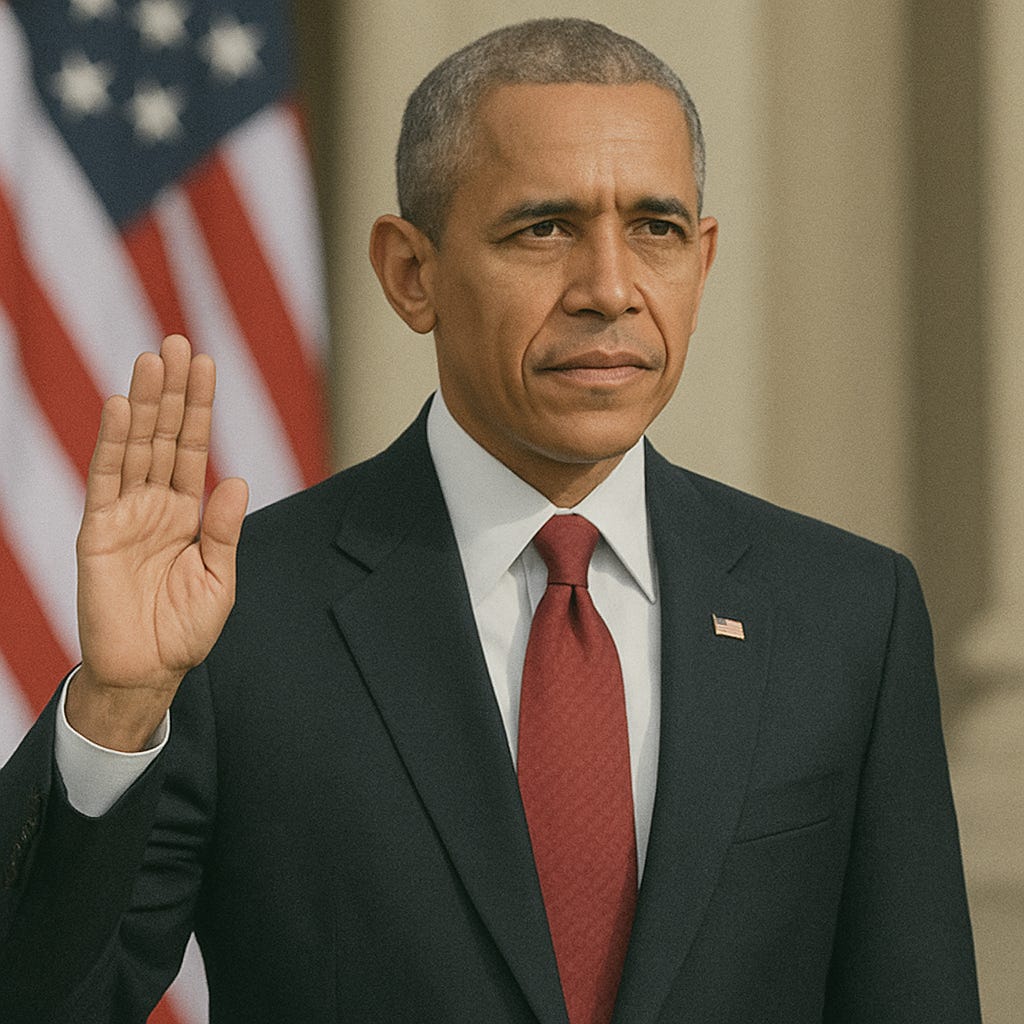
If Congress subpoenas former President Barack Obama to testify about his role in the now-discredited Trump–Russia investigation, there are two questions the public should focus on. First, can he be forced to testify? Second, if he lies, can he be prosecuted?
The answer to both questions is yes.
Let’s start with the obvious: the timeline. Whatever criminal conduct may have occurred during the 2016 election and transition - the illegal surveillance, deception of the FISA court, politically motivated intelligence abuse - it happened nearly a decade ago. For most federal crimes, the statute of limitations is five years. See 18 U.S.C. § 3282. That means that absent a specific tolling provision or ongoing conspiracy, prosecution is now off the table. Even if Obama broke the law, the window for accountability closed sometime between 2021 and 2023.
Additionally, because of the Supreme Court’s ruling in Trump v. United States, where the Court held that a former president is absolutely immune from criminal prosecution for official acts taken while in office, President Obama would likely be immune from prosecution. So even if it is clear that President Obama had authorized illegal surveillance or directed law enforcement or intelligence agencies to target political opponents while acting as the President, then under the Trump decision, he is categorically immune from criminal prosecution for those acts. That immunity is retroactive and permanent. It protects Obama now just as it protects Trump.
But that new immunity that the Supreme Court just clarified in Trump v. United States is a double-edged sword, because that immunity also means that under clear Supreme Court precedent, President Obama would no longer enjoy a Fifth Amendment right to refuse to testify in front of Congress.
A witness can only assert the Fifth if they face a real and appreciable risk of criminal prosecution. See Ohio v. Reiner, 532 U.S. 17 (2001). If the acts in question are immune from prosecution, then there is no valid Fifth Amendment privilege.
This rule is not just implied, it is explicit in Supreme Court case law. In Kastigar v. United States, the Court held:
Immunity displaces the danger. Once the reason for the privilege ceases, the privilege ceases. 406 U.S. 441, 439 (1972)
So if Congress subpoenas Obama to testify about his official role in the Russia investigation, and if the current President (Donald Trump) declines to assert executive privilege on his behalf, then Obama cannot invoke either executive or Fifth Amendment privilege to avoid testifying. The right to assert executive privilege belongs to the office of the presidency, and the decision whether to assert that right is made by the current president, Donald Trump.
So unless Donald Trump asserts executive privilege, President Obama will have to speak. He will have to tell the truth.
And if he lies, he can be prosecuted.
The key statute here is 18 U.S.C. § 1001, which makes it a felony to knowingly and willfully make any materially false statement in any matter within the jurisdiction of the federal government, including testimony before Congress. Unlike perjury, § 1001 does not require an oath. It doesn’t matter if Obama is testifying in a closed-door deposition, under subpoena, or voluntarily. If he knowingly lies about a material fact, that’s a crime. The penalty? Up to five years in prison.
And if he does testify under oath in front of Congress and lies, then 18 U.S.C. § 1621 also comes into play. That statute criminalizes perjury, false statements made under oath about a material matter.
This is not a theoretical concern. If documents, recordings, or other witnesses contradict Obama’s testimony - if he denies authorizing surveillance that other officials say he did approve, or denies knowledge of a FISA application that bears his briefing memo - he could be exposed. And unlike most political witnesses, Obama’s status as a former president wouldn’t shield him from testifying. In fact, the legal standard would be even clearer: his prior immunity from prosecution removes his right to remain silent, and any knowing falsehood is fully chargeable under federal law. And it would not be time-barred.
Congress has long been reluctant to compel testimony from former presidents. But there is no legal barrier to doing so, especially when the current president waives privilege. Trump has already done so in other investigations, and it seems very likely President Trump would do so here as well. If he does, Obama’s only options would be to testify truthfully or risk committing a fresh felony in front of the nation. Any case for lying to Congress would be prosecuted in the District of Columbia by U.S. Attorney Jeanine Pirro.
It would be ironic. The original conduct - the coordination, the surveillance, the misleading intelligence assessments - may have been unlawful but is now out of reach. The Supreme Court says it cannot be punished. But if Obama lies to Congress to cover it up, he could still go to prison. Not for what he did as president. But for what he says he didn’t do, years later, as a citizen.
And that might not just be poetic justice. It’s the law.
Uhhh...
It's not like he WOULDN'T lie. The guy lies all the time, soooo... ?
If his lips 👄 are moving, he’s going to lie. Pattern of practice through out his life.