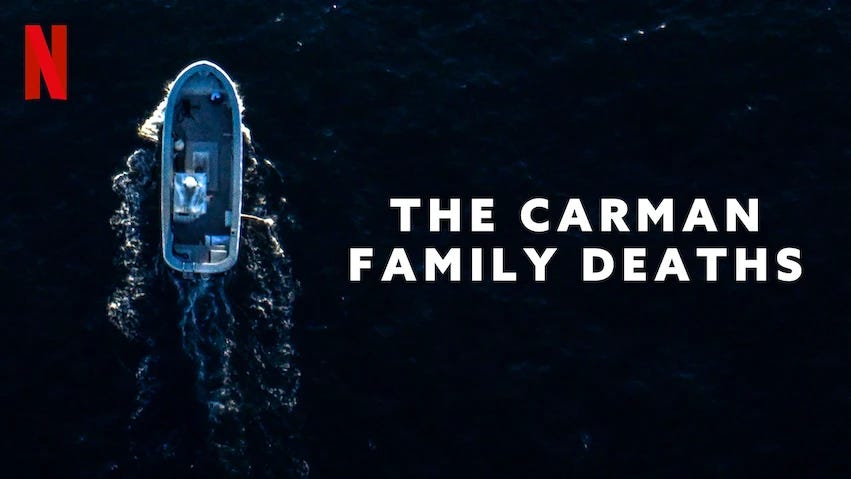
Netflix’s The Carman Family Deaths starts as what looks like a tragic missing-person case at sea—then quickly turns into something any law enforcement officer would recognize as a slow-burning, high-stakes investigation filled with contradictions, suspicion, and unanswered questions.
The documentary focuses on Nathan Carman, a young man who was rescued alone in a life raft after an offshore fishing trip with his mother, Linda Carman, in September 2016. According to the documentary, the pair left from South Kingstown, Rhode Island, for what was supposed to be an overnight outing near Block Island. When Linda failed to contact friends the next day, the family reported them missing.
What followed as a massive U.S. Coast Guard search—covering roughly 62,000 nautical square miles—but with no sign of the boat or Linda. Eight days later, a passing freighter spotted Nathan drifting about 100 miles south of Martha’s Vineyard and pulled him to safety. Linda was never found.
Now: Think about that. Nathan survived at sea on a life raft alone for eight days with little food and water? This writer has been to the ocean around Martha’s Vineyard many times and I can tell you: the water in that area can be really rough. Oh, and it’s also filled with sharks. (It’s even where Jaws was actually filmed).
From an investigative standpoint, the moment Nathan is recovered is the moment the case stops being a straight search-and-rescue story and becomes a suspicious-death file. You’ll have to watch to see why. Suffice to say, a few things don’t add up.
But the real pivot point—the thing that makes this documentary hit like a major-crimes briefing—is that the “missing mother” case is not the family’s first tragedy.
And maybe — not the family’s first murder.
From a law enforcement perspective, this is the nightmare category: a missing person at sea tied to an earlier homicide in the same family. These cases don’t stay emotional—they turn evidentiary. Investigators start asking not just “what happened,” but who benefits, who controls the narrative, and who has a pattern of being the last one standing.
The documentary also touches on how Nathan’s autism spectrum diagnosis complicates public perception. Officers watching will recognize this immediately: behavior that reads “cold” or “detached” on camera is not the same thing as guilt. But it also doesn’t clear suspicion. Investigations can’t run on feelings—they run on corroboration: timelines, mechanical analysis, phone data, insurance filings, and forensic findings.
In the end, The Carman Family Deaths leaves viewers with what law enforcement often leaves cases with: a set of facts, a list of red flags, and the grim understanding that sometimes the ocean—and family secrets—keep the final answer buried. The ocean is dangerous—but it’s also a perfect “crime scene destroyer.”
The doc benefits from its New England atmosphere and “whodunit” vibe — there’s an almost gothic feel to it all. But in the end, it’s a straight murder mystery. And worth the time.
The Carman Family Deaths is running on Netflix right now. It has enough twists and turns, family drama, and surprises to keep you up on a cold winter night. And let’s just say: there’s more than one villain.
Enjoy the weekend!