

With all the attention being paid these days to our courts, judges, and the justice system generally, here’s a movie certainly worth watching, or rewatching if it’s been a while.
Judgment at Nuremberg. Made in 1961, it’s one of the best courtroom dramas Hollywood ever produced, examining a fascinating chapter of the American effort to bring Nazi war criminals to justice after World War II.
Directed by Stanley Kramer, this black and white masterpiece stars Spencer Tracy, Burt Lancaster, Richard Widmark, Maximilian Schell, Marlene Dietrich, Judy Garland, and Montgomery Clift. Quite a lineup, and nearly every one of them gives one of the best performances of their careers.
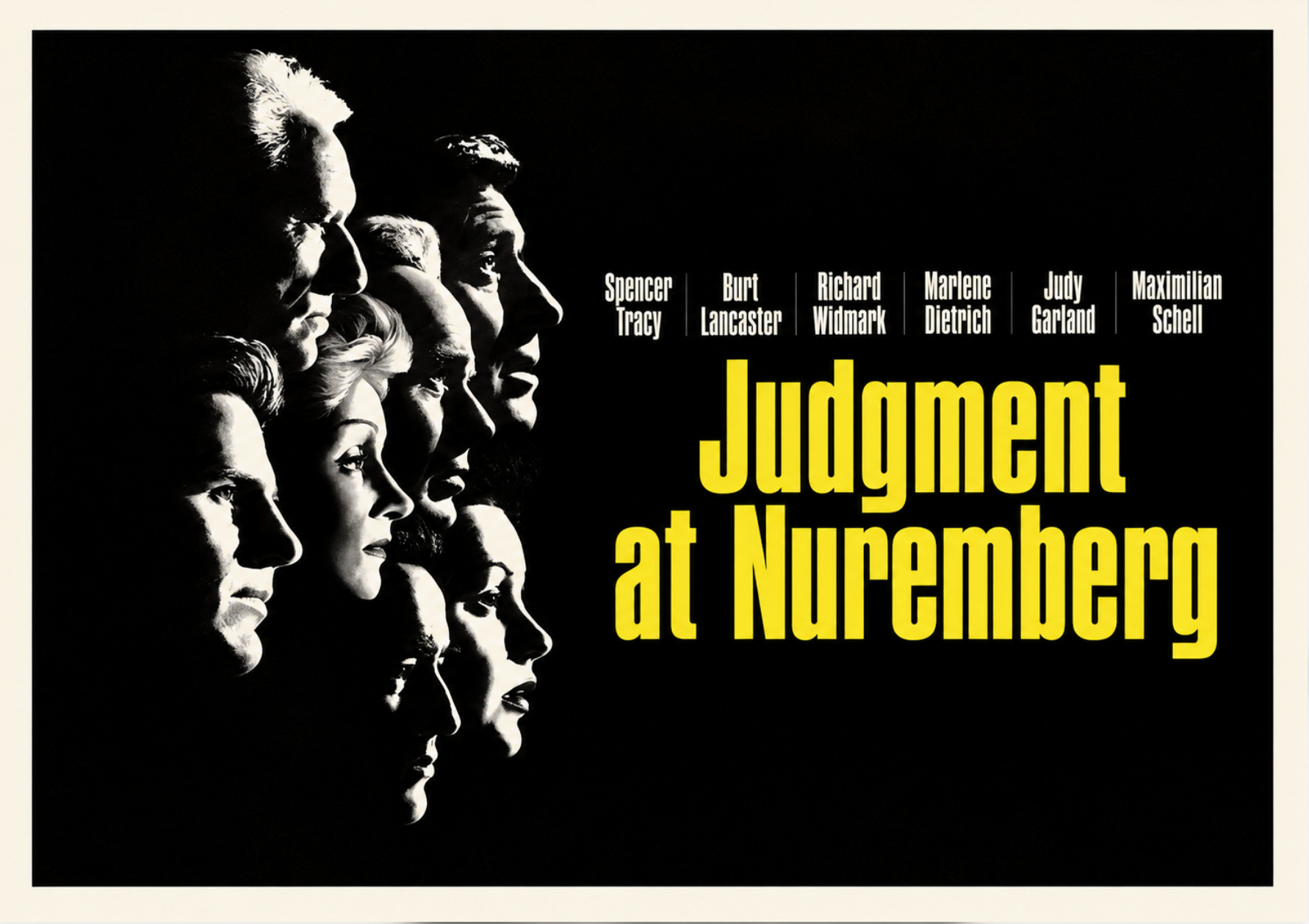
The movie takes place in 1948, during the American military tribunals that followed World War II. But unlike the famous Nuremberg trial of Hitler’s top Nazis, this proceeding focuses on four German judges who helped give the Nazi regime’s atrocities the appearance of legality. These weren’t concentration camp guards or Gestapo officers. Judges - educated, respected jurists whose job was supposedly to administer justice.
A little history here. The original Nuremberg prosecution was led for the United States by Supreme Court Justice Robert H. Jackson, whom President Truman appointed to prosecute the surviving Nazi leadership. Jackson was a formidable lawyer, and his opening statement remains one of the great prosecutorial addresses in history. Working under Jackson was U.S. Army Colonel Telford Taylor, who subsequently became America’s chief war crimes prosecutor and oversaw the later proceedings, including the trial of Nazi judges that inspired this movie.
Years ago, I read Taylor’s massive book, The Anatomy of the Nuremberg Trials: A Personal Memoir. It’s a terrific firsthand account of the original prosecution, written by a man who was actually there. Taylor takes you deep into the weeds of the investigation and prosecution, to the point where - from a lawyer’s or investigator’s perspective - halfway through the book you feel as though its your case. If you have any interest in the subject, and don’t mind wading through some fairly dense legal procedure along the way, I strongly recommend it.
Anyway, back to the movie.
Spencer Tracy plays Dan Haywood, an American judge who arrives in a devastated Germany to preside over the trial. The central defendant is Ernst Janning, played by Burt Lancaster, a distinguished German jurist and respected legal scholar who now finds himself accused of crimes against humanity.
The prosecution, led by Richard Widmark’s Colonel Tad Lawson, argues that Janning and his fellow judges knowingly used their courts to enforce Nazi racial laws, persecute innocent people, and send victims to their deaths.
Maximilian Schell plays Hans Rolfe, the brilliant young German attorney defending Janning. Schell practically steals the movie, and his courtroom arguments are so persuasive that you occasionally find yourself questioning the prosecution’s case. Rolfe argues that the judges were applying the laws of their country, that they did not create Hitler, and that the entire German legal system had been transformed under the Nazi regime.
It’s an interesting defense, particularly when you consider that some of the defendants were accomplished legal scholars long before Hitler came to power. The question facing the court is whether their participation in enforcing Nazi laws made them personally responsible for the resulting crimes.
As an attorney, I found the courtroom exchanges fascinating. The film raises fundamental questions about justice and retribution, giving the proceedings the feel of a first-year law school seminar. But Kramer doesn’t let the legal arguments remain abstract. Montgomery Clift plays a German man forcibly sterilized after Nazi authorities classified him as mentally deficient, while Judy Garland plays a woman whose relationship with an older Jewish man resulted in a prosecution that destroyed both their lives. Both performances are remarkable, and the testimony makes for some of the most compelling scenes in the film.
Meanwhile, the Cold War is beginning, the Soviet Union is emerging as America’s principal adversary, and West Germany is becoming an increasingly important American ally. These developments provide a fascinating political backdrop to the proceedings, as the American judge must weigh the defendants’ individual responsibility for crimes committed under a regime that no longer exists, while also confronting a larger question: What effect will the prosecution and punishment of these men have on the new alliances taking shape in Europe?
There is an extraordinary moment late in the film when Janning finally confronts what happened in his country. Lancaster is magnificent here, and I won’t spoil the scene.
One of the things that makes Judgment at Nuremberg so interesting is its examination of the German judicial system under Hitler. The Nazis didn’t simply eliminate Germany’s courts. They used them, along with existing legal institutions and a succession of new laws, to implement their policies. The movie explores how that process worked and the role of the judges who participated in it.
And the historical backdrop is fascinating in its own right. The Nuremberg proceedings were an extraordinary American undertaking, requiring prosecutors to assemble mountains of captured German documents, establish individual criminal responsibility, and present their cases before international tribunals. Jackson and Taylor helped establish principles of international criminal law that continue to influence war crimes prosecutions today.
One aspect present in both the movie as well as Taylor’s book was the sheer extent to which the American military had become the organizing force in a shattered Europe. With governments, institutions, and infrastructure in ruins, the U.S. Army was often the only functioning authority capable of getting anything done. The trials themselves were a remarkable example of that American leadership, combining military resources, legal expertise, and organizational capacity on an unprecedented scale. Both the book and the film capture something of that moment, when the United States assumed a leading role in rebuilding the postwar world, a position it has maintained in one form or another ever since - for better or worse.
Judgment at Nuremberg runs just over three hours, much of it consisting of people talking in courtrooms. But don’t let that discourage you. The film earned 11 Academy Award nominations, and Schell won Best Actor. Tracy, Lancaster, and the rest of this extraordinary cast are worth the price of admission on their own.
You can watch Judgment at Nuremberg free on Tubi or Pluto TV. It’s also available on MGM+ and to rent through Apple TV. (I still have the VCR tape.)
Between the extraordinary cast, the legal maneuvering, and the historical setting, there’s plenty here for anyone interested in World War II, the law, or the remarkable American effort to hold the Nazi leadership accountable.
Well worth three hours of your weekend.
Is Judgment at Nuremberg the best military courtroom drama ever made? I think it might be. And where does it rank among the greatest legal films of all time? I’d love to hear from others on this.
Breaker Morant was great (Australian film dealing with war crimes). There’s also a long documentary about the Tokyo War Crimes Trials, (essentially the Japanese counterpart to the Nuremberg Trials), that was very well done. Watched it a long time ago, but I remember it being somewhat anti-war/American. I'm pretty sure it was this: The Tokyo Trial (1983) -Director: Masaki Kobayashi.
I'm glad that you did not spoil the ending. I believe that I watched this many years ago and plan on rewatching it, now. I've recently been watching some history videos about the Nazi occupied countries. After the defeat of Germany, the millions of German speaking citizens that lived in these countries were in chaos.These populations had been in these areas for centuries, before borders were formed as they are today. Some collaborated with the Nazis, some did not. I noticed that they all became part of the Soviet Union. The treatment was as atrocious as anything the Nazis did. Fascism versus Communism appears to be just pick your poison. I pray that the USA, remains free of both scourges.