

Sci-Fi films often miss the mark with a sequel, and Blade Runner didn’t seem like the film where the story had much to build on. But Blade Runner 2049 pulls it off in fine fashion, continuing and staying true to the story inspired by Philip K. Dick’s novella, Do Androids Dream of Electric Sheep.
Executive Producer Ridley Scott teams up with Director Denis Villeneuve (Dune) and Screenwriters Hampton Francher (original Blade Runner) and Michael Green to tell a fantastic story of cops and androids.
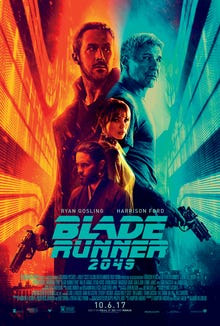
The film stars Ryan Gosling as “K” an LAPD cop who hunts outdated and illegal androids and “retires” them. I always found Ryan Gosling to be a little stiff as an actor, but he is playing an android cop here, so he’s got that going for him. He is excellent in the film. He is supported by Blade Runner originals Harrison Ford and Edward James Olmos. Ana de Armas plays Gosling’s holographic love interest, and Robin Wright plays his tough boss.
The film continues the theme of the book and original movie, exploring the same philosophical questions across a wider purview and asks whether identity and life still matter in a world that has learned how to manufacture souls. “K” finds some evidence that an android couple were able to have a child. This was something that society never intended and was believed to be impossible.
“K” is tasked with finding out if this infant survived and “retire” it if it is. His android mind is designed for compliance, but can his mind handle this assignment?
At the center of the film is the central question of Philip K Dick’s book, “What makes a life real?” “K” begins the story believing the answer is simple, he is not real, and that is that. When he discovers the evidence that a replicant may have been born rather than manufactured, the idea destabilizes everything. Birth implies continuity, memory, lineage. Things machines are not supposed to have. Is he real? Are his memories real? Does he deserve to have an autonomous life?
It raises moral questions as “K” continues his work hunting his fellow androids. “K” is built for compliance but begins to go off the rails. His own implanted memories guide him to believe that the android infant is still alive. As an android, should his mission or his feelings take precedence in his life?
The film is as bleak a look at the future as one can find. A society which cannot define, “What is humanity?” Post-apocalyptic scenes of destruction. Grey clouded skies and smog permeate every landscape. Oppressive and depressing giant block tower buildings. Sleazy and run down cities full of prostitution and vice. It’s like the South Bronx on a rainy Tuesday.

Unfortunately, this is the outlook that cops can develop after too much time on patrol in a busy precinct. A bleak outlook. A lack of emotion. A loss of empathy and respect for life, sometimes even their own. It is a trap that any cop can fall into. Sometimes even the best cops need help getting a fresh look at life – a transfer, a helping hand, a listening ear. Someone to step up and give them the help that they sometimes can’t give themselves.
Blade Runner 2049 runs long at almost 3 hours. It can be hard to follow at times – I had to rewind the movie to catch a scene again a few times. But it is a well written and meaningful film with an important question that will stick with you long after the credits have rolled. You can catch it for free on YouTube or pay the usual $4 to rent it on any platform. Anyone who is not an android will like the film.
Thanks for reading The Ops Desk. Stay Safe!

Not only a good article about a film but good about screenwriting and story structure.