

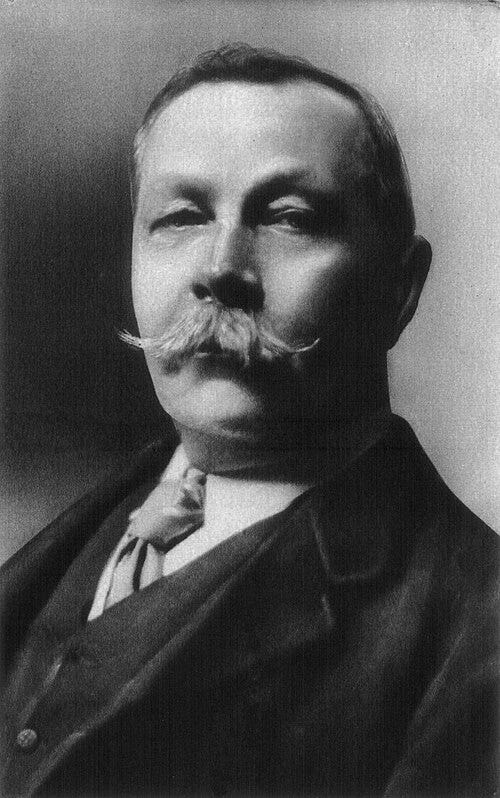
Sir Arthur Conan Doyle did not write the first detective novel; most regard Edgar Allen Poe’s 1841 Murders in the Rue Morgue as having that distinction. His 1887 novel, A Study in Scarlet, however, introduced us to one of the most famous and enduring characters in literary history.
Sherlock Holmes is more than a character; he is an icon. His name adorns everything from comics to cartoons and everything in between. His name is still being used in sarcastic idioms today. (Any rookie cop pointing out the obvious at a crime scene is inevitably mocked as a modern day Sherlock Holmes.)
A Study in Scarlet started the long journey of Sherlock Holmes through the past hundred and forty years. The novel, which Doyle completed in three weeks, created the fully formed story of Holmes and his steadfast associate, Dr. Watson.
The Watson character relates most of the Holmes stories. He is introduced in A Study in Scarlet through his first-person narration. A doctor, and recently returned disabled veteran of the Second Anglo-Afghan War, Watson meets Holmes by happenstance through a fellow soldier. The pair agree to share an apartment at 221B Baker Street as neither carry a wallet full enough to afford their own place.
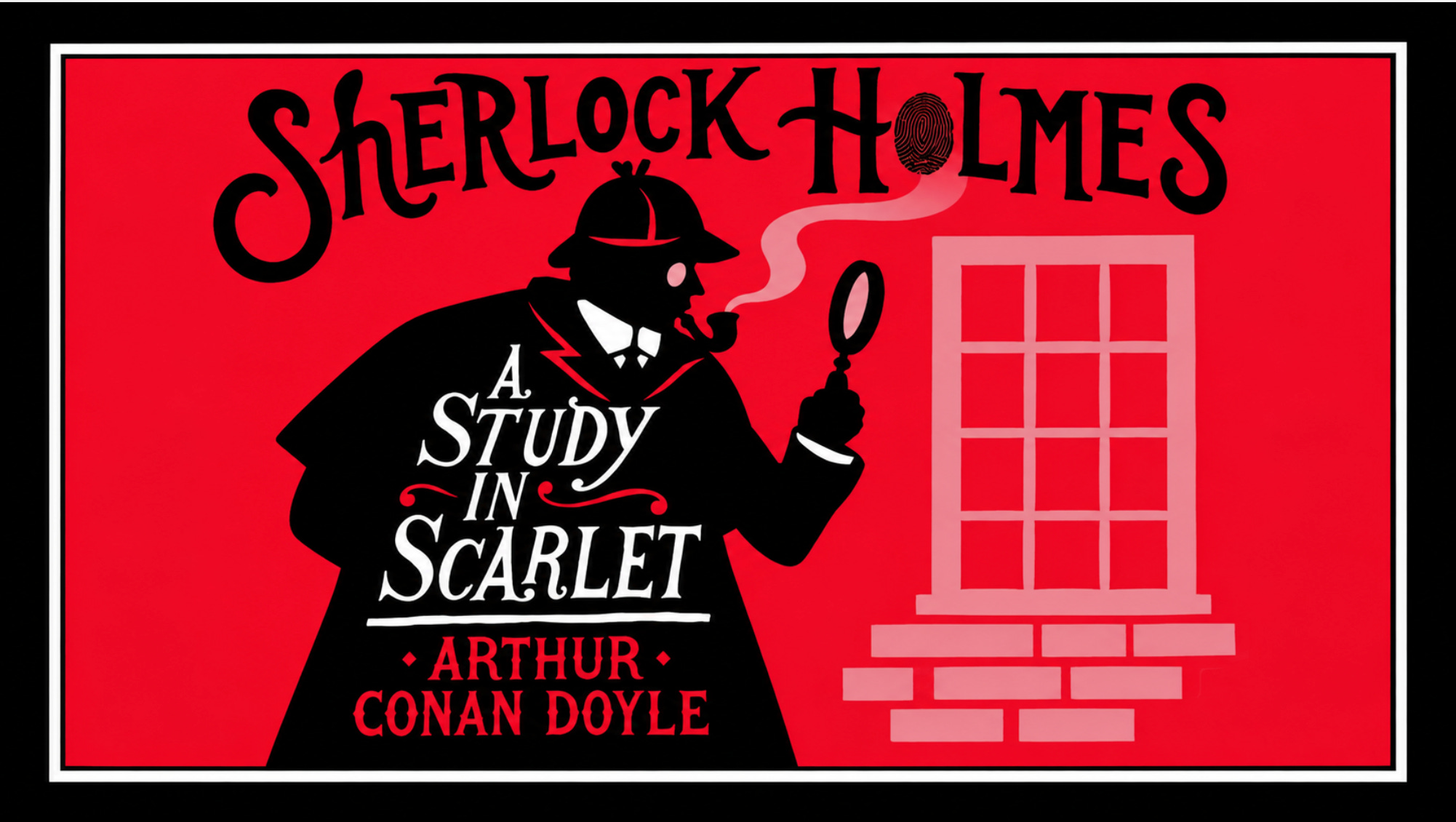
Immediately, Doyle paints Holmes as the enigmatic and eccentric private detective that we know him today. He describes him as having no knowledge whatsoever in the fields of politics, literature, or philosophy, but a profound knowledge of chemistry, anatomy, the law, and every sensational crime known to history.
Initially, Watson does not know what to make of Holmes. He is usually reserved and unconventional, but at times obsessive, as he will see on full display with their first mystery together.
As the plot gets underway, Sherlock Holmes’ presence is requested by Scotland Yard at the scene of the suspicious death of American Enoch Drebber. in a South London house. Holmes takes Watson along to the abandoned South London house where the body lies as if it perfectly natural to bring your roommate along to a homicide.
Doyle, of course, needs Watson there to tell the story. The conceited Holmes needs him there to show off his great intellect. Regardless of the reason, Watson is greatly impressed.
We are introduced to the incredible deductive powers that have made the Sherlock Holmes legendary. Doyle uses the Watson character as a vehicle to amaze his readers with Holmes’ keen eye and sharp investigative intellect, while at the same time shielding the audience from the legendary detective’s deeper suspicions and conclusions.
In an unusual twist, Doyle relates the murder and Holmes’ investigation first. He then brings the reader back several decades and across the Atlantic to Morman Utah to explain the motive for the crime.
Sir Arthur Conan Doyle’s writing style is critical to formulate the Sherlock Holmes mysteries. It is for a wide audience, but he carefully and descriptively describes the settings, creating an aura of foreboding to complement the story. His narrative must be well-planned, and he depicts small details that, of course, later become critical pieces of information needed to solve the mystery. It is up to the reader to deduce what is a critical fact and what is meaningless, misleading, minutia.
His story necessitates complexity, but Doyle knows to stop before leaving the audience behind. His vocabulary is typical of the Victorian Era, and I must confess that I needed to look up a few words for their meaning. Luckily the thesaurus has been supplanted by the more user-friendly GTS.
Even if Sherlock Holmes never made it past this first appearance, A Study in Scarlet is a very good book. It moves, keeps the reader engaged, and is relatively short at about 160 pages. You can buy it in paperback for about $8 on Amazon, or download a free pdf, as the copyright has long expired. Enjoy this quick introduction to the world’s most famous detective. It will have you ordering the next in the Holmes series.
A note on Sir Arthur Conan Doyle.
Doyle can spin an interesting story, but his own life story makes Sherlock Holmes seem like a lounge-about. Doyle was a medical doctor before he began is literary career. He opened his own practice, worked as a ship’s doctor, and served as an Army Surgeon during the Boer War. An avid sportsman, he played soccer and cricket at a high level and enjoyed skiing, boxing and golf. He served as a politician, investigated “solved” crimes – getting at least two innocent people freed, and was a military history buff. He left his Irish Catholic roots behind for a deep study of spiritualism. On top of all that he was a prolific writer. He wrote 32 books and hundreds of short stories, articles, and essays. His writings included fiction, poetry, military history, true crime, spiritualism, political commentary, and an autobiography (which might be my next book!). He died in 1930 at the age of 71 after his heart said “¡No más!”, to his energetic body and mind. Truly a man for all seasons!

Thanks for reading The Ops Desk. Stay Safe!
My Mother had me read these before I was in High School.
My favorite mystery author and his truly phenomenal team of Holmes and Watson! I've read every novel multiple times and just enjoy renewing my relationship with the best detective ever!!