

Life on Mars (2008-2009)
Life on Mars was a successful British cop show. It portrayed a modern-day Manchester police detective who, after being hit by a car, wakes up in 1973. Life on Mars was remade for the US in 2008 to try to mimic the Brit version’s ratings success. For whatever reason, the show didn’t take off here across the pond, but it was a pretty good show with a great cast and worth a watch.
Life on Mars is one of the most unique police dramas ever made. Mixing detective work, science fiction, and a healthy dose of nostalgia, the show follows modern-day NYPD Detective Sam Tyler, who wakes up in 1973 after being struck by a car. Whether he is dead, dreaming, in a coma, or somehow traveling through time is the central mystery, but that’s almost secondary. The real attraction is watching a modern cop collide with old-school detective work.
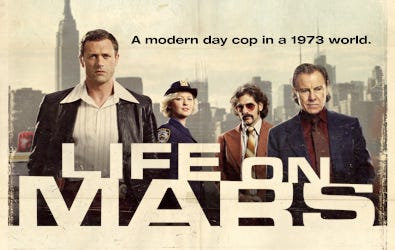
Sam suddenly finds himself assigned to the fictional 125th Precinct in Manhattan, where the rules are dramatically different. There are no computers, no cell phones, no DNA evidence, no surveillance cameras on every corner, and certainly no body-worn cameras. Detectives solve crimes the old-fashioned way, with interviews, informants, and instincts.
If you’ve ever worked investigations before technology became king, you’ll appreciate just how much this show gets right.
Tyler is trying to find out how he wound up in 1973 while still handling a detective’s case load. One mystery after another rolls in for Tyler to solve: murders, robberies, and kidnappings. Meanwhile, his personal mystery is getting weirder and weirder – hearing voices, seeing images from the future, and getting strange instructions. It’s like Tyler is living an out of body experience while juggling a really hard job.
The biggest reason to watch Life on Mars is the cast.
Keitel plays Lieutenant Gene Hunt, and he absolutely owns every scene he’s in. Hunt is loud, intimidating, politically incorrect, impatient, and fearless. He believes good cops catch bad guys first and worry about paperwork later. Every modern policy that frustrates Sam Tyler is something Gene Hunt dismisses with a sarcastic grin. Today, Gene Hunt would probably spend as much time answering questions from Internal Affairs as he would supervising detectives. In 1973, he was exactly the kind of commander that got the job done. Keitel nails the role.
Jason O’Mara does an excellent job as Detective Sam Tyler. Every episode forces him to reconcile everything he learned as a modern detective with the reality of policing in the 1970’s. He essentially has to relearn his job, deprived of the tools of modern investigations, all the while trying to figure out how to get back to his old life.
The supporting cast is equally strong.
Michael Imperioli plays Detective Ray Carling with the swagger of an old-school detective who believes he’s already seen everything. Gretchen Mol’s Annie Norris is one of the first female detectives trying to prove herself in an overwhelmingly male profession. Jonathan Murphy and Lisa Bonet round out the cast of characters in the detective squad.
Where the show really shines is its recreation of 1970s New York City.
Even though NYC is not the Disney Times Square of a few years ago, New York today has got nothing on the 1970’s. It’s grimy, dangerous, covered in graffiti, and filled with abandoned buildings, pornography theaters, corruption, and rising violent crime. The city itself almost becomes another character. Anyone who remembers New York before the renaissance of the 1990s will recognize the atmosphere immediately. The show adds in some great 70’s rock and roll to the soundtrack and a few classic muscle cars to make the show a bit more appealing.
The biggest mystery of the series is how Sam Tyler is going to get back to his old life. And that winds up being the most controversial things about Life on Mars. The last episode is a plot twist so far out of left field that it divided watchers of the show. Some liked it and some hated it. Was this a stroke of cinematic genius, or a quick fix to a show that was getting cancelled? You can decide for yourself.
For cops, Life on Mars is worth watching because it asks an interesting question: Has technology created better detectives, or has it masked the loss of some-time tested investigative skills? There are arguments on both sides, but a good detective must embrace both technology and old investigative techniques.
Life on Mars only lasted 17 episodes before they pulled the plug. The dynamic of time travel could only be strung out for so long, but if they had created the show with the same cast as a 70’s police drama, I think it could have done really well. I found a few episodes on YouTube, but to get the full experience, you will have to buy the series on a streaming service for about $15. This weekend enjoy the eclectic mix of 70’s police work and modern sci-fi with Life on Mars.
Thanks for reading The Ops Desk. Stay Safe!

I enjoyed the show but more so, the soundtrack. Some great 70s tunes! Oh, and the vehicles, too. I don't know how old you are Chris, but I am guessing you're much younger than Paul and, like me, did a good part of your growing up in the 70s and 80s (OK, OK, yeah, that was a shot at Paul). My first car was a 1970 Nova and, to make it sound like a muscle car, like other kids my age, I flipped over the air filter cover. Voila'. Instant 4-barrel carb sound. Watching LOM and seeing those rides immediately brought back some great times! Thanks for the walk down memory lane. Stay safe, brother.
How nice to see some others appreciated Life on Mars! It’s a shame it has been so ignored.