

Vigilance – Raymond W. Kelly
We were fortunate enough to serve under two of the most highly regarded commissioners in NYPD history. Both had different management styles, but both were effective. I always saw William Bratton as the flamboyant, motivational, innovator, and Ramond Kelly as the stolid, brass tacks, executive. Both were brilliant and successful, both dedicated their lives to public service, and both improved the NYPD.
In his book, Vigilance, Raymond Kelly introduces us to his second stint as Commissioner with a frightening look at the state of the city in 2002. The recent attacks on 9/11/01 left a scar in the heart of lower Manhattan and in the hearts of New Yorkers. But the threat of terrorism was not in the rear-view mirror. It was clear and present. It would, in many ways, define his 12-year stint as leader of the NYPD.
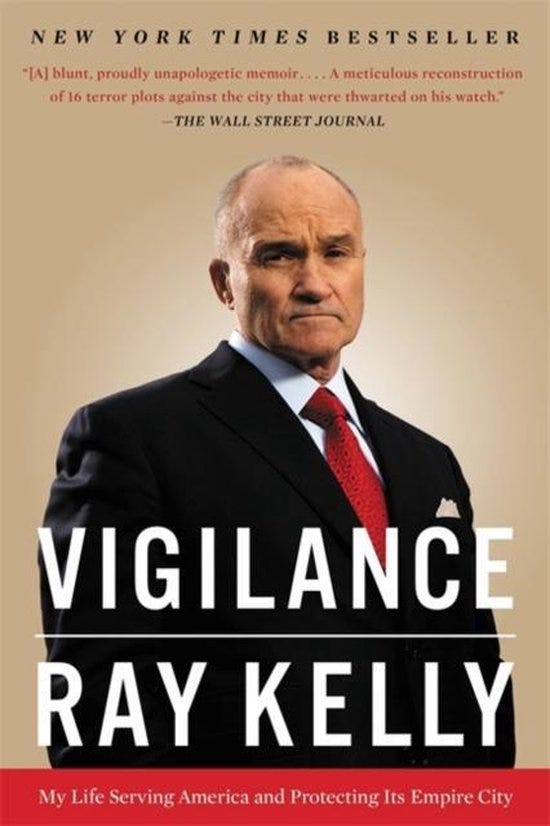
Kelly realized the danger and took control. He did not rely on the feds – he owned the threat and created a solution. It was controversial at the time – it certainly ruffled some feathers in Washington DC – but it was emblematic of Kelly as a leader. He would do his utmost to ensure that NYC was safe. He would not deflect or renounce that responsibility – it was his job now.
Kelly’s book spends some time detailing his life and career, from working class beginnings on the upper west side (before that was an exclusive locale), to the jungles of Vietnam, where he served as a Marine Infantry officer, where he learned critical lessons about responsibility and leadership. Returning to the NYPD he began his storied career in a time of tumult and increasing violence.
Kelly explains how his early experiences formed his ethos and management style. He carried a lifetime of service and learning to the 14th floor of 1 Police Plaza, where he oversaw 12 years of crime reductions and successful anti-terrorism operations.
Vigilance details the many threats and pitfalls that the city faced. Kelly details the numerous foiled terror plots, key personnel decisions, and political machinations that he dealt with, all the while laser focused on stopping crime. Kelly recalls details great and small in critical events that unfortunately many New Yorkers have long forgotten.
Kelly defends his time as Commissioner through the book. Despite great accomplishments he was widely vilified by police haters towards the end of his NYPD career. It is always easy to second guess a cop when crime is down, and terror plots are foiled. Kelly takes the slings and arrows and defends his decisions.
Vigilance is like Raymond Kelly himself – clear, to the point, and without much self-aggrandizement. It is a manual for leadership and good policework.
For working cops and especially for sergeants and lieutenants, the book functions as a set of leadership lessons. You’ll come away with concrete ideas worth using: cross-briefings that blend counterterrorism and patrol, tighter public-private partnerships for situational awareness, roll-call instruction about reasonable suspicion, and after-action reviews that turn near-misses into doctrine. You’ll also come away with questions: How do we sustain proactive policing while being vilified and stifled? How do we measure what matters without turning statistics into the goal? How do we build deeper community ties without sacrificing our ability to see threats early?
Vigilance is a little more the 300 pages. It is a quick read, filled with cop stories and problems solved. You can purchase the book for $9 paperback or $3 digitally. My biggest takeaway is the reminder of the numerous terror plots that the city faced in the years after 9/11. In many cases we were saved from brave NYPD cops and the system that Raymond Kelly set up to tackle these threats. We owe Kelly a debt of gratitude for his service. Enjoy the book.

Thanks for reading The Ops Desk. Stay safe!