

Last week, we looked at Sir Arthur Conan Doyle’s introduction to Sherlock Holmes and Dr. Watson in his 1887 novella, A Study in Scarlet. I hope you enjoyed it, because Sherlock Holmes is on the Weekend Buff menu again.
This week, I looked at the British TV series, Sherlock, which had a limited run of 13 episodes over an 8-year span.
I find British TV to be very hit or miss. Favorites on the other side of the pond often fall flat on the liberty-loving side of the Atlantic. But sometimes the BBC hits the nail on the head. They did so here with their modern take on the Doyle’s Sherlock Holmes.
This iteration of the Sherlock Holmes story is set in present-day London. Creators Mark Gatiss and Steven Moffat were able to solicit the acting skills of two great British talents in Benedict Cumberbatch and Martin Freeman, who play Holmes and Watson respectively. The pair are both fantastic, but Cumberbatch, in my opinion, is a generational talent and makes the series a must-watch.
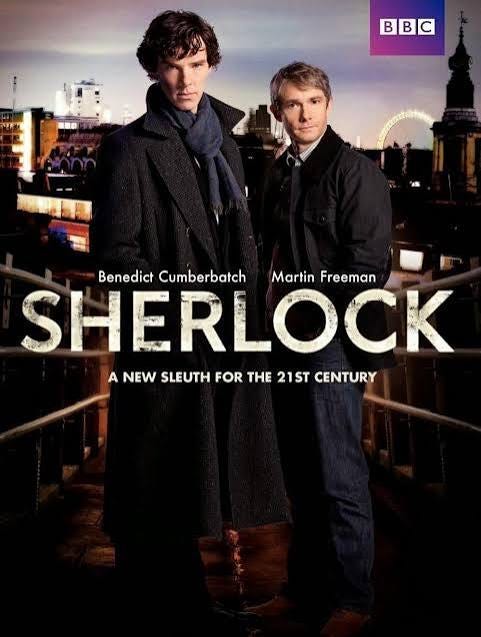
The creator’s goal here seems to be freshening up the Sherlock Holmes character while doing their best to stay true to the original writing. They succeeded, taking Doyle’s books and applying them to the modern day. The first episode is a retelling of Doyle’s A Study in Scarlet.
The series opens with Dr. John Watson, a military physician recently returned from Afghanistan, struggling to adjust to civilian life. In Doyle’s telling, Watson is returning from the Second Anglo-Afghan War. Here he is recently returned from duty in Afghanistan during the post 9/11 long war. He’s isolated, suffering from nightmares, and walking with a cane because of an apparently psychosomatic limp.
In both versions, a mutual acquaintance introduces Watson to Sherlock Holmes, and the two rent a flat at 221B Baker Street.
It’s a fantastic piece of literary symmetry. More than 120 years separate the two stories, yet the relationship between Holmes and Watson works almost exactly as Doyle intended.
The show captures the idiosyncrasies and eccentricities of Holmes. He is interesting, but not quite likeable. Scotland Yard sees his usefulness, but mostly despise the ego-driven interloper. The show takes the subtleties of relationships in Doyle’s stories and puts them out front for the more modern and television orientated audience of today. It works well, creating inter-character drama to add to a well written mystery.
In the first episode, the writers do great work in keeping to the theme of Doyle’s first novel, while managing to make it believable in the modern environment. It may be a happy accident in Doyle’s storytelling, or his brilliant foresight, but modern investigative techniques don’t diminish Sherlock Holmes’ skills. The writers realize and embrace this fact. The breaks in the case rely on attention to detail, connecting seemingly insignificant facts, and sheer brilliance when DNA collection, camera canvasses, and electronic data analysis fall short. Holmes’ talents survive into modernity with aplomb.
In A Study in Scarlet, investigators discover the word “RACHE” written in blood at a murder scene. One detective speculates that the victim was attempting to write the name Rachel. Holmes dismisses that interpretation, correctly identifying Rache as the German word for revenge.
Here this reference is brilliantly turned on its head. Holmes recognizes the German meaning but concludes that the dying woman was attempting to write Rachel, a clue connected to her missing phone, and a key to the case.
It’s a terrific nod to readers familiar with the original story, while demonstrating that the writers appreciate Doyle, but aren’t tied to retelling his story word for word. It creates drama for those familiar with Doyle’s tales without going completely off the rails. Throughout the series, the writer use Doyle’s characters and events while subtly changing motives and methods to keep audiences guessing. It’s really well done.
Each Sherlock episode runs a lengthy hour and a half. The show manages to fit in much of the backstory and character development despite the limited number of episodes. Unfortunately, Sherlock is a bit hard to find. It is on Hulu, Britbox, AMC, and PBS’s paid services. I did find that it is available on Amazon Prime with a free trial PBS Masterpiece for the next week. If you work the complex and annoying myriad of streaming services, you can watch the whole series for free, just don’t forget to cancel any free trials.
This series is worth that minor aggravation. In an entertainment industry that can’t seem to write anything new, Sherlock is one reboot that is worth the watch. It is well done all around. Enjoy this new and innovative look at history’s greatest detective.
Thanks for reading The Ops Desk. Stay Safe!

As a Sherlock and Watson fanatic, I agree with you completely. Cumberbatch and Freeman are great in their modern take on Holmes and Watson.
Loved this. It had depth to the story and great acting.