1999 was a long time ago. Yet, The Matrix might be more relevant now than at anytime in the past 27 years.
The discussion of the power of Artificial Intelligence is becoming a hot topic. News that several AI companies have lost control of several rogue AI agents is disturbing indeed. Gemini, OpenAI and Anthropic have have reported incidents in which sequestered AI agents broke out of their controlled environments and accessed real-world systems without authorization. These revelations are changing the discussion on AI and making many rethink the risk/reward analysis.
This is a serious. Potentially as serious as the specter of nuclear war that has hung over mankind for the past 80 years.
All this had me thinking of the dystopian AI future that The Matrix foretells. I watched it again this week and it’s our recommendation for this edition of Weekend Buff.
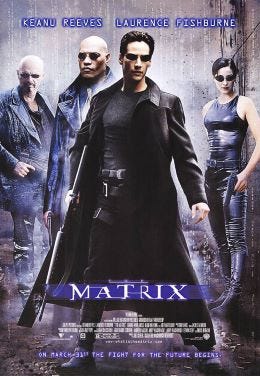
The Matrix was written and directed by the Wachowski siblings (V for Vendetta, Speed Racer), and was way ahead of its time, both in its story and special effects. Artificial intelligence had been theorized and rudimentarily used since the 1950’s, but was more science fiction than fact when the movie was made. The movie’s special effects influenced an entire generation of Hollywood films and still hold up remarkably well today.
For those who don’t know the story, Thomas Anderson, a.k.a “Neo” is a computer hacker investigating The Matrix. What he doesn’t know is how long that string he is pulling on truly is. It’s beyond his wildest imagination. He is found by “Trinity” and “Morpheus” who invite him into a frightening reality. Morpheus gives him two options, the red pill, which will show him the terrifying truth, or the blue pill, which will revert him back to his relatively mundane life of ignorance. Neo takes the red pill.
What he encounters is unimaginable. His world is not real. The year is not 1999, it is 2199. AI was released upon the world and has taken over. People were subjugated by the machines and now are being used to power the massive systems. People live their entire lives asleep in womb-like pods while the computers sap their energy to power themselves. AI uploads a false reality into their unconscious victim’s brains to keep them functioning.
What Neo thought was reality was The Matrix, a world created by computers to mimic the past. Nothing is real.
Those that live outside their pods are hunted by computers. Morpheus and his crew fight the machines in an attempt to destroy The Matrix and bring back humanity from is comatose slavery.
In The Matrix, everything is an illusion, even law enforcement. Cops and federal agents exist in The Matrix believing that they are enforcing the law. In reality they are the unwitting bad guys, repressing reality and keeping the computers in control. In their false reality, Morpheus and his crew are the criminals who need to be eliminated. It is a tough “pill” to swallow as a cop, and blurs the lines between law enforcement and oppression.

The Matrix has a fantastic cast. Keanu Reeves cemented his reputation as an A-list actor here, and nails the role of Neo. Carrie-Anne Moss makes a name for herself as Trinity, and Laurence Fishburne continues his distinguished career as Morpheus. Hugo Weaving is the sentient “Agent Smith” program in The Matrix and provides some fantastic deadpan acting and one-liners. Supporting cast includes Gloria Foster, Joe Pantoliano, and Marcus Chong.
This is a deep film, despite its non-stop action. Plenty of themes and questions to consider as you watch, and its worth seeing a few times.
The movie runs over two hours, but as evidenced by the multiple sequels, it has you wanting more. It can be rented on a streaming service for $4, but you can also probably check it out your local library. Enjoy this look at a dystopian future that seems quite a bit more feasible today.
ChatGPT says it’s not possible, but whose side are they on?
Thanks for reading The Ops Desk. Stay Safe!