

We have reviewed the two True Grit movies, and Rooster Cogburn where John Wayne reprised the roll of the Federal Marshal. I figured that I might as well finish off the body of work by reading the book that started it all.
True Grit was written by Charles Portis in 1968, and it became an instant best seller. Westerns were in their golden age in the 50’s and early 60’s; this novel was a bit late to the game. Portis, however, created a story that was an instant American classic. True Grit is widely considered one of best American novels of all time.
Both True Grit movies stayed remarkably true to the book, almost line by line. I think it is safe to say that everyone knows the story, so I won’t recap it here.
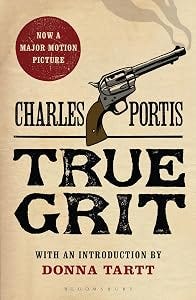
The book is told in the first person, from the eyes of a much older Mattie Ross living in the late 1920’s. She is a simple and straightforward person, and Portis captures that with direct language. This is not superfluous flowing prose. There is no thesaurus of adjectives in Mattie’s tale. She does not exclaim, does not assert, does not quip. She simply “says”. Mattie the aged and candid narrator surrounds her dialogue with “I said” or “said I” in almost every line in the book. She is very much the same person as her 14-year-old past self.
She lets her deep and strong memory of the events shape the story. The hunt for Tom Cheney, her father’s murderer, took place in the later 1870’s and is the defining moment in her life. She has re-lived it in her mind a thousand times and remembers every detail. The dialogue tells the story with a mix of Arkansas country and plainspoken Calvinism. Portis is masterful in this style, making every line spoken by the characters strike hard.
The changes in society that occurred between the events of this story and its later narration is not lost in Portis’ writing. Mattie Ross is looking back on a much different America. True Grit was published in 1968, a year of great change in our country. Many Americans looked fondly on the past, despite the horrors of the two world wars. Traditionalists decried the peaceniks that looked to change the old order. Mattie is, if nothing else, a traditionalist.
Mattie the narrator also looks back on her deadly adventure with an unexpected fondness considering the horrible events. “Time just gets away from us”, she says while looking back through the years.
The late 1870’s was a violent time in America. Former soldiers, like Rooster Cogburn, are traversing the untamed areas of the country, carrying with them the mental and physical scars of 4 years of a terrible war. The Civil War defines many of the characters. Characters are often identified by the side they were on in the war, and by their deeds during it. In 1861 America had resorted to violence to solve its problems, and the characters in this story continue in that tradition.
In a way, Mattie appreciates the violence. She wants a Marshal with “true grit” and passes over other lawmen to find the one with the itchy trigger finger. She wants her justice, and if that comes from a bullet or a judge doesn’t matter much to her. She is a direct person, and there is nothing more direct than the end of a gun. She has little use for the people in her modern society; they are soft and gossipy. She gives harsh treatment to former outlaws Cole Younger and Frank James when she meets them in the 1900’s. They have grown cowed and enfeebled. The were once hard men, now tamed by modern society. Her heroes are still Marshall Cogburn and Texas Ranger LaBoeuf, strong men with true grit.
True Grit is obviously a law enforcement story. Two cops, two police agencies, and a gang of violent perps. My takeaway, however, is from the complainant in this case. Mattie Ross would be viewed by a modern detective differently – and it depends on the detective. Good, hardworking detectives would appreciate her dedication. For a less driven detective, she would be a nightmare of phone calls, visits, and endless questions about the progress of her case.
As a cop, is a frustrating feeling to be the only one who seems to care about an investigation. And far too often that is the case. A committed victim can be tough to work with, but most good investigators will take that any day over a complainant who misses appointments, gives vague statements, and balks at going to court.
Cogburn and LaBoeuf are quick to dismiss the headstrong young lady. She is a pain in the ass…and a liability. She has no business being with them on their hunt for a murderer. Irritation eventually turns to admiration, and the lawmen adopt her commitment and drive. In modern policing, that story often still rings true.
True Grit is an easy read, but one that benefits from a revisiting. It is a little more than 200 pages, but they are heavily margined, and you can finish it in a day or two. What appears to be a simple western has a depth that the simple vocabulary does not foretell. You know the story but will appreciate Portis’ masterful writing style.
You can find True Grit in most libraries, but it is worth buying on Amazon. You can get a used copy for about $6. It is a good book to have on hand if you are stuck inside on a rainy day or find yourself looking for a quick read while camping in the Indian Territory, hot on the trail of a cold-blooded killer.

Thanks for reading The Ops Desk. Stay Safe.
John Wayne received a well earned best actor award portraying Rooster Cogburn in the first film. Wayne also filmed a successful sequel as Rooster, with Katherine Hepburn.
The rattlesnake scene in this movie still gives me the shivers.