


As the United States fights a war with Iran overseas, it’s increasingly clear we are fighting a second, related one here at home.
But this one is not just against potential “sleeper cells” or jihadi-wannabes. It’s against an ideology.
And yes — they want America to lose. On both fronts.
So sure, we’ve all heard talk of “sleeper cells” deployed to America by Iran. I’m here to tell you: unlikely. Iran has never had this capacity — operationally or financially. Situating long-term cells here, waiting to be activated? No history of this, nor serious capacity.
What they DO have: Hezbollah. A global mafia, funded 50% by Iran and 50% by criminality. They’re not here to do terrorism ops; if they were, trust me, you’d know it. They’re here to run various criminal schemes. And plenty came in during the Biden administration. Of that there can be little doubt.
So yes, that’s an issue. That said, I think in the end, Hezbollah just wants to survive to scheme another day — with or without their benefactors in Tehran.
No. More common, difficult to detect, and likely to act are the self-radicalized malcontents spurred on here by the marriage of Islamist ideology and indulgent, leftist grievance politics. And we can pinpoint exactly when this “union of the oppressed” formed.
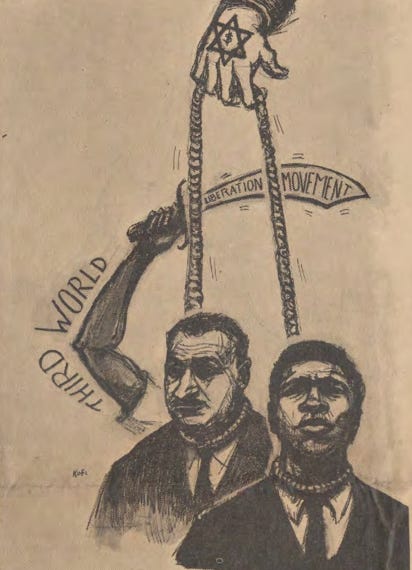
In 1967, a small, militant newspaper known as the “SNCC Newsletter,” run by the notorious Student Nonviolent Coordinating Committee, published an article titled, “The Palestine Problem” — replete with a cartoon of an Israeli-labeled hand hanging both an Arab and a black man. (Among the SNCC editors: H. Rap Brown — aka, “Jamil Abdullah al-Amin,” who recently died in prison while serving life for the murder of two Georgia sheriff’s deputies).
Now previously, Jews — and more specifically, Israelis — had been held in high regard within the civil rights movement. We were, after all, not long from the revelations of the Holocaust, Israel itself could be viewed as socialistic, even communistic, thanks to the kibbutz system, and the voting tendencies of America’s Jews were firmly left. The bona fides of Israelis as among the world’s “oppressed” were firmly established.
But with the publication of this piece, that narrative began to change. The article, linked HERE, is that rare instance where we can actually pinpoint the beginning of an historical sea-change. In the piece, the SNCC asserts that in fact it is the Palestinians — our “brothers” as the piece states — who are actually the oppressed. The piece lists 32 points, without attribution, that supposedly “demonstrate” the depredations of the Israelis on the Arab world — to include Israel sending assets to Africa to “sabotage African liberation movements.”
From there, over the decades and as Israel’s success as a nation grew, the narrative of the oppressed Palestinians battling the oppressive Israelis began to take consolidate and spread. Today, Islamic “civil rights” leaders have fully internalized this, ensuring their cause remains firmly embedded within the portfolio of today’s leftist grievance merchants. It’s a great force-multiplier for them.
It’s why you’ve begun to see demonstrations featuring trans-rights marchers beside ICE OUT! signs beside Ayatollah Khameini supporters beside open-border advocates. It’s why you see biological males transitioning to female have begun to convert to Islam and wear the veil.
For today’s protest industry, it’s all causes, and any causes, that oppose western culture, capitalism and yes, Donald Trump. The common denominator is simply that you are “oppressed” — and whatever the pre-printed-sign-of-the-day is will do.
Which explains a mayor like Zohran Mamdani and other city leaders, who frame a jihadi bombing event as “white supremacy.” Islamist jihadis? Never! Just fellow travelers. You know — comrades.
Which also explains why members of the DSA have announced they’re traveling to Cuba to support the communist regime there. Or why the City University of New York will allow for a conference whose speakers allege that, “every drone Iran fires is also in defense of Cuba.”
And so, as we attempt to combat a homegrown threat that is undeniably rising — four attacks in two weeks — we do it in cities run by leftists whose commitment to oppression politics means they’ll literally be unable to name the threat we face. Because they’ve been co-opted by it.
Here in NYC, our mayor can’t even get a security clearance. You think the federal government is going to trust him with detailed information? So that NYPD can do its job?
Do you think he cares?
Name one major American city today not run by a committed leftist who is either an analog of Mamdani, or simply Mamdani-light. Go ahead — we’ll wait.
So as the Democrats continue with Defund 2.0 — the refusal to fund DHS — and our mayor and governors bend over backwards to tell us that it’s you who are the problem, just remember something: there’s a reason today’s left is rooting for Iran.
Because if the mullahs are fighting Trump’s America, they must be the good guys — the oppressed. And to today’s left, that makes a murdering, medieval thug like the Ayatollah the equivalent of Greta Thunberg or even Rosa Parks. It’s all one, big, well-funded struggle.
And for that team, the only way to “win” is for this terrible, oppressive place known as “America” to lose. In Iran, and here at home.
Let’s Play… Political Twister!
In Washington, politicians often discover the importance of national security after the consequences of their votes become impossible to ignore.
That’s the position Democrat Senator Elissa Slotkin now finds herself in.
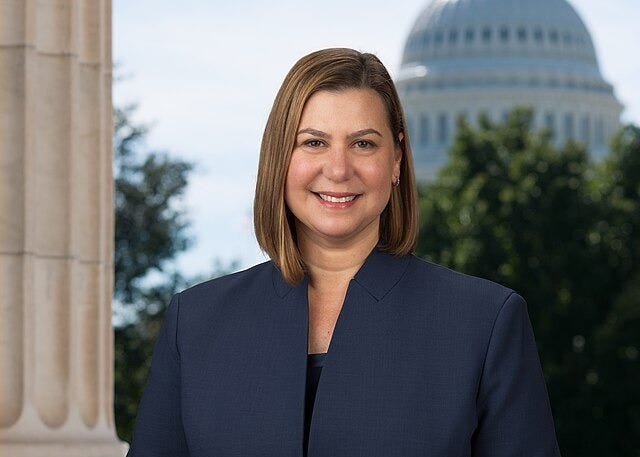
Slotkin, if you recall, was the prime mover behind “The Seditious Six” — the six U.S. Congress members urging American military members to disobey orders they don’t agree with.
Now, just days after voting with fellow Democrats to block funding for the United States Department of Homeland Security, Slotkin has abruptly changed her tune following a terror attack targeting a synagogue in her own state of Michigan. Suddenly, the urgency of funding the agency responsible for protecting Americans became crystal clear.
Appearing after the attack, Slotkin acknowledged the obvious, saying: “Certainly we need to fund the Department of Homeland Security.”
That statement is undeniably true. The problem is that when the vote came, she did the opposite. Literally as we entered into hostilities with a foreign adversary known for terrorism and cyber attacks.
What a perfect encapsulation of today’s left. Slotkin loves to dine out on her CIA history, where she served as an analyst and briefer. She then votes against the intelligence community — until an attack occurs.
She, of all Congress members, should know that intelligence is designed to prevent attacks. A capacity on the homefront she just voted down.
Thereby aligning her with a party that stands for defunding DHS, ICE, border and cyber security, and so… with the Ayatollah.
Shameful.
Noemore!
The relatively embarrassing reign of Kristi Noem as head of DHS has come to an end. She appeared to be the most vacuous person to sit in on a cabinet meeting in recent memory (Joe Biden excepted, of course). She also displayed a remarkable lack of self-awareness and a consistent talent for gaffes (again, not quite Biden-level).
But the final straw came last week during a Senate Judiciary Committee hearing, where she managed to look inept, dishonest, and potentially criminal — quite a trifecta.
Noem claimed the President had approved her to spend $221 million on an advertising campaign meant to deter illegal immigration. The campaign itself was cringe-worthy, often featuring Noem on horseback in outfits straight out of the Barbie Ranch clothing line. It looked less like public policy and more like a vanity project.
Trump removed her from her position just hours after the hearing, reportedly remarking that he spent “less money than that to become President.”
The removal was long overdue. Noem had compiled a growing list of unforced errors:
• Writing in her own book about shooting and killing her 14-month-old dog for failing at training.
• Claiming she had met with Kim Jong-Un — a blatant fabrication.
• Labeling Rene Goode a potential domestic terrorist. Goode endangered an ICE agent during an illegal protest, but “domestic terrorist”? That cheapens the term.
• A DHS spokesman falsely stating detainee Geraldo Campos attempted suicide when he actually died of positional asphyxia while resisting guards.
• Failing to meet with Tim Walz or Jacob Frey during protests surrounding Operation Metro Surge. Tom Homan ultimately stepped in at the President’s direction and met with them to try to secure local cooperation. Walz and Frey may be nuts, but federal agents still need local support.
• Allegedly engaging in an extramarital affair with Corey Lewandowski, a lobbyist acting as her de-facto chief of staff. Trump refused to allow Lewandowski to become a paid DHS employee, so he served as a Special Government Employee — typically a part-time or unpaid role.
• Lewandowski allegedly firing a Coast Guard pilot for failing to pack Noem’s blanket on a trip — only to reverse course when that same pilot had to fly them home. Noem ultimately survived the trip without her blanky.
Trump removed Noem but gave her a soft landing as Special Envoy to the Shield of the Americas. That raises an obvious question: if she lied to Congress — a potential crime — why keep her in government at all?
There may be some parsing involved. Trump might have approved an advertising campaign generally while Noem exceeded the authorized spending. Or there may be some other discrepancy (as in: its focus on the Director herself). Trump may also have preferred keeping her inside the tent rather than risking internal conversations becoming public.
That decision may prove costly. We may not have heard the last of Noem’s missteps.
For instance: DHS hired several firms to run the infamous ad campaign. One was Safe America Media LLC, incorporated in Delaware on February 6, 2025 — just eight days before signing the DHS contract. Another was Designed Market Media, an older Virginia firm registered to Michael McElwain. The companies share an address, and McElwain owns the property. He is a longtime Republican advertising operative.
A smaller contractor was American Made Media Company, also formed in early 2025 and run by Trump campaign veterans Sean Dollman and Nick Trainer.
Subcontractors handled parts of the campaign. One was Louisiana-based People Who Think LLC, run by Jay Connaughton, an associate of Corey Lewandowski and former Trump campaign adviser. Another was Strategic Media Services, which purchased airtime for the ads. That company is run by Ben Yoho, the husband of DHS spokesperson Tricia McLaughlin.
If this is starting to look fishy, you’re not alone. Republican Senator John Kennedy of Louisiana clearly didn’t like the optics when he grilled Noem during the Judiciary Committee hearing.
While many hearings devolve into theatrical “gotcha” moments, Kennedy went directly to the substance — asking whether Noem had ties to the firms, whether the President authorized the $221 million expenditure, and whether the contracts went out for public bid.
Noem denied ties and insisted the President approved the spending. But that may not be the case — and lying under oath to Congress is a crime.
The contracts were labeled “urgent” because Trump declared the border a national emergency. Noem used that designation to bypass normal federal bidding rules. Only a handful of companies were allowed to apply, and the bidding window lasted just a few days before contracts were awarded.
Now the Senate is investigating. And when even a Republican stalwart like Kennedy is sounding the alarm, the optics are not good.
The situation could also raise questions about Trump’s involvement. He has publicly claimed he did not authorize the $221 million expenditure. But if that is true, was he unaware? After all, several of his campaign associates appear to have benefited from these lucrative contracts.
Trump did not remove Noem until the issue surfaced during the hearing — and even then gave her a soft landing.
This story is clearly not over, and Trump does not need another scandal. So why not simply cut bait and use the famous “YOU’RE FIRED” line he is so fond of?
That remains to be seen.
Public corruption should never be tolerated, yet it increasingly appears systemic in Washington. Hopefully Trump truly had no knowledge of these contracts. But if evidence shows otherwise, another impeachment fight could easily emerge if Democrats perform well in the midterms.
One thing is already clear: Kristi Noem has proven herself incompetent and possibly corrupt. She should not be collecting a government paycheck.
Sunday Pod: An Interview With Counterterrorism Detective Tom Smith
Team, join me for a conversation with Detective Tom Smith (retired), who worked counterterrorism cases in New York for years (how we never crossed paths is beyond me…).
Is Hezbollah the threat we’re hearing? Will Iran bomb California with drones? What are the things we need to worry about now?
And: What’s it all going to look like AFTER the war?
In any aspect of police work, there’s no substitute for the actual experience of making cases. Join Tom and I as we discuss what that’s really like — and what it must be like for those working in today’s heightened, more difficult, environment.
So click below for the sizzle… or HERE for the full conversation.
From The Legal Desk: Venezuela, Cuba, and Trump Derangement
The past few days has seen major media finally catch up to what we relayed weeks ago: the old Cuba is ending. On Friday night, the Cuban people burned a local communist party headquarters in the center of the Island. Meanwhile, Venezuela’s transformation continues to accelerate. Both countries are changing. Both are critical. But the way the United States will deal with them and the levers available are very different.
In Venezuela, the Trump administration’s approach is already paying off. Since the removal of Maduro’s grip, Washington holds the leverage. There is both incentive and deterrent, economic engagement and the threat of continued pressure.
This is not regime change the old way. It is not about forcing our system onto another country. It is about stabilizing a collapsing state, preventing chaos, and reintegrating Venezuela into the global economy with a government that can stand on its own.
That shift matters. Venezuela has the natural resources to make the transition feasible. It has existing infrastructure linked to the U.S. market. American refineries can handle Venezuelan crude. What is needed now is confidence. Confidence from private industry that the situation is not going to flip back into crisis. On that front, things are moving in the right direction.
Cuba, on the other hand, will be a different fight.
Yes, the trajectory looks similar: popular discontent, economic failure, political decay. The headlines will treat Cuba and Venezuela as twin crises and as two possible wins for President Trump. But beyond the fact that Cuba lacks the oil resources that give Venezuela a buffer in transition, the U.S. tools available are very different legally and politically.
In Venezuela, today’s sanctions are largely executive. They were imposed through executive orders that can be eased or lifted as conditions improve. The president has the authority to adapt strategy in real time.
Cuba’s sanctions are not so flexible.
Most of the sanctions framework against Cuba is embedded in laws passed by Congress and signed by the president. The two major sanctions laws, the Helms-Burton Act and the Torricelli Act, cannot be undone with a stroke of a pen. That means the economic embargo, which bans virtually all American business with Cuba, is going to require Congress. Any real shift toward normalcy will require more than executive action. It will require Congress to agree. Senators are already grumbling about being sidelined on Iran, and many will see Cuba as their chance to reclaim influence over foreign policy.
So watch for pushback in Washington. Good ideas, even ones that clearly serve U.S. interests, can get tangled in partisan resistance (i.e. T.D.S.).
Trump’s foreign policy is winning in Venezuela because the tools fit the situation. Cuba might feel the same, but legally it is a different case entirely. As much as we want to see the corrupt communist regime in Cuba disappear, once they do: we may be faced with yet another uphill battle.
And finally…
Cops are paid to put up with a lot, but: folk music? (click the below, if you dare)

Wow. That’s just MEAN.

Cuba, Venezuela, and Trump Derangement With A Latin Flair
The past few days has seen major media finally catch up to what we relayed weeks ago: the old Cuba is ending. On Friday night, the Cuban people burned a local communist party headquarters in the center of the Island. Meanwhile, Venezuela’s transformation continues to accelerate. Both countries are changing. Both are critical. But the way the United States will deal with them and the levers available are very different.
In Venezuela, the Trump administration’s approach is already paying off. Since the removal of Maduro’s grip, Washington holds the leverage. There is both incentive and deterrent, economic engagement and the threat of continued pressure.
This is not regime change the old way. It is not about forcing our system onto another country. It is about stabilizing a collapsing state, preventing chaos, and reintegrating Venezuela into the global economy with a government that can stand on its own.
That shift matters. Venezuela has the natural resources to make the transition feasible. It has existing infrastructure linked to the U.S. market. American refineries can handle Venezuelan crude. What is needed now is confidence. Confidence from private industry that the situation is not going to flip back into crisis. On that front, things are moving in the right direction.
Cuba, on the other hand, will be a different fight.
Yes, the trajectory looks similar: popular discontent, economic failure, political decay. The headlines will treat Cuba and Venezuela as twin crises and as two possible wins for President Trump. But beyond the fact that Cuba lacks the oil resources that give Venezuela a buffer in transition, the U.S. tools available are very different legally and politically.
In Venezuela, today’s sanctions are largely executive. They were imposed through executive orders that can be eased or lifted as conditions improve. The president has the authority to adapt strategy in real time.
Cuba’s sanctions are not so flexible.
Most of the sanctions framework against Cuba is embedded in laws passed by Congress and signed by the president. The two major sanctions laws, the Helms-Burton Act and the Torricelli Act, cannot be undone with a stroke of a pen. That means the economic embargo, which bans virtually all American business with Cuba, is going to require Congress. Any real shift toward normalcy will require more than executive action. It will require Congress to agree. Senators are already grumbling about being sidelined on Iran, and many will see Cuba as their chance to reclaim influence over foreign policy.
So watch for pushback in Washington. Good ideas, even ones that clearly serve U.S. interests, can get tangled in partisan resistance (i.e. T.D.S.).
Trump’s foreign policy is winning in Venezuela because the tools fit the situation. Cuba might feel the same, but legally it is a different cage entirely.

Great content here as I've come to expect from The Ops Desk. One thing always comes to mind when Cuba is discussed: The scenes from the Godfather involving Michael and Hyman Roth in Cuba. Especially when Roth says, "The hotels are bigger and swankier than Vegas. " l can see Trump building hotels and casinos there when he's no longer in office if a non-communist government does come into power. And, when Michael describes the rebel detonating a suicide grenade in the captain's car as, "The rebels can win." (And they did). Maybe the Cuban people have had enough of Communists and only need a charismatic leader to bring a democratic government into power. I hear that scuba diving would be a big hit in Cuba because of the mostly virgin diving on the reefs there- if change comes for the better. Interesting time we're living in brothers and sisters.
America is fighting enemies abroad, but the real danger is the ideological sabotage happening here at home. The strange alliance of grievance politics, radical activism, and Islamist sympathies has produced a movement that reflexively sides against American interests. They call terrorists “misunderstood,” label border enforcement “racist,” and treat Western civilization as the villain in every conflict. That mindset doesn’t just weaken national resolve—it emboldens our adversaries. Nations win wars not only on battlefields but in the battle for cultural confidence. When political factions cheer America’s defeat to score ideological points, they reveal something ugly: their loyalty is to the narrative, not the nation.