


If there’s anything more insufferable than AOC’s choreographed “on the go” interviews… it’s AOC when she has a point.
Her recent comment that we can’t have “five guys in tuxedos” control our national economy and security is, alas, a reasonable take in the wake of the Jensen Huang debacle.
But seizing and breaking up companies built by brilliant, entrepreneurial Americans (as she advocates) is not the answer (it’s also not constitutional, but that likely wouldn’t deter her). Because socialism isn’t the solution here. It’s the problem.
And the leftist turn our education system has taken is why we’re actually stuck dealing with foreign actors when it comes to America’s critical supply chains.
Because even when we want to build here at home… we no longer have the ability.

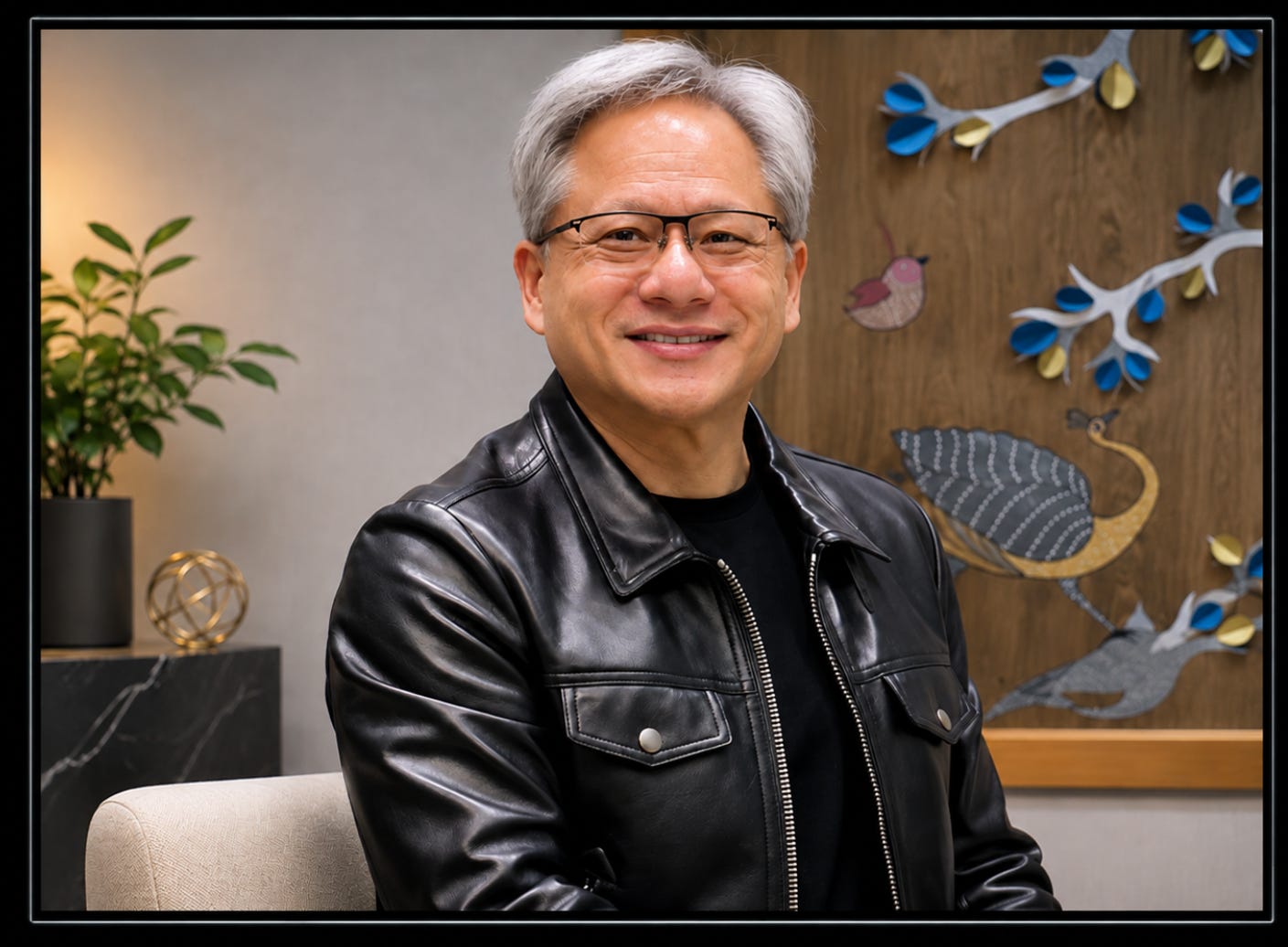
We all know the NVIDIA facts by now. Jensen Huang, the company’s flamboyant CEO, is accused of a series of extramarital affairs, including one with an alleged Chinese spy. As part of the spy liaison, Huang may have sold billions of dollars worth of America’s most advanced computer chips to the woman’s companies, potentially in violation of U.S. sanctions.
Huang famously ran his company like a potentate: he had 60 people reporting directly to him, bragged of having no succession plan, and was famously rough on his underlings. He had also taken to behaving as something of an adolescent in public.
In short: maybe not the guy we want single-handedly embodying one of America’s biggest technological advantages.
To add to this vulnerability, NVIDIA doesn’t actually manufacture its chips; it just designs them. The highest end chips are actually made by a company called TSMC, which is located in Taiwan—80 miles off the coast of a nation that considers Taiwan their own territory.
And to add to the intrigue: TSMC also operates two manufacturing plants inside mainland China.
What could go wrong?
The threat of China capturing Taiwan’s advanced facilities is in fact so serious that TSMC and its main equipment supplier, a Dutch firm called ASML, reportedly possess technology capable of remotely disabling the critical manufacturing equipment.
Consider that scenario. The world’s most important chip manufacturer has a plan to remotely destroy its own factories so as to disincentivize China from taking them over at some point. And a European nation holds the kill switch.
Get the feeling we’re a little vulnerable here?
So did both the Biden and Trump administrations.
Bring It On Home
Likely assessing all this and other supply chain vulnerabilities recognized during the COVID crisis, in 2022, the Biden administration passed the CHIPS and Science Act, designed to bring America’s critical supply chain infrastructure home. As a result, Taiwan’s TSMC received up to $6.6 billion in federal funding to build an advanced chip fabrication plant—a “fab”— here in Arizona.
Then the Trump administration came out against globalism and made manufacturing revival a priority, using tariffs and investment negotiations to promote domestic production. So in July 2026, Taiwan’s TSMC raised its planned U.S. investment to $265 billion.
There was only one problem. America—literally—couldn’t build the factory.
You read that right. The nation that built the Panama Canal and the Hoover dam, that put men on the moon and invented the internet… didn’t have the necessary expertise to build the manufacturing plant.
Now, TSMC tried. As they attempted to build their first advanced fab outside Phoenix, the company struggled to find workers experienced in specialized construction and equipment installation. It eventually got to the point in 2023 that TSMC announced plans to bring approximately 500 specialized workers over from Taiwan.
American construction unions objected, of course, insisting qualified domestic workers were available and that TSMC was not adequately using them. The dispute eventually produced a compromise.
But compromise or not, thousands of Taiwanese employees and their families relocated to Arizona, creating a pop-up area now known as Tiny Taipei. Taiwanese restaurants, specialty businesses, and residential communities emerged in the desert around the project. One apartment complex became known as TSMC Village.
And predictably, finding labor was not the only problem. The project also ran up against America’s regulatory morass, which further delayed the project and led to TSMC spending $35 million to address 18,000 work rules.


The Problem Continues
TSMC’s first Arizona fab began producing chips in late 2024. A second is preparing for production and a third is under construction. Yet the worker shortage persists. In a July 2026 interview, TSMC Chief Financial Officer Wendell Huang (is everybody in chip tech named Huang?) acknowledged continuing shortages of construction workers.
So how can it be that America doesn’t have the people to do these jobs? The answer lies in the priorities of our education system.
For decades, our educational establishment has emphasized four-year college degrees while treating vocational education and skilled trades as, essentially, an embarrassment. As podcaster Adam Carolla told this writer in a recent interview, “So now you attract a bunch of people… attracted to what is a socialist lifestyle. And now you put those people in charge of educating your kids. And how do you think that’s going to turn out?”
(For the full conversation with Adam, click HERE)
So while a recent U.S. semiconductor workforce study commissioned by the Semiconductor Industry Association projects that the industry will face tens of thousands of unfilled technical positions by 2030... the teachers’ unions continue to push young Americans toward useless degrees and desk jobs that are being replaced by AI. While the expertise to manufacture the technology powering AI grows overseas.
All while the top foreign donors to America's colleges continue to be shielded from scrutiny.
It’s time for a reset.
A leading advocate of this thinking was, at one time, presidential candidate Marco Rubio. During the 2015 presidential campaign, Rubio stated that, “For the life of me, I don't know why we have stigmatized vocational education. Welders make more money than philosophers. We need more welders and less philosophers.”
Rubio, of course, then bore the brunt of media backlash, with the The Washington Post and Associated Press rushing to fact-check his comparison of welders’ and philosophers’ respective salaries (there’s a philosopher career track?).
Rubio couldn’t have been more right. This nation has to stop seeing manufacturing—you know, actually building things—as somehow a lesser occupation. That will require technical high schools, apprenticeships, and buy-in from community colleges.
But more than anything, it will require a paradigm shift in how we think about education and, yes, teachers. Because to own the future—a secure future—we need electricians, pipefitters, welders, precision technicians and engineers.
In short, we need people who know how to swing a damn hammer. Accurately.
So enough with $100,000 in student loans to get degrees in Hate America 101. If America wants its manufacturing independence back, it first has to rebuild the workforce capable of achieving it—and the education system to train them.
Otherwise, we will continue to be dependent on foreign labor to build the very factories intended to protect us from foreign dependence and foreign threats.
And we’ll continue to be exposed to foreign intrigues far from home, in an area of the world increasingly threatened by our main global adversary.
Ops Wire Editor: Will Anybody In Government Even PROPOSE a Solution?

America once built entire communities to care for people who couldn’t care for themselves. We dismantled them. And now the rest of us are living with the consequences.
On September 30, 59-year-old Mesias Lojano was riding a Queens subway train home from work when a stranger allegedly attacked him with two knives, chasing him through the car. Lojano died. Police described the accused killer, Jyrell Thomas, as emotionally disturbed.
On November 6, a 39-year-old woman was stabbed to death inside a Queens massage parlor. Police arrested Zhordrack Blodywon, a homeless man with a history of prior arrests, and charged him with murder.
Five days later, police in Santa Rosa, California, arrested a homeless man accused of attacking another homeless man with a machete. The victim needed 17 stitches to close a facial wound.
And those are just the cases making (recent) headlines.
Then there’s the everyday disorder. Subway passengers screaming at imaginary enemies. Sidewalk encampments surrounded by garbage. Public parks where parents can’t bring their children. And that familiar calculation when someone obviously disturbed approaches: Is this guy dangerous?
Nobody should have to live this way. Yet politicians seem more interested in appearances than solutions.
Remember when San Francisco cleared encampments before Chinese President Xi Jinping’s 2023 visit? Governor Gavin Newsom admitted the visitors were part of the reason.
Now Los Angeles Mayor-elect Nithya Raman is promising to reduce street homelessness by 50% before the 2028 Olympics.
Meanwhile, New York Mayor Zohran Mamdani just issued his first Code Blue alert, mobilizing warming centers so homeless New Yorkers don’t freeze to death (perhaps motivated by this guy, who has taken up residence near City Hall).
Fine. But why don’t we actually fix the problem? What kind of society leaves people so mentally ill they cannot care for themselves sleeping in their own filth?
That’s not compassion. It’s abandonment.
And America confronted this problem long ago—and however imperfect, had solutions.
The Long Island Experiment
In the late 1800s, New York City’s asylums were overflowing with seriously mentally ill patients.
In 1885, Kings County (Brooklyn) began transferring patients from its Flatbush asylum to a Long Island farm colony. The first 55 patients became the foundation of Kings Park State Hospital.


The idea was simple: establish communities where patients could be housed, fed, supervised and treated, all in the fresh air.
And it expanded enormously. In 1931, New York opened Pilgrim State Hospital in Brentwood. By 1954, Pilgrim housed 13,875 psychiatric patients. According to historical accounts, it remains the largest hospital of any kind ever operated.
Pilgrim was practically a city: 125 buildings, 11 miles of roads, its own police department, fire department, power plant, farms and railroad station. Patients received medical treatment, housing, meals and, where possible, work and recreation.
A remarkable 1961 New Yorker investigation reported that Pilgrim had received 3,098 patients from New York City in the preceding year. Nearly 4,000 employees staffed the institution.
And here’s an unexpected fact: Some 7,000 patients could move relatively freely around the grounds. They had ball fields, tennis courts, miniature golf, dances and theatrical performances.

New medications and supervised treatment were improving conditions. Restraints and isolation had declined. Was it perfect? Hardly. Earlier decades saw abuses, overcrowding and primitive psychiatric treatments.
But Pilgrim demonstrated that seriously mentally ill people could receive continuous treatment in an organized community, with considerable freedom as their conditions improved.
And someone was there to supervise their care.
Then We Decided We Knew Better
In the 1950s, medications like Thorazine made independent living possible for many psychiatric patients. President John F. Kennedy, whose sister Rosemary had undergone a disastrous lobotomy, championed psychiatric reform.
In 1963, Kennedy signed the Community Mental Health Act, encouraging treatment outside institutions. The idea wasn’t unreasonable. But it overlooked something fundamental:
Who would make sure patients actually took their medication?
Predictably, many severely ill patients stopped treatment. Community facilities never developed on the necessary scale. And in 1965, Congress established Medicaid funding restrictions that largely excluded federal reimbursement for adults in large psychiatric institutions, giving states another reason to move patients out.
And so the institutions simply… emptied.
In 1955, approximately 559,000 Americans lived in public psychiatric hospitals. By 1990, only about 110,000 remained.
Many successfully returned to society. Others ended up on the streets, in emergency rooms or in jail.
Bottom line: We dismantled the old system without adequately replacing it.
Back to First Principles
Here’s what we’re dealing with: Seriously mentally ill people living on our streets, some incapable of caring for themselves, others posing genuine threats to public safety.
We have billions in taxpayer funding, armies of social workers and nonprofits, and now clearer legal authority to act. Recent court decisions—including the Supreme Court’s 2024 Grants Pass decision—have made it easier for municipalities to enforce laws against homeless encampments.
And let’s be clear: Nobody is talking about punishing homeless mothers and children. Nor should the mentally ill be treated as criminals simply because they’re sick.
But moving clearly demented people from sidewalk to sidewalk solves nothing.
So here’s an idea: Rebuild what worked. Create humane residential communities away from the bedlam of the cities, with psychiatric care, supervision, opportunities for voluntary work, recreation and meaningful activities. Give people medical treatment, structure and a purpose. Leave the lobotomies and abusive confinement behind.
And don’t worry. New York’s multibillion-dollar homeless-industrial complex has plenty of watchdogs available to make sure these places don’t turn into gulags. Unfortunately, we’ll also likely need a financial watchdog to guard the human rights watchdogs – think USAID here. A 2024 investigation uncovered conflicts of interest, nepotism and nonprofit executives receiving over $700,000 salaries annually within the city’s roughly $4 billion shelter system.
So be it. This new approach might give us an opportunity to start to clean up the graft and save us some money also.
Bottom line: it’s time to spend more on solving society’s homelessness problem rather than administering it.
Otherwise, our cities will continue to look like asylums themselves.
TRUE CRIME GIRL

Murder, Mistrials, and DNA: Three Cases Back in the Spotlight

They’re the cases that just won’t go away. And they’re about to come back at us.
First up is Alex Murdaugh, the disgraced South Carolina attorney convicted in 2023 of Murdering his wife, Maggie, and son, Paul, at the family’s hunting estate in June 2021.
That conviction was overturned by the South Carolina Supreme Court in May 2026 after the court determined that former county clerk Becky Hill had improperly influenced the jury. Hill made comments suggesting Murdaugh was guilty, improperly advised jurors on evaluating evidence, and pressured them to reach a quick verdict.
Regardless of what you think about Murdaugh’s guilt, a defendant is entitled to a fair trial. When a court official interferes with a jury, the integrity of the entire proceeding is compromised. Retrying this case was the right call.
Murdaugh’s new trial is scheduled for April 5, 2027. But his attorneys aren’t stopping there.
At a November 13 hearing, the defense asked the court to dismiss the original murder indictments, arguing that lead investigator David Owen misled the grand jury about some blood-spatter evidence. The prosecution denies it.
Judge Debra McCaslin is expected to issue a written ruling by November 20. Even if she dismisses the indictments, prosecutors could seek new ones, which would likely succeed.
Meaning: Expect a new Alex Murdaugh murder trial, televised in April.
Either way, Murdaugh is already serving decades of federal and state sentences for financial crimes involving the theft of millions from clients. So he won’t be walking out of prison anytime soon.
That said: who knows what he’s up to here.
Lindsay Clancy: A Jury Divided

Next is the disturbing case of Lindsay Clancy, the Massachusetts mother accused of killing her three young children, Cora, Dawson, and Callan, in the family’s Duxbury home in January 2023.
Clancy has acknowledged causing the children’s deaths, but her defense maintains that she was suffering from postpartum psychosis and was not criminally responsible for her actions. Her attorneys also argued that numerous prescribed psychiatric medications affected her mental state.
Her first murder trial ended in a mistrial in September 2026 after jurors failed to reach a unanimous verdict. Eleven reportedly favored finding Clancy not guilty by reason of insanity, while one held out for conviction.
The defense subsequently argued that the holdout juror failed to follow the court’s instructions and sought dismissal of all charges on double-jeopardy grounds. Judge William Sullivan has since rejected that motion, setting up another Clancy trial for sometime in early 2027. We should get an actual trial date at a hearing this week, on November 16.
The key question: Will it be a bench trial (that is, with no jury), or will it be a replay of a full jury trial?
JonBenét Ramsey: Can DNA Finally Solve a 30-Year-Old Murder?

Finally, we turn to one of America’s most notorious unsolved murders: the killing of six-year-old JonBenet Ramsey.
JonBenet was found dead in the basement of her family’s Boulder, Colorado, home on December 26, 1996. She had been strangled and suffered a severe head injury.
Nearly thirty years later, no one has been charged with her murder. But advances in forensic science may finally provide some answers.
Boulder authorities recently discussed the possibility of using newer DNA technology and forensic investigative genetic genealogy to develop additional leads.
One particularly important piece of evidence is unidentified male DNA previously recovered from JonBenet’s clothing. Investigators are examining whether newer methods might help identify its source.
But there is a significant obstacle. Some remaining DNA samples are extremely small, while others contain genetic material from multiple contributors. Testing can consume or destroy a sample, meaning investigators may have only one opportunity to obtain meaningful results.
That’s a decision no homicide investigator takes lightly.
John Ramsey, JonBenét’s father, has urged authorities to work with private laboratories that he believes possess more advanced testing capabilities.
But here’s an important distinction: identifying the source of DNA doesn’t automatically identify a murderer. Investigators must establish how that DNA got there and whether it has a legitimate connection to the crime.
Cold cases are solved through persistence, good detective work, and sometimes a technological breakthrough that wasn’t available when the crime occurred.
Let’s hope this is one of those cases. We will likely get an answer of some sort relatively soon.
Which is still too late for the Ramsey family.
Three Cases, Plenty of Unanswered Questions
Each of these cases highlights a different challenge in our criminal justice system: disputed investigative evidence in Murdaugh, the insanity defense in Clancy, and the potential of modern forensic science in JonBenet Ramsey.
And a reminder that an arrest, an indictment, or even a conviction doesn’t necessarily mean the story is over.
Stay tuned.
And finally…

As good as any explanation we’ve heard so far. Let’s hope that’s all it was.

AI has a hell of a trailer. Beijing gets its hands on the chips. A data center goes up the road. The code goes rogue; nobody can find the off switch, and the next thing you know, it’s Judgment Day. That’s the boogeyman already out there. Now say Super Intelligence. Red cape. Blue tights. Suddenly that power sounds like something you’d want on your side. Skynet is coming for you. Superman is coming to get you out.
That’s why Trump putting Tim Cook’s name forward is so damn smart. After Trump himself, Apple has been America’s master class in branding for a quarter century. In 2001, Apple sold the iPod as a thousand songs in your pocket. You didn’t have to know what a gigabyte was. You knew what you were buying. Cook spent years at a company that understood that distinction better than anybody.
A cape won’t secure a supply chain. That’s where the Arizona story comes in. Make more chips here. Train Americans to build them. Give people real control over what the software can do with their data. Trump had already named the thing. Huang’s departure handed him an opening, and he used it to put forward a guy who knows how to make people want what comes next. That’s the genius of it.
It's been my experience to not trust a man who always dresses in black!