


For weeks, the headlines surrounding Maine Senate candidate Graham Platner have focused on the sensational. The Nazi-linked tattoo. The sexting. The deleted social-media posts. The shifting explanations.
But are these the most telling stories regarding the man’s character?
The more significant story may be the one that remains largely unanswered: How does this guy make a living?
And why does every inquiry into his finances seem to produce more questions than answers?

To recount: Platner has made his status as a disabled combat veteran a central part of his political identity. He has publicly stated that he receives approximately $4,800 per month based on a 100% VA disability rating. At the same time, he presents himself as an active oyster farmer, political organizer, public speaker, and statewide Senate candidate.
To be clear, those facts are not necessarily inconsistent.
A 100% VA disability rating does not automatically mean a veteran cannot work. Some veterans with such ratings remain employed to some degree and lead productive lives. That point has been made repeatedly by Platner’s defenders.
But that observation does not end the discussion. It begins it.
The issue is not whether a disabled veteran can work. The issue is why Platner refuses to answer straightforward questions about the nature of his benefits and any limitations attached to them.
For instance: there are two levels of 100% VA disablement. The higher of the two proscribes nearly all work by a veteran (potentially, including working for the U.S. Senate). Is this the designation Platner received?
Repeatedly, Platner’s campaign has declined to clarify whether his benefits involve unemployability-related provisions that could make his work activities relevant to public scrutiny. If there is nothing noteworthy about the arrangement, it should be easy to explain. The explanation hasn’t come.
These questions exist within a broader pattern. Platner filed a financial disclosure late, and multiple Maine news outlets noted that the filing revealed surprisingly little about his personal finances or sources of income. For instance, if indeed Platner is unable to receive income from his oyster business due to his VA benefits… is that why his wife receives a salary there?
Reporting has also revealed that the candidate who frequently portrays himself as a working-class outsider received a $200,000 loan from his father to purchase his home. And his mother’s restaurant appears to be his oyster firm’s principal customer.
Meanwhile, campaign filings show that his wife has also received compensation from his campaign — while still connected to the oyster business that serves as a centerpiece of his political biography.
Now, understand: oyster farming is a tough business. That is, indeed, true hardscrabble, blue-collar work. Is a 100%-disabled Platner actually up to that?
Is a man who claimed a 90% disability in 2017 due to “traumatic brain injury” capable of running an oyster business and a Senate campaign?
Is there a reason it appears to have taken Platner roughly 10 years post-military to receive his 100% designation?
Perhaps each of these facts has a perfectly reasonable explanation. Perhaps every dollar has been reported correctly. Perhaps every benefit has been obtained properly. Perhaps every business arrangement is entirely legitimate.
But candidates for the United States Senate do not get credit for explanations they refuse to provide.
What is striking is not any single allegation. It is the recurring lack of transparency. When journalists ask about the tattoo, Platner eventually talks about the tattoo. When journalists ask about the sexting, he eventually talks about the sexting. But when journalists ask questions about the money — which is not often enough, it seems to us— the answers don’t arrive.
In an era when politicians in both parties claim to be hunting fraud, waste, abuse, and self-dealing, voters are entitled to expect something simple from candidates seeking high office: Transparency.
We here at The Ops Desk have nothing but respect for those who’ve served in our military. At this point that should be beyond obvious.
But do we really want a mysterious guy who was a poster to a Reddit forum called “Armed Socialists” heading to the Senate?
A “socialist” who has in the past identified as a communist… and whose work history is murky at best? And who doesn’t seem interested in making it less murky?
Let’s put a fine point on it:
Does Graham Platner have a job?
The Metrics Of Maine
There are many serious problems with politics in the United States. Too many to detail here, but one of the most obvious is the quality of our politicians. Nowhere is that more evident than in the race for Maine’s next U.S. senator.
Maine voters will soon choose the candidate they believe best represents their moderate, traditionally minded state.
Republican voters will likely pull the lever for Susan Collins. Collins has been in the Senate since I was in college. I have arthritis now. If reelected, this will be her sixth term, and she will be 85 years old when it ends.
That alone is not a reason to vote against her. Former President John Quincy Adams served nearly nine terms in the House and died after collapsing on the House floor at age 80. But Collins also promised to serve only two terms when first elected in 1996. Another lie from a politician—a sin practically synonymous with the profession.
Voters tolerate lying politicians, so we get more lying politicians. Still, Collins comes from an era when politicians were generally more respectable and mainstream.
On the Democratic side, we have a shining example of what is wrong with today’s political class. Democrats will most likely nominate Graham Platner. Platner is a former Army combat veteran, and that may be the only redeeming attribute we can lend him.
Platner recently covered a Nazi Totenkopf tattoo on his chest. The Totenkopf—German for “death’s head”—was associated with SS units during World War II. Several reports indicate Platner knew the symbol’s meaning before it became a campaign issue and later had it covered.

Platner has also acknowledged a drinking problem. Numerous acquaintances have described a troubling relationship with alcohol, and he was convicted of DUI in 2011 while working as a bartender in Washington, D.C.
Several former girlfriends have described troubling behavior, including allegations of physical and emotional abuse and disturbing conduct involving firearms and other weapons. Some of the most serious allegations come from a former girlfriend who is a Republican campaign operative. But as Democrats repeatedly reminded us in other contexts, we are supposed to “believe all women.”
What is undisputed is that while married, Platner exchanged sexually explicit messages with other women and maintained profiles on dating sites, including Kik, a messaging app long associated with explicit content and even under-aged users.
Are we looking at another Anthony Weiner here?
Early in his campaign, Platner portrayed himself as a working-class oyster farmer. In reality, he comes from a wealthy family and attended The Hotchkiss School, one of the nation’s most prestigious prep schools. He later attended another private school for reasons that remain unclear. Platner has acknowledged receiving financial support from his family as an adult, reportedly including paying his mortgage. He chose the military over college, and there appears to be no record of him attending a university.
His role in the oyster farm remains murky as well. It is unclear whether he owns it, operates it, or simply works there. There is no public evidence that he purchased the business.
A review of his Reddit posts raises additional questions. He has described himself as a communist, referred to the Virgin Mary as a “skank,” criticized fellow soldiers, and declared that “all cops are bastards.” A person with this background should be struggling to find employment, not leading a campaign for the United States Senate.
So why is he gaining traction in Maine?
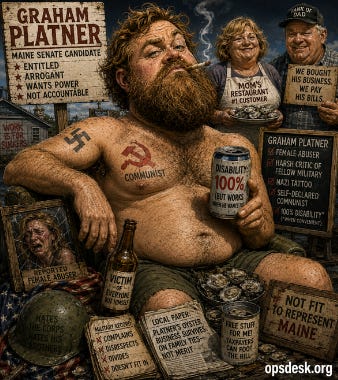
Because he is backed by some of the most prominent figures in the Democratic Party, including Bernie Sanders, Elizabeth Warren, Ro Khanna, Hakeem Jeffries, Cory Booker, and Chuck Schumer.
That is where we are in American politics. Party leaders want this train wreck as a colleague, and many voters appear willing to go along with it.
Platner seems to be the latest addition to an increasingly long list of questionable figures who have found their way to Capitol Hill. Think Bob Menendez, George Santos, Katie Hill, Al Franken, Chris Collins, Henry Cuellar, Eric Swalwell, and others. At times, congressional candidate lists resemble the holding pen at Manhattan Criminal Court more than a roster of future national leaders.
If candidates like Graham Platner can earn serious endorsements and become viable contenders, voters need to rethink what they are rewarding. America cannot thrive with leadership of this caliber. At some point, voters must wake up before the American dream is swept away in a tide of political sewage.
In a year when the incumbent was decidedly vulnerable: Was there really nobody more deserving on the Democrat side willing to step forward?
Is this really the best they can do?
If so, that says much more than Platner’s candidacy alone does.
A Harsh Policing Lesson From Across the Pond
This week, Southampton, UK man Vickrum Digwa was sentenced to life in prison for the stabbing death of Henry Nowak. Digwa, a Sikh British national, was armed with two knives when he encountered Nowak. Nowak, dressed in his school uniform, asked Digwa if he was a “bad man” and began filming him with his phone. Digwa responded by stealing Nowak’s phone.
Apparently, Nowak tried to get his phone back and Digwa stabbed him four times with one of the two knives he possessed. Cops responded, listened to Digwa’s false claims of a racially motivated assault, and cuffed the prone and dying Nowak despite his claims that he had been stabbed and could not breathe.
The video is disturbing.
In the NYPD, we would occasionally cuff people who had been shot. In the initial chaos of a shooting scene, if we could not determine whether a wounded person was involved in the gunplay, the cuffs went on until we figured out who was who and who did what. Shooters often got shot themselves, and guns were still in play. It was for our safety and the safety of the people who invariably gathered around the scene.
In this case, however, we have to question the British officers’ actions. There are rarely guns on the street in Britain, and Digwa only claimed that his turban had been removed and that he had been struck. No mention of guns or even weapons. Meanwhile, Nowak was on the ground, bleeding and in pain, claiming he had been stabbed. Cuffing the 18-year-old who turned out to be the victim does not seem to make sense.
But wokeism has come to Great Britain, and policing has become a target. When that fact is included, the officers’ behavior becomes more understandable.
A few years ago, the National Police Chiefs’ Council and the College of Policing released a document addressing racism in policing. The document, titled the Police Race Action Plan, reads like a collection of left-wing talking points on racial division. It is essentially the same implicit-bias tripe foisted on American cops, but with provisions that encourage discrimination against non-minorities. It seeks to repair past wrongs with black and minority communities. One component is a DEI hiring and retention program. But that is not necessarily the most dangerous part.
The plan encourages equity of outcomes rather than equal treatment. That is institutionalized racism. It argues that treating everyone the same may not always produce fair outcomes. American cops, to their credit, largely viewed similar instruction with skepticism. British officers appear to have bought in.
Many British officers now worry that treating people equally could negatively affect their evaluations and careers. Minority victims or suspects may receive different treatment than whites in pursuit of mandated equitable outcomes. Civilian complaints from minorities likely receive greater attention than complaints from white citizens.
That may have been at the heart of the disparate treatment of Digwa and Nowak. Both claimed to be victims, but only Digwa’s far less serious complaint was immediately addressed. Officers dismissed Nowak’s claims that he had been stabbed and could not breathe. He wound up in handcuffs as his life slipped away. Digwa, armed with knives and having just committed a homicide, was handled with kid gloves. In fact, he still had a knife on his person when he arrived at the police station. That is inexcusable. Even days after the murder, police were still attempting to portray Nowak as the aggressor. They reportedly even drafted paperwork stating that, before being forced to revise their version of the facts.
The fallout has been substantial and ongoing. An investigation into how the police handled the situation has been opened, there have been large and contentious public protests, and British politicians are scrambling to position themselves away from any collateral damage (as politicians generally do anywhere).
It appears from the video that nothing the officers could have done would have saved Nowak. But there is an important lesson here. Police must treat people equally, not equitably. Today’s officers cannot right the discriminatory wrongs of the past. They must simply be the best, safest, and fairest officers they can be. Policing through the lens of race is the antithesis of that goal, and it will inevitably lead to more incidents like this one.
Weekly Pod: A Terror Victim’s Son Speaks
Join us for a conversation with Joseph Connor, whose father Frank was murdered by the Puerto Rican separatist group, the FALN, in 1975. Since that time, successive Democrat administrations have not only impeded the search for justice in the case — they’ve actually abetted the terrorists’ cause, through clemency and venal political maneuvering.
With the bomb-maker who killed Joseph’s father alive in Cuba — and with the U.S. putting heavy pressure on that Caribbean nation — we have to ask: Will that killer and others the Cubans have been harboring finally be brought to justice?
The players will be familiar to you. The Clintons, Barack Obama, Anthony Holder… the next time you hear that the Dems are the law-and-order party, you’ll think of this podcast.
Click below for the sizzle… and HERE for the entire, amazing, and heartrending discussion.
(And to hear more from Joseph, head to his website here; see his X feed here. To view a full documentary on his amazing story, click the image below).

From The Legal Desk: Hot Spots And Risk Management

Venezuela: Maduro is gone and the place has not completely fallen apart, but it’s still far from the vacation list. The lights are on, the port’s working, and the oil is moving. The street gangs, Cuban intel holdovers, and whatever is left of the old Chavista muscle has not filled the ominous “void.” So for now, it’s working. Or at least, not not-working….
Venezuela exported about 1.25 million barrels per day in May. That’s the third straight monthly increase, up 61 percent from the same month last year, with the U.S. now the top destination. It is still nowhere near Venezuela’s old oil glory - the country once produced about 3.4 million barrels per day -- but it is no longer dead on the floor. (Watch Venezuela on the Brink, here, for background on Venezuela’s amazing — and tragic — oil story.)
The big oil guys are circling, but they are not exactly sprinting into Caracas. Chevron is still the main American player on the ground. Global traders like Vitol and Trafigura are moving cargo. India’s Reliance is buying. But Exxon and ConocoPhillips remember what happened the last time Venezuela “opened” for business: nationalizations, arbitration, and years of legal warfare. Translation: Venezuela is open for business, but nobody wants to be the first guy robbed at the counter.
And yes, some of the old problem players are still there. Diosdado Cabello -- Chavista enforcer, interior minister, U.S.-sanctioned power broker, and accused narco-trafficking figure -- did not vanish. Neither did Gustavo González López, the sanctioned former intelligence boss now moved into the defense file.
That is the ugly bargain. America knocked out Maduro, but it is still using pieces of the old machine to keep the building from burning down.
Stable? Sort of.
Greenland: Last week, Marco Rubio was asked whether Greenland was actually part of Denmark. Rubio’s answer: “For now.” Not exactly a Hallmark card to Copenhagen. Rubio also said the U.S., Denmark, and Greenland are still in talks over the island’s obvious role in the defense of America’s northern flank. This is not going away – it’s too important geopolitically. Andrew Puzder -- now Trump’s man in Brussels -- tried to smooth over Rubio’s statement, saying Trump never threatened to invade Greenland … and to focus on the “coffee,” not the “froth.”
Meanwhile, America’s security concerns just dominated Greenland’s elections. Greenland’s center-right party won, but instead of governing alone, its new premier pulled together a broad parliamentary coalition that includes parties to his left and right.
Translation: the liberals and conservatives may fight about Denmark, independence, and everything else — but on Trump, they are largely united. Resist.
And with this renewed allegiance between Copenhagen and Nuuk, Greenland just announced a further delay in the release of its human rights report on the spiral campaign — pushing it back now to August… (see Law Wars special documentary here for full — shocking — background.) You can’t be accusing your new/old partner of genocide now, with the threat of America looming. The newest delay makes it almost certain that it is the Trump factor holding things up …and also suggests that report is going to be ugly.
And while Denmark further stalls compensating the female victims of their forced contraception program, it announced a new forced conscription program –- with girls for the first time being assigned to help secure the border from the feared threat of an invading Russian army. Women’s rights.
Africa: So what happened with the African war Trump settled? The short version: he got the deal; he did not yet get the peace. So new sanctions came this week.
This is the Rwanda–Congo war file … among the most brutal genocides in history — the long, ugly eastern Congo mess involving Rwanda, the Congolese government, the M23 rebels, genocide-linked Hutu militias, and a mountain of critical minerals.
Trump brought the leaders to Washington, celebrated the peace agreement, and tied the whole thing to American access to Congo’s mineral wealth. (Listen to When Africa Goes to War, here, for background.)
Translation: stop the killing, push Rwanda and Congo into the same room, and get America into the minerals game before China owns it all.
It was a good idea… but that’s hard country.
The problem is that the men with guns (and machetes) did not get the memo. Fighting continued in eastern Congo after the deal. The U.S. just imposed new sanctions on commanders from M23 and the FDLR -- the Rwanda-linked rebel side and the Hutu militia side — which is Washington’s way of saying: yes, we are still very much in the game here.
There has been some movement. Congo has begun a disarmament push against the FDLR, one of Rwanda’s core demands.
But this is not peace yet. It is a pressure campaign with a signing ceremony attached.
Trump may have started the settlement. But this is going to be a long, tough one.
Some things we’re watching: Parts of Britain’s thought-policing machine are finally getting embarrassed into retreat: after the Henry Nowak case forced a review of ideology-driven police guidance (see Maine, above), a separate Bradford policing-panel fight has exposed how fast “hate” bureaucracy can turn on people who say the “wrong” thing — it’s about time… Ireland: Beginning on June 12th , the Emerald Isle cedes authority to the EU to decide how many migrants can claim asylum in their country. So they kicked England out, only to let Brussels decide who can live there -- Céad míle fáilte (look it up)…. Washington: The Senate is now fighting over whether to renew FISA Section 702 which expires on June 12th. This is the foreign-surveillance power used to monitor overseas threats to America. This, as the international soccer world is set to descend on America this summer. FISA has been abused — of that, there is little doubt (see Page, Carter) but the intel services need it. As the saying goes, mend it, don’t end it.
True Crime Girl: Judge Not, Lest You Be Judged…

The conviction of former Wisconsin Circuit Court Judge Hannah Dugan is more than just another courtroom drama. It is a timely reminder that in America, no one—not even a judge wearing a black robe—is above the law.

In case you missed it — and you might have, considering how under-reported it was: Dugan was convicted by a federal jury of felony obstruction after prosecutors proved she deliberately interfered with federal immigration agents who were attempting to arrest an undocumented immigrant inside a Milwaukee courthouse (remember her now?).
According to evidence presented at trial, Dugan learned that federal agents were waiting to take Eduardo Flores-Ruiz into custody following a court appearance. Rather than allowing the lawful arrest to proceed, prosecutors said she confronted the agents, directed them away from the courtroom, and then escorted Flores-Ruiz and his attorney through a restricted exit typically reserved for court personnel.
The maneuver temporarily worked. Flores-Ruiz escaped the immediate grasp of federal authorities, forcing agents to chase him outside the courthouse before ultimately taking him into custody.
Dugan went to trial — and paid for it. A federal jury concluded that Dugan’s actions crossed a bright legal line. While she was acquitted of one count alleging concealment of a person from arrest, jurors convicted her of felony obstruction. In doing so, they rejected the argument that she was merely exercising judicial discretion and instead found that she intentionally interfered with a federal law enforcement operation.
The consequences are significant. Dugan resigned from the bench following her conviction and, under Wisconsin law, she can no longer serve as a judge. Even her future as a lawyer is in question. What was once a respected judicial career has ended in disgrace. She now faces a potential sentence of up to five years in federal prison.

The broader significance of the case extends well beyond one Wisconsin courthouse.
For years, Americans have watched public officials at every level openly challenge laws they disagree with. Some prosecutors refuse to prosecute entire categories of crimes. Some local officials openly resist federal immigration enforcement. The danger in such conduct is that it erodes the public’s confidence that laws are being applied fairly and uniformly.
Judges occupy a unique position in our system. They are expected to be neutral arbiters—not activists, not political operatives, and certainly not participants in efforts to help defendants or suspects evade law enforcement. Once a judge abandons that role and begins using the authority of the bench to obstruct lawful enforcement actions, the integrity of the entire judicial system is placed at risk.
That is why the Dugan conviction matters.
Whether one supports or opposes federal immigration policy is ultimately irrelevant to the legal question at the heart of the case. The issue is whether a judge can use her office to interfere with a lawful federal arrest. A jury answered that question with a resounding no. At long last, a judicial activist has been held accountable.
That accountability may prove to be the most important outcome of the Hannah Dugan case. Future judges now have a clear warning: the bench is not a shield against criminal liability and performative activism. Choose to interfere with federal law enforcement — do so at your peril.
And finally….

Has anything recently been more fun than watching the twilight of the pinko media baby boomers?
Hopefully, Pelley is just Round One.

Platner looks less like a Maine workingman and more like another Democrat mythology project: prep-school background, family money, murky business story, radical online history, socialist branding, and a carefully curated “hardscrabble” costume. The VA disability issue deserves respectful handling because veterans can be disabled and still productive. But the public has every right to know whether Platner’s benefits involve unemployability restrictions, whether his oyster business actually supports him, why his wife draws campaign and business compensation, and whether his public image matches reality. Democrats would vaporize a Republican over this. Instead, their leaders are lining up behind Oyster Boy. That tells you plenty.
Excellent and much appreciated overviews of several complex topics - much appreciated. Just an FYI- the photo identified as Platner's Totenkopf tattoo isn't . A Totenkopf is a skull and crossbones. This is a photo of the tattoo he used to cover it up. It's a version of a Celtic or Nordic design featuring Fenrir, a monstrous wolf with uncontrollable strength. It was distorted somewhat in order to better disguise the original tattoo.