


There are certain things that should transcend politics. September 11th is one of them.
And how our leaders reacted to the event’s anniversary tells us a great deal about them.

In fact, how our politicians react to 9-11 has become something of a litmus test. You don’t have to endorse every counterterrorism policy America adopted. But you should at the least be able—without the moral equivalency—to acknowledge what happened: nearly 3,000 innocent people were murdered by Islamist terrorists, hundreds of cops and firefighters ran toward the danger, and thousands more have since died from 9-11-related illnesses.
It’s the least we should expect on the event’s 25th anniversary.
Yet look at how some of the current leadership class in the Democrat Party handled it.
Congresswoman Rashida Tlaib apparently couldn’t find room on her busy social-media feeds for even a simple remembrance of the victims.
Ayanna Pressley, another Congressional “Squad” member, acknowledged the victims, then added that she’s also “thinking about” this:

“Persecution” of Muslim people? In America? Really?
Would that be like the persecution of any other religion other than Islam in every Islamic nation on earth?
Then there was Ground Zero.
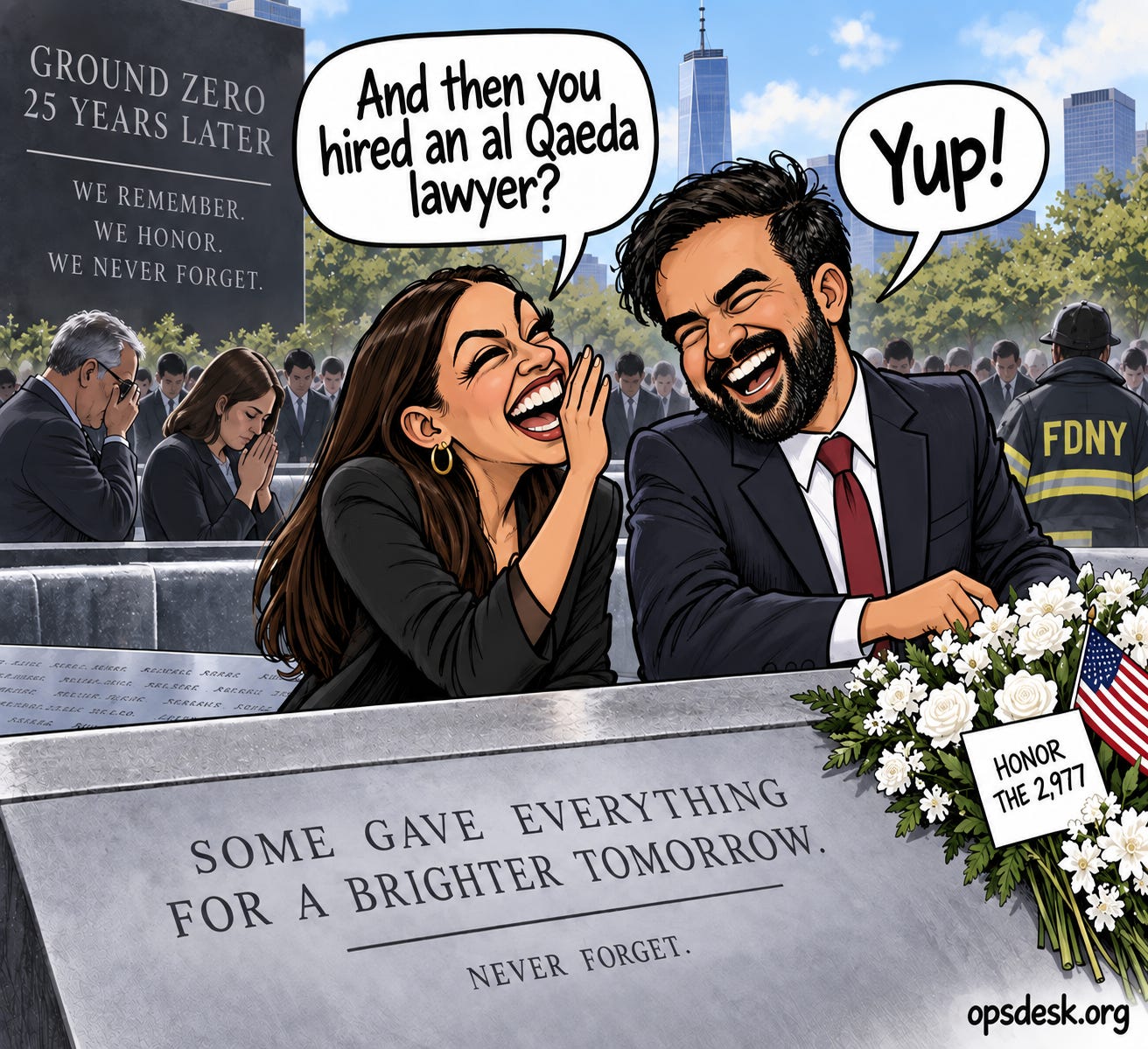
During the solemn reading of the victims’ names, cameras caught Mayor Zohran Mamdani and Congresswoman Alexandria Ocasio-Cortez smiling and laughing together. Their defenders insist the moment has been mischaracterized—that the two were simply greeting each other. Perhaps. But when grieving families are reading the names of their murdered relatives, and everyone else around you is standing in solemn silence… would a bit of decorum have been too much to ask? Particularly for the mayor of the city that was attacked?
But the real 9-11 litmus test goes beyond social-media posts and appearances at Ground Zero.
On Sunday, the New York Post reported that two newly elected Democratic Socialist congressional candidates backed by Mamdani—Darializa Avila-Chevalier and Claire Valdez—are involved in an effort to oppose the Department of Homeland Security budget when they arrive in Washington. According to the Post’s sources, the two have been working with members of the “Squad,” including Ilhan Omar and Rashida Tlaib, on the effort.
The potential cost to New York City? More than $215 million in counterterrorism funding.
That money comes through the Urban Areas Security Initiative, or UASI. And here’s the part that makes this particularly incredible: UASI was created in 2003 as a direct response to 9-11.
The program distributes hundreds of millions of dollars to high-risk urban areas for terrorism prevention and preparedness. In New York, that money helps pay for things like bomb squads, emergency communications and the equipment and training first responders would need following a catastrophic or radiological attack.
In other words, this isn’t some abstract federal slush fund. It is part of the security infrastructure created because terrorists flew two airplanes into the World Trade Center.
According to the Post, even Mamdani has fought to preserve the money. Earlier this month, he complained about the federal government withholding some of it, specifically citing funding for 12 bomb squads, FDNY communications and radiological-response capabilities.
Yet two socialist candidates he backed are reportedly willing to jeopardize those same funds as part of their ideological war against DHS. Valdez’s representative vehemently denies the Post’s account, calling its anonymous sources either misinformed or dishonest. But the Post is standing by its reporting.
Which brings us back to the litmus test.
Remembering 9-11 isn’t about posting the right photograph once a year. It isn’t about showing up at Ground Zero and then checking the box. Or at least not laughing.
It’s about understanding what happened there—and making sure it never happens again. And the newest generation of Democrat politicians, many too young to really even recall that day, seem incapable of seeing that.
More troubling still, these politicians are not operating on the fringes anymore. They are driving the Democratic Party, particularly among younger voters.
A generation is coming of age with no firsthand memory of that day—and too often without being taught the history that preceded or followed it. If we don’t do a better job educating our children about 9-11, about the enemies who attacked us, and about the bloody history of communism and other failed ideologies now being repackaged for a new generation, we shouldn’t be surprised by what comes next.
Is the European-style socialism and appeasement that is leading that continent to obsolescence really what America’s future will look like? Beginning with this year’s midterms?
Perhaps America has just had it too good, for too long. We forget how hard-fought our freedoms and prosperity have been. We forget that, for all our faults, this nation still offers unmatched opportunity.
Today’s radicals become tomorrow’s establishment. If we fail to teach the lessons of the past, this may well be what America’s future looks like: threatened at an existential level, and too weak and conflicted to muster a real response.
Ask yourself how a Democrat president—an AOC, Newsom, or Klobuchar—would respond to another 9-11 today.
That is the litmus test we should all be using in the voting booth.
On The Ops Wire: What’s Trump Up To In Ireland?
In perhaps the least likely international love affair since Harry and Meghan, Donald Trump spent the weekend in a European nation. And by all accounts, he loved it.
Now, this is a president who has been borderline hostile to that continent, and has spent the last two years insisting that Europe is headed in the wrong direction. Unchecked migration is changing their cities and straining their governments. Climate and energy policies are weakening economies. NATO members rely too heavily on American defense spending. Elitist European political establishments have ignored growing anger among voters.
And Ireland has been firmly onboard with pretty much all of this.
Yet Donald Trump just spend the weekend there and was effusive in his praise of the place in ways we’ve rarely seen. Was it an accident?
Unlikely.
First: let’s first recognize Ireland’s stance on Eurozone issues.
Immigration into Ireland has been enormous for a country of only about 5.5 million. For the previous five years ending in April, roughly 500,000 immigrants have entered Ireland—approaching 10 percent of the country’s population. In American terms, that would be roughly 34 million. In five years.
Ireland is also deeply committed to the climate agenda and the European Union. Prime Minister Micheál Martin has described his government as “unapologetically and absolutely committed” to the EU, and the government has stated it expects Ireland’s commitment to carbon neutrality to fundamentally change Ireland’s economy.
And then there is Israel. Ireland has become one of Europe’s most visible advocates for the Palestinian cause. It recognized a State of Palestine in May 2024 and went out of its way to intervene in South Africa’s genocide case against Israel at the International Court of Justice.
Nor is Ireland’s political culture particularly friendly to Trump. President Catherine Connolly previously described Trump as “abhorrent,” while thousands protested Trump’s visit.
Trump’s response? He called Connolly “terrific.”
So what’s going on?
It could be personal. The Trump family has deep ties to Ireland. Trump’s golf resort at Doonbeg is part of that, but the connection runs deeper. The Trump children were partly raised by Irish women. Eric Trump has repeatedly described Dorothy Curry, their nanny from County Cavan, as his “second mom.” He spent summers with her family in Cavan and has said those childhood experiences left him feeling almost Irish himself.
So Trump may simply not put Ireland in the same mental box as Brussels, Germany, and Denmark.
But there may be another reason for Trump’s embrace. As we’ve described in this space, Ireland itself may be changing. And Trump may see Ireland as the nation that can lead Europe in a more Trumpian direction. And the wedge issue is—you guessed it—immigration.
Immigration has become such a hotbed issue in Ireland, it’s creating an alliance that would have been unthinkable until now: the opposite sides of “The Troubles,” the Loyalists and the Nationalists.
For most of the last century, Irish nationalists and Northern Irish loyalists stood on opposite sides of the central political question on the island. Nationalists generally wanted Northern Ireland united with the Republic. Loyalists wanted it to remain part of the United Kingdom.
Now immigration appears to be cutting across that old divide.
Anti-immigration activists from the Republic have increasingly cooperated with loyalist activists in Northern Ireland. In Belfast, demonstrations have even featured the Irish tricolour alongside Union flags.
In 2025, loyalist Mark Sinclair, a former member of the Ulster Volunteer Force, traveled from Belfast to Dublin and addressed an anti-immigration rally outside the General Post Office.
It would be hard to overstate the significance of the visit, and the location. The GPO was the headquarters of the 1916 Easter Rising and remains one of the great symbols of Irish independence. Yet the rally organizer described the event as a “day of unity between nationalists and loyalists.” Research cited by The Irish Times described cross-border cooperation in which shared opposition to immigration can “override older sectarian fault lines.”
And as this space has covered, there have been numerous instances of violence, even firebombings, against migrant targets.
Now, does this mean that nationalists and unionists suddenly agree on reunification? No. But what can’t be denied is that something unusual is happening.
And Trump may see an opportunity. Which is why, unlike pretty much every U.S. president before him, on this recent trip he didn’t avoid wading into the issue of reunification. Trump stated unequivocally that, regarding the Irish nation, he would, “love to see it unified. I think it would be a great feather in everybody’s cap if that happened. It’s going to happen eventually.”
In Dublin and London, jaws must have been on the floor. Trump then added that if reunification was ultimately going to happen, “It may as well happen now.” He called it “a fantastic thing,” and, referring to Martin, said Ireland had “the right man over here to get it moving.”
Trump acknowledged the sensitivity of all this himself, by adding, “Now the UK will have something to say about it, obviously.”
London’s response was unsurprisingly swift, with Prime Minister Andy Burnham’s government saying, “I am not aware that there is majority public support for another referendum, and until that changes, there will not be one.”
Now, perhaps Trump simply believes Irish reunification is historically inevitable. Perhaps his affection for Ireland draws him toward the nationalist position.
Or perhaps Trump sees a country whose politics are beginning to collide with the consequences of the European immigration model he has spent years attacking.
Germany offers perhaps the clearest example. Trump has repeatedly criticized its immigration and energy policies. Now the anti-immigration Alternative for Germany, or AfD, has made extraordinary gains, particularly in the former East Germany.
Indeed, across Europe, migration is becoming one of the defining political issues of the era. Yet we don’t see Trump in Germany, wading into the issue there.
Yet in perhaps the least Trumpian nation in Europe, Trump just praised the government and the people, offered a trade concession, shrugged off political insults and expressed support for reunification.
Maybe there is no grand strategy. Trump may simply love Ireland. But the two explanations are not mutually exclusive. As resistance to mass migration begins to scramble old political alliances on the island, he may see Ireland as unusually fertile ground.
Germany may demonstrate where Europe’s anti-immigration movement is going. Ireland could be where Trump decides to join it.
Meaning that Donald Trump may have just chosen his European beachhead.

True Crime Girl: Lindsay Clancy and the Dangerous Redefinition of Criminal Responsibility

We are living in a world where everything is upside down—especially when it comes to crime.
The people who commit crimes have become the victims, and the people who try to prevent or prosecute crime have become the bad guys. We saw it with the Daniel Penny case in NYC, and we are seeing it with ICE as agents try to deport criminal illegal aliens. Now we’re seeing it with Lindsay Clancy, who has somehow now become the true “victim” to many, a hero to the country’s online progressive class.
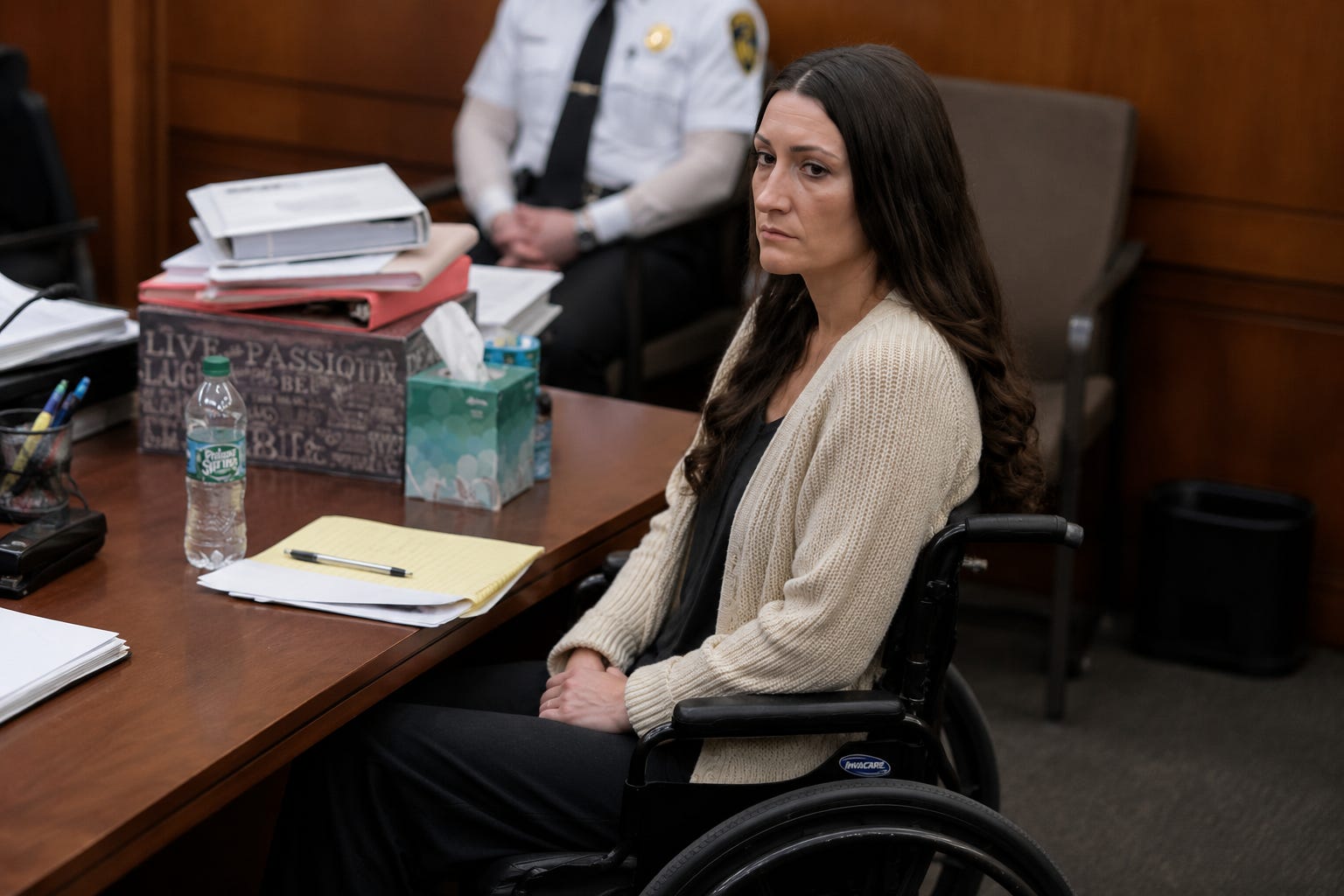
As we’ve all heard by now, 11 of the 12 Clancy jurors ultimately concluded that she should be found not criminally responsible for her horrific actions. All nine women on the jury and two of the three men sided with the defense. Their sympathies ultimately lay with Clancy and her claims of severe mental illness.
And now the lone juror who held out for a conviction is being portrayed as the bad guy for believing she should be held criminally responsible for what she did. Reporters are doing a deep dive into his past digging up allegations of domestic violence and a reported eviction notice. These same reporters don’t seem nearly as interested in doxxing the other jurors.
Additionally, three female jurors gave an interview to NBC10 Boston this week. They discussed their frustration with the lone holdout juror, describing him as “arrogant” and expressing disbelief that he would not listen to the other jurors. They also criticized what they viewed as the prosecution’s lack of compassion toward Clancy.
We have since learned something else about that jury.
There was only one person of color on it—and he was the Black man who refused to change his vote despite intense disagreement from the other 11 jurors.
That revelation left CBS News host Gayle King stunned. “Woah, I have to sit with that for just a second,” King said after learning that the holdout was Black.
Now, why would the juror’s race matter to Gayle? Unless she sees the case, like so many others, in political rather than legal terms?
And recall that defense attorney Kevin Reddington has himself singled out this juror for ridicule. Thus far, the juror has been silent. But don’t be surprised if, at some point soon, the lawsuits start flying. We may actually see an unprecedented situation in which a holdout juror sues not only a defense attorney, but even his fellow jurors, for defamation.
One of the problems in this case was the ludicrous Massachusetts law that puts the burden of proof on the government to prove the accused is sane. The formulation essentially becomes: “Yes, I did it, but I was crazy at the time. Prove me wrong beyond a reasonable doubt.”
Now, consider what happens if we stretch that principle too far. Virtually any horrific murder can eventually be explained away as the product of some mental defect rather than treated as a crime for which the perpetrator bears responsibility.
Now that’s truly crazy.
And soft-pedaling the issue leads to dangerous results. Because sure enough, the copycat cases are arriving.
An Illinois mother named Corie Walsh, who prosecutors say had become deeply invested in the Lindsay Clancy trial, stands accused of hanging her 2-year-old son, Barrett, in the basement of the family’s home. Authorities say Barrett died from asphyxia caused by ligature compression of the neck. Walsh has been charged with first-degree murder.
Her defense attorney says Walsh was “severely mentally ill” and experiencing a “psychotic episode.”
Sound familiar?
Prosecutors say Walsh had been discussing the Clancy trial with friends just hours before her son was found. They also allege that she told investigators she believed Barrett was the “devil” or “anti-Christ.” Her attorneys insist there is no evidence that the Clancy case inspired the killing. Of course they do.

Walsh is entitled to the presumption of innocence, and her mental condition will undoubtedly become an important issue as her case proceeds.
But society should be very careful about confusing an explanation for horrific conduct with an excuse for it.
Mental illness may explain why someone commits an unthinkable act. It does not automatically erase criminal responsibility.
People who kill children can be mentally ill. They can also be murderers.
The two are not mutually exclusive.
When we forget that—when child-murder gets couched in psycho-babble and online sloganeering—it’s society’s weakest members who suffer the consequences. Not the lawyers, the reporters, the social media influencers….
The kids.
And finally….
According to The New York Times, Obama is telling the Dems to make the AI scare a central issue of the midterm elections.
Does AI need to be regulated? Sure. But just remember this about the same people screaming about the AI apocalypse….

Of course, we could always just leave it to China. We’re sure that’ll go well for us.

I’m half Irish ☘️ and attended Saint Patrick’s Academy. I’m very proud of President Trump for his respect for Ireland and its people.