There are national humiliations — like, say, this one — and there are national humiliations.
What Israel just inflicted on the Iranian mullahs may be in a class by itself.
We’ve all heard the story by now. The extent of the damage done to the Iranian regime by Israel’s recent pinpoint strikes may not be known for years, if ever. At this writing, Israel — a nation about the size of New Jersey, confronting a nation twice the size of Texas — is a single decision away from ending Iran’s entire oil-refining industry. Which is one of the few sources of revenue and international leverage the Islamic Republic has.
It all speaks to the difference between a modern, outward-facing system compared to a regressive, oppressive theocracy. And nowhere is that difference more evident than in the quality of the respective nations’ intel operations — which, one could argue, made all the difference here.
An Intelligence Coup For The Ages
Israel’s recent series of precise attacks on Iranian military and nuclear assets didn’t just rattle the Islamic Republic—they revealed the complete incapacity of Iran’s vaunted security apparatus.
The Israeli operation reportedly eliminated at least 20 high-ranking Iranian military officials, including the top four commanders of the Islamic Revolutionary Guard Corps (IRGC), as well as at least nine key weapons scientists. These were not random strikes. These were specified targets, executed with chilling accuracy. You don’t get that kind of kill list without deep infiltration and months—if not years—of intelligence groundwork.
The top guy, Hossein Salami, was apparently hit with such accuracy, only his apartment was struck by the killer drone — leaving the rest of the high-rise building nearly unscathed.

Now, you don’t get that kind of accuracy with a joystick and a Ring camera in Tel Aviv. Chances are, there was an Israeli asset on the ground in Iran who “painted” the target; that is, he shined a laser of some sort onto the specific target, thereby guiding the missile in (there are other possibilities, of course).
Either way, it all speaks of an utter humiliation for Iran’s internal security apparatus, which had enjoyed a pretty good rep in the intelligence community.
The problem is: they focus on the wrong target.
A Security State That Can’t Secure Itself
Iran portrays itself as a fortress state, constantly warning of external threats, Zionist plots, and Western subversion. Its surveillance state is infamous: dissidents are followed, phones are tapped, journalists jailed, and even university students are monitored by campus informants. And yet, when it comes to the one thing intelligence agencies are supposed to do—detect and prevent foreign penetration—Iran sucks.
Why? Because the regime’s intelligence structure is not built for external security. It is built for internal paranoia.
Iran has at least seven major intelligence bodies. But instead of operating in coordination, these agencies compete with and spy on each other. They report through different chains of command. Their mission is not national protection—it’s regime protection.
This system was in fact deliberately designed by the Supreme Leader to prevent coups and consolidate clerical power. Each silo of intelligence is tasked with watching the others, ensuring no one grows too powerful—or too independent. The result is a country paralyzed by its own internal distrust.
A System Targeting Its Own People
So the regime’s surveillance isn’t about stopping foreign spies. It’s about stopping Iranian citizens from thinking independently or acting autonomously. And this misplaced focus is exactly why Israel has been able to operate seemingly at-will inside Iran.
From the 2020 assassination of nuclear scientist Mohsen Fakhrizadeh—allegedly via a remote-controlled AI gun—to cyber intrusions into Iran’s Natanz facility, and now the most recent series of targeted killings, the pattern is clear: Israel penetrates, plans, and executes with surgical precision, while Iranian officials read student emails and then are left scrambling for damage control.
Reportedly, Iranian officials now fear their entire security apparatus has been penetrated.
Jeez… ya think?
Nepotism, Corruption, and Rot
Adding to the dysfunction is the deeply nepotistic and corrupt nature of Iran’s power structure. Appointments in the intelligence services are often made based on personal loyalty and family connections, not competence. The children of the elites get the big gigs; think of it as DEI based on blood ties.
The result is a security elite that is more concerned with pleasing superiors than protecting the nation.
Iran's image of invincibility has long relied on bluster and myth. But this latest operation stripped that away. For all the regime's threats and posturing, Israel exposed a core truth: Tehran can’t even protect its top generals. You have to imagine that if Israel had wanted to get the Ayatollah… they could have.
A Lasting Regime—But a Weakened One
To be clear, this doesn’t mean Iran’s regime is collapsing. It’s still brutally efficient at repressing its own people and controlling the narrative. And it remains a danger—regionally and globally.
But the message is now out: Iran’s intelligence defenses are penetrable. Its top brass are vulnerable. And Israel knows where to strike—and when.
The Ayatollah’s regime may still stand, but it’s been exposed. And remains so.
We can’t be the only ones noticing. That Israel could do this — without direct U.S. assistance — sends an unmistakable message: the regime of the mullahs in Tehran is a house of cards.
Here’s hoping enough of the Iranian people see it, too.
The Smarter Of The Two?
We would have pegged Tim Walz an IQ point or two smarter than his running mate Kamala Harris. That’s nothing to write home about, as that might have been a race to the bottom in the history of presidential elections.
Perhaps we were wrong. On Friday, Walz said one of the stupidest things we have heard a politician say in a while – and that’s a real accomplishment. When asked about the burgeoning conflict between Israel and Iran, Walz stated that the country that should negotiate a peace settlement is… China.
CHINA!
Thank God that those two dim bulbs didn’t win the election. Putting China in charge of a negotiation with Iran flies in the face of all logic. Israel and the United States are as closely linked as any two countries and share very similar goals in their dealings with Iran – specifically, no nuclear capabilities for the largest state sponsor of terror on the planet right now.
We have agreed with President Trump that a nuclear Iran is a clear and present danger to the world and the United States specifically. Iran simply cannot be trusted to handle the awesome power of nuclear capability in a responsible fashion.

Walz stated that the United States is too involved in the conflict to be a fair arbitrator. Fairness is not a concern when it comes to a nuclear armed Iran. However, peace is a good thing, and we should always strive in that direction. Empowering our most powerful adversary to handle negotiations would be like putting the fox in charge of the hen house.
China would never work to cut a deal that would be fair to the United States – just the opposite, they would work to ensure that Iran is a thorn in the side of Israel and the West for decades to come.
What makes Walz’s statement worse is that he indicated that China has the “moral authority” to negotiate a peace. Perhaps this guy is as drunk as Kamala. Moral authority and the Chinese government should never be used in the same sentence. Perhaps the fact that he dated the daughter of a Chinese Communist Party official in his younger days left him open to sympathy for the dictatorial regime.
Trump is not exactly killing it on the international negotiations front in recent months, but at least we are not saddled with a Harris-Walz disaster. Another good decision by the American voter.
Sunday Pod: An Intel Coup For The Ages
This week Eric Seidel, former IDF member and federal and state prosecutor, joins Paul for a deep-dive into how Israel managed what may be among the greatest intel coups of modern times.
Eric has unique insights you won’t hear elsewhere, including the news — as yet unreported here in the U.S. — that Israel acted on intelligence of a surprise attack coming from Iran. So Israel struck first.
One could hardly conjure a better example of the value of penetrative intelligence work than the current hostilities between Israel and Iran. Israel is the size of New Jersey; Iran, twice the size of Texas. Yet right now, Israel has the firm upper-hand. There is more than one reason for this.
But the big one: smart, streamlined, actionable intelligence.
For those interested or involved in intelligence and security work of any sort, this is one that will be studied for years. And it could well determine the future of the Mideast — and hence our world — for years to come.
Click below for a reel… and HERE for the full thing.
A Tough Assignment for the Police
In a week of tough jobs for cops, the situation in Minnesota might be the toughest. A deranged individual killed a Minnesota politician and her husband on Saturday and wounded another. The perp impersonated a police officer to gain access to the homes of the two politicians and carried out what appeared to be the beginning of a well-planned plot to kill dozens.
At the time of this writing, the perp is still on the loose. After engaging in a gun battle with responding officers, he managed to escape into a residential neighborhood in suburban Minneapolis.

This presents an extremely dangerous mission for the officers tasked with bringing this perp to justice. Hunting an armed individual in a residential neighborhood is a dicey proposition. Climbing though people’s backyards – searching house by house – is a recipe for disaster in a regular perp hunt. Add in the fact that this is in suburban Champlin, where homeowners are more likely to be armed than in New York City, where we have done similar searches, and things can go south quickly.
Searching for a police impersonator raises the stakes, as cops from multiple agencies are looking for a man wearing a police uniform. You can imagine the problems that may arise in confrontation situations between officers that don’t know each other.
Added to this, the residents of this neighborhood are likely scared and on edge. They don’t know if the people in their yards or knocking on their doors are really the police, or the impersonator looking to claim another victim. Armed civilians could be confronting real cops. It’s hard to imagine a worse scenario.
The police on this case must use caution, but second-guessing their instincts could have deadly consequences.
What a nightmare. Good luck to Minnesota’s Finest in bringing this case to a safe and successful conclusion.
Two Americas on Display: The Army's 250th Anniversary Parade vs. the No Kings Riots
This week, two very different visions of America played out on the nation’s streets.
In Washington, D.C., the United States Army marked its 250th anniversary with a grand parade, a living timeline of American military history. Marching down Constitution Avenue were soldiers in period uniforms — Continental Army infantrymen with tricorn hats, Civil War Union troops, Doughboys from World War I, and modern Special Forces operators. Tanks, artillery, and historic vehicles rolled by, highlighting the evolution of America’s military might and the sacrifices of those who have served to defend the nation for two and a half centuries. Families lined the route, waving flags and applauding as veterans, active duty soldiers, and cadets paid tribute to the Army’s proud legacy.

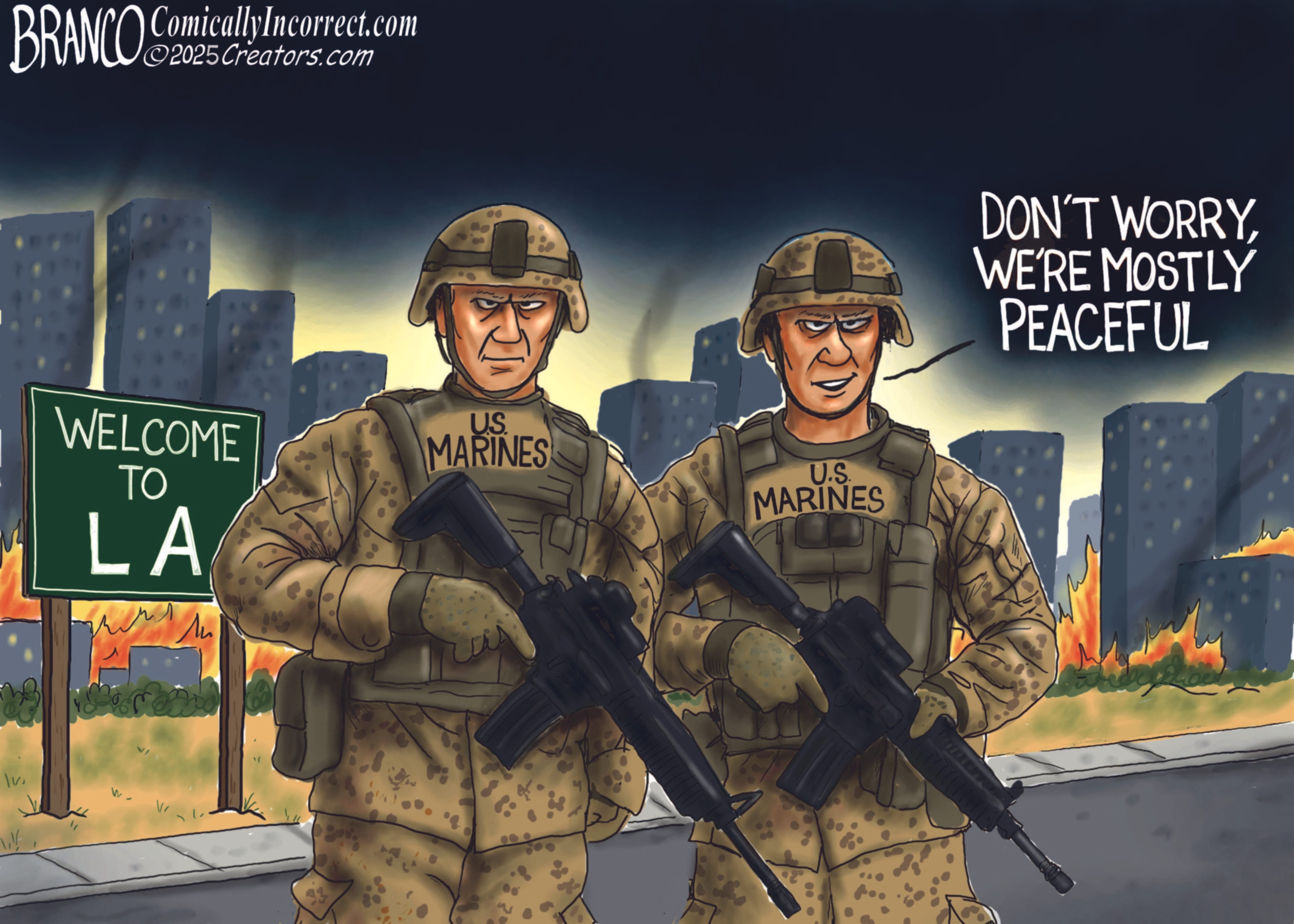
At nearly the same time, in cities across the country, we had the No Kings movement. Framed by much of the media as "peaceful protests," these demonstrations predictably morphed in many instances into violent riots. Black-clad agitators clashed with police, vandalized businesses, and even attacked federal officers. In several cities, No Kings rioters directly confronted Marines on security assignments and targeted ICE agents performing their duties. Law enforcement reported that coordinated groups used makeshift shields, fireworks, and incendiary devices against officers. Entire city blocks were shut down as police attempted to restore order.

The contrast couldn’t be starker.
On one side: discipline, service, and a 250-year legacy of defending American freedoms. On the other: lawlessness, destruction, and open hostility toward the very institutions that allow these leftists to throw tantrums.

The Army parade reminded the country of the price paid for liberty and the enduring strength of America’s founding principles. The No Kings riots, meanwhile, exposed a radical fringe determined to tear down those very foundations.
Two Americas marched this week — one honoring sacrifice and unity, the other fueled by anger and destruction. The choice between them is becoming clearer every day.
And finally…
FAFO Dept: Like so many before them… the “peaceful protestors” are finding out, aren’t they.