So NYS AG Letitia James is indicted. I guess what she said about Donald Trump during her last election campaign is true: nobody is above the law.
But because that’s true… there are a lot more revelations to come in this case. Here’s why.
As anyone following the case knows, there are all sorts of puzzling questions remaining around James’s real estate portfolio. First of all: as a career politician, James’s salary has been relatively modest; as NYS AG, she reportedly makes about $220k. Yet she lives in a five-unit brownstone she owns in Brooklyn that she values on her NYS filings at well over $3 million. She also owns the two houses in Virginia.
And if the Virginia houses are NOT investment properties, as she has contended — then she’s been collecting no rent from them (unlikely, but for the sake of argument). She’s floating all this on a government salary and the occasional paid speech?
There’s also the fact that, reportedly, some of the mortgages on the homes are unrecorded. Okay — apparently this happens. But why so MANY mortgages? She’s got multiple mortgages on all the properties, with her valuations of the houses fluctuating wildly. The banks went along with all this?
Then there’s the issue of the “grand-nieces.” Are they in fact related to her? And have they been paying her? In cash? Or is Tish everyone’s favorite grand-aunt, who is happy to put you up for years at a time for free?
Did Tish know these “grand-nieces” have multiple felony arrests? And that one of them, Nakia Thompson, is an absconder from North Carolina? And was recently arrested again on a threats charge? And who likely should have her felony charges reinstated due to not finishing her probation?
Why doesn’t Tish — who gave a fiery speech in front of the courthouse after her arraignment, in which she invoked Martin Luther King — clarify all this herself? As ostensibly New York State’s top law enforcement officer and attorney, does she not have an ethical obligation to explain why she is (according to her) allowing this fugitive to live rent-free in one of her houses?
Then there’s the smoke around the case. According to MSNBC, two DOJ sources leaked to that network that the case would not be going forward because the evidence was insufficient. Now comes word that the attorney on that case, Beth Yusi, has been dismissed for sending confidential case files to her own personal email.
Raising the inevitable question: Is this attorney, and those files, the source of the leak in question?
And finally: Are we to believe that, in light of the lack of clarity on who-was-paying-for-what — that all James’s taxes are in order? Including the taxes on benefits she enjoys as NYS AG, such as a take-home car?
And in light of the way she appears to have run her finances: Are all the expenditures on her NYS AG expense account legit? The meals? The travel?
Here’s the point: We don’t believe it’s all going to hold up. So expect a superseding indictment — an indictment that adds more, and heavier, charges.
Cliche Department: Nobody is above the law, and people in glass houses shouldn’t throw stones. From where we sit, James has at least three glass houses. And throwing contrived, unethical stones at Donald Trump started her down a very bad road.
“Operation Nothing But Bet” — The Mob and the NBA
So by now we’ve all heard about the recent FBI/DHS/NYPD takedown of a mafia scheme involving basketball point-shaving and rigged card games. But is that all there is to the case? Don’t bet on it (ouch — sorry).

Here’s why. Back in 2007, as we covered in this week’s Weekender, the FBI had a similar point-shaving case involving a bent NBA referee, Tim Donaghy. Donaghy alleges that there were many others in on the scheme he was arrested for, and was ready to wear a wire and work for the FBI in return for a reduced sentence. Then, after a meeting between the FBI and the NBA, word of Donaghy’s arrest mysteriously leaked out — effectively ending the case there.
Did the FBI learn its lesson this time, and keep the case quiet? And perhaps wire some arrestees up and circulate them back into the case? And get up some electronic surveillance, like wiretaps, bugs, etc?
And now that word breaks that a “star retired NFL player” could be implicated, are other sports involved?
As anyone who has ever run a long-term case knows, a key decision point is when to take it down. Is there more to be gained by letting it run? Is the risk justified? Have all the bad actors been identified?
Unfortunately, in addition to investigatory limitations, politics, risk-averse decision-makers, and even finances often play into the decision of when a case has to end.
The point is: you almost never get it all — pieces always remain on the chessboard. So, post-takedown, the gamesmanship begins. “You want a deal? Want to avoid jail? Tell us who else was involved.”
The mob knows how to do this stuff. Once they get one player ensnared, inevitably the next move is to offer the same “services” to the mark’s buddies — who often want in. It’s the nature of these things that they expand.
As the arrestees — especially the sports figures — seek to avoid prison, expect more shoes to drop, more names to pop.
And one last question we feel compelled to ask: Is this case actually just part two of the Donaghy case? The FBI cleaning up what they left on the table last time?
Perhaps The Biggest Supreme Court Case Of Our Time
America is, at the end of the day, a nation of laws governed by a written constitution (not as common throughout the world as many think). As such, interpreting that constitution is the front-line of all our political and policy battles. And while the law can get arcane — it’s where our future is adjudicated. And there’s a big one coming: Louisiana v. Callais, on the issue of racially based gerrymandering.
When we think of “gerrymandering,” it usually conjures up weirdly shaped districts that benefit one party. But behind those squiggles is a tougher question: what happens when race drives the design?
Here’s how it went: Louisiana’s 2024 map added a second majority-Black congressional district to comply with the Voting Rights Act of 1965, which ensures minority voters have a fair chance at electing their candidates of choice. But challengers argue that the map goes too far — that it’s a “racial gerrymander,” where race predominated over all other factors, violating the Equal Protection Clause.
The Court is reportedly rehearing the case now, after requesting new briefs that could redefine the boundary between representation and racial classification.
You might shrug: “One district in Louisiana, who cares?” But people, this case is a national domino. If the justices strike down Louisiana’s map, they could effectively limit how states use race to fix past discrimination in redistricting. That would weaken the Voting Rights Act’s muscle and shift power back to state legislatures — most of which, right now, are Republican-controlled. In practical terms, that would favor the GOP, allowing them to redraw more partisan-friendly maps without needing to preserve minority districts.
The political ripple would be big. States with large Black or Latino populations are likely to see fewer minority-majority seats. Minority turnout could either surge in protest or sag in frustration. And with 2026 midterms approaching, even a handful of redrawn districts would likely tilt control of Congress. And continue to going forward.
The decision could also heighten polarization among the states, as state legislatures that tilt red or blue redraw maps to attempt to increase their representation. But as it’s the Democrats who benefit from racially based maps — the Republicans stand to be the beneficiaries.
In short, this isn’t just about Louisiana. It’s about who gets to draw the lines that decide who gets to lead — and, if the Court sides with the challengers, the Republicans stand to gain in 2026. At the least.
Weekend Podcast: Isabel Vincent on Mamdani’s Overseas Funding
Join us this week for a return visit from Isabel Vincent, NY Post features writer, who has broken the story of NYC’s potential next mayor, socialist Zohran Mamdani, and his 170 foreign contributors.
Why are people from as far away as Australia sending Mamdani’s campaign money? Why from Dubai? Canada? Europe?
Is there more going on here? And how well do we really know Mamdani? A man whose campaign was reportedly purposely boosted by TikTok’s algorithm?
You know — the TikTok controlled by Beijing…. (and that’s not his only Beijing connection).
We’re lucky to have Isabel here to lay it out. Because truth is — we don’t really know much about the man who could soon be a leading force in the Democratic party.
Are we being played?
So click below for a preview — and HERE for the whole pod.
Donald Trump And The Monroe Doctrine
As followers of The Ops Desk know, we were out early on developments in the Caribbean. Reportedly, Venezuelan President Maduro recently offered the entire resources of his nation to the United States. Trump turned him down. Ruh-roh.
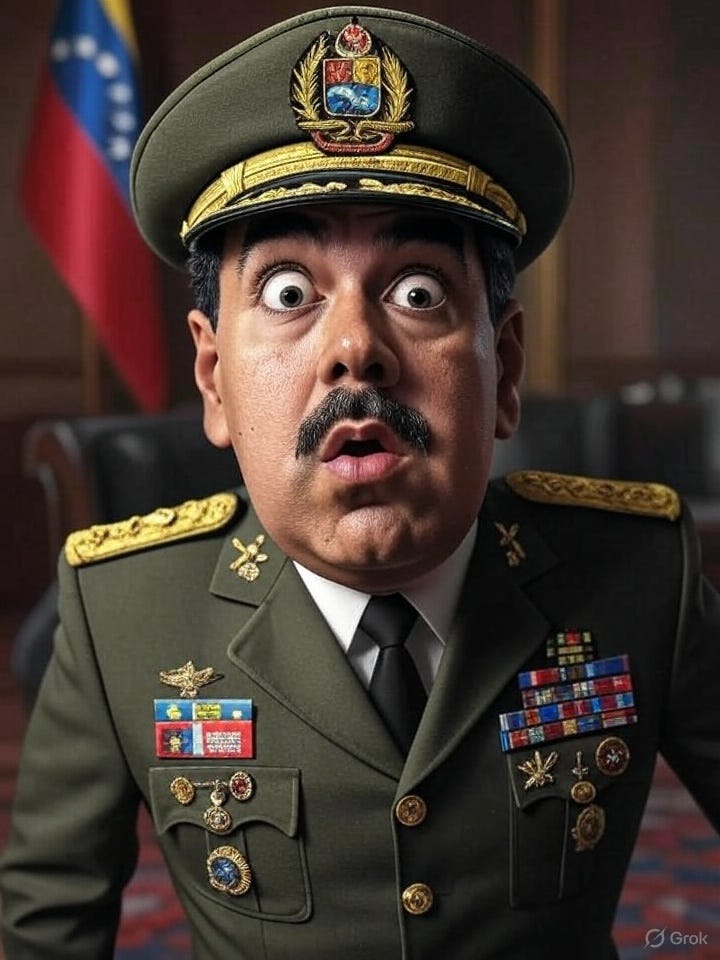
Now comes word that Trump has ordered our most advanced carrier group, the U.S.S. Gerald Ford, into the Caribbean. Considering that a Venezuelan F-16 already risked touching off hostilities by buzzing an American ship in international waters, one gets the feeling that we’re one moment of bad judgment away from hostilities.
But what could also be happening: Venezuelan opposition leader and Nobel Peace Prize-winner Maria Corina Machado could be rallying military dissenters for a native-led coup. And the U.S. is warning-off any nations with a mind to meddle (read: China, Russia, Maduro’s buddies in Iran, even Colombia).
If that’s the case, whatever is about to happen feels imminent. It’s not cheap to move assets like that across the globe. And taking the Gerald Ford out of circulation in the Mediterranean, where it was training with NATO allies, is a gamble — and currently represents the world’s largest naval deployment.
All this doesn’t appear lost on Maduro’s communist buddy in Colombia, President Gustavo Petro. Petro is suddenly getting very mouthy towards Trump, perhaps in an attempt to rally the international community to his side. Forget it. Nobody’s rushing to defend the narco capital of the world against an American carrier group.
This space has said it before: we are witnessing a transformation of the U.S. sphere of influence, a reassertion of the Monroe Doctrine. And whether one agrees with the strategy or not, Venezuela, Colombia, Cuba, Panama, Bolivia… all are in play. Trump’s clearly had enough of communist narco-terrorists visiting death upon American kids.
A salient question: Where does Maduro go, if the Venezuelans don’t send him to hell first? Who would want him? Recall, he’s under indictment by the DOJ for narco-trafficking. Any nation with a U.S. extradition-treaty is contractually bound to hand him over to us.
Our bet: Iran, or perhaps China — who provides the precursor chemicals for what has become Venezuela’s principal export.
Chicago Blues
So as Donald Trump continues to attempt to bring some law-and-order to Chicago, J.B. Pritzker continues his irresponsible, childish habit of calling Donald Trump and MAGA-world “Nazis.”
With that context, we offer just two points:
It was Pritzker who signed into law the SAFE-T Act, which adopted all the worst aspects of New York’s failed bail-reform laws;
And while Pritzker may duck the questioning like he’s a wiseguy on the stand, claiming as he does that Chicago’s murder rate is dropping each year, consider: Chicago finished 2024 with 573 murders — the first time the city recorded fewer than 600 murders in five year. Sounds great, right? Wrong. Chicago is less than 1/3 the size of NYC. At that rate, NYC would have over 1,800 murders.
New York City has not had 1,800 murders since 1993. You know — right before New York instituted all the broken-windows policing methods that things like the SAFE-T Act undoes.
Nazis, indeed.
And finally….

Sacre bleu! (For the record — they’ll get these perps eventually. But all the jewels? Non).