


Friends, this week will likely bring us the resolution in the Lindsay Clancy murder trial. This space has been as factual and agnostic on the outcome as possible. But now that it has gone to the jury… it’s time to take a position.
Now, the fact that a guilty verdict feels more like justice doesn’t mean it will go that way. As we’ve discussed, Massachusetts (ludicrously) puts the burden on the government to prove a defendant claiming insanity is actually sane. A hung jury is also always a possibility.
But we lead this week with another interview with John DePetro, New England crime reporter, who has been in court for the whole trial. He’s watched the jurors, the judge, and Lindsay herself. He’s also seen defense attorney Kevin Reddington in action for years, and gives us some inside baseball on the man (including that he apparently threatened to punch a Fox reporter!).
John, whose excellent and informed crime reporting can be found here, joined us on the Nightwatch to give final thoughts before we get a resolution in the case—whatever it may be.
And as you’ll see… we come to our own conclusions here.
So click below to join us! (Note: no firewall).

True Crime Girl: Four Missing Women and One House of Horrors
Were it not for the ongoing Lindsay Clancy trial, this writer feels certain that a case unfolding in Philadelphia would be dominating the true crime headlines.
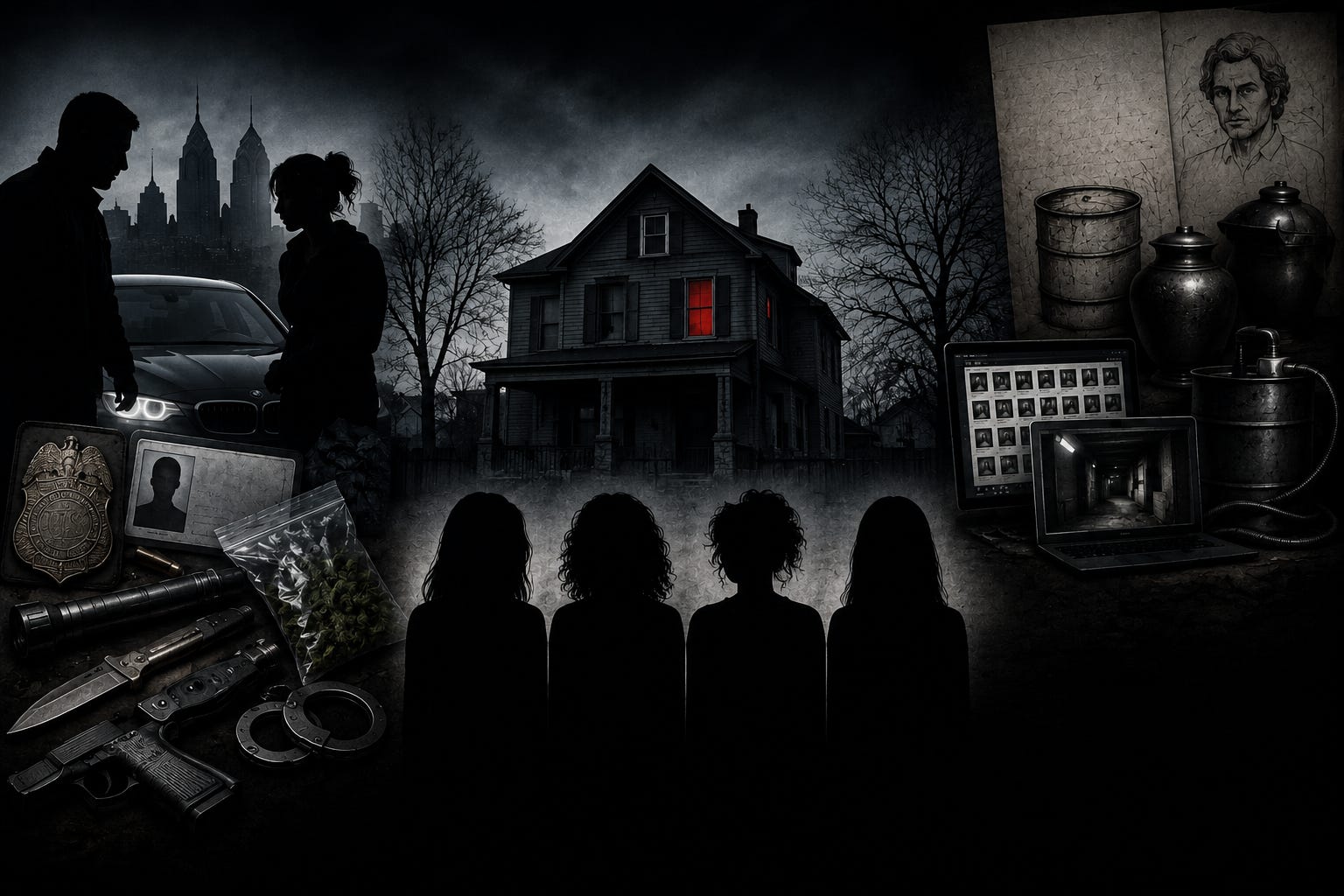
Most members of law enforcement eventually encounter a case that rattles them to the core. But for the officers who entered a house of horrors in the Olney section of Philadelphia, this may be a case that makes them question whether they chose the right profession.
On June 19, a U.S. Park Police Ranger approached a black BMW near Independence Hall in Philadelphia. As the ranger approached the vehicle, he reportedly heard an anguished woman inside say words to the effect of, “You’re going to hurt me.”
The man in the vehicle was 44-year-old Eugene Albert Horsch.
The Ranger saw indications of possible drug activity, and a search of the BMW turned up some truly disturbing contents, including:
A fake federal DEA credential bearing Horsch’s name and photograph
Cocaine, fentanyl and marijuana
A glass drug pipe
Switchblade knives
A collapsible baton
A cattle-prod-type device
Handcuffs
Two loaded firearms, including one with an obliterated serial number
Something tells me this Horsch guy was not exactly on his way to church. He also had prior felony convictions that prohibited him from possessing firearms.
And as if all of that wasn’t bad enough, the story somehow gets darker.
The woman who was with Horsch presented identification bearing the name Blair Tonzelli — a woman who had been reported missing in 2023. The woman reportedly told investigators that Horsch had given her the ID because she had outstanding warrants and did not want to use her real identification. She said she did not know Tonzelli.
That discovery helped lead investigators to Horsch’s home at 417 West Chew Avenue in Philadelphia’s Olney section.
What they found there transformed a bizarre gun-and-drug arrest into something far more disturbing.
Investigators recovered:
Another firearm, ammunition and gun parts
A large marijuana-growing operation
Additional fake federal credentials and materials that could be used to produce counterfeit IDs
Bank cards and additional identification connected to missing woman Blair Tonzelli
Numerous containers of unknown chemicals and oily substances
A 55-gallon drum connected to hoses and pipes
Five urns believed to contain cremated remains
Computers, hard drives and an enormous quantity of digital material
An unsigned handwritten document describing violence and referencing serial killer Ted Bundy
Authorities initially said more than 20 containers of unknown substances had been sent to a federal laboratory in Chicago for analysis. Subsequent reporting indicated that investigators ultimately sent about 50 containers of an oily substance for testing.
Then came another chilling revelation.
According to police records obtained by The Philadelphia Inquirer, a woman told investigators that Horsch had claimed to know which chemicals could be used to dissolve human remains — allegedly telling her that he knew three chemicals that could reduce a body to the point that the remains could be flushed down a toilet.
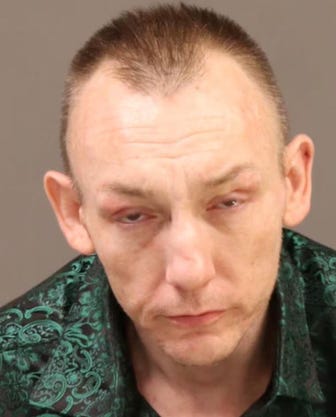
Investigators also learned more about Horsch’s father, Raymond Charles “R.C.” Horsch, who died in 2025 at age 82.
R.C. Horsch was an erotic photographer, filmmaker, and writer whose work frequently involved violent, sadomasochistic and serial-killer themes. He photographed and filmed women—including women struggling with addiction—in staged scenes depicting strangulation, drowning and other forms of violence and death.
In some of his writings, R. C. Horsch cultivated the persona of an “empathetic” serial killer who murdered addicts to end their suffering. He intentionally blurred the line between autobiography and fiction, leaving his audience to wonder what was real and what was fantasy.
That distinction has suddenly become extremely important.
Among the evidence recovered from the house was an unsigned handwritten document that referenced Ted Bundy and described an act of violence involving zip ties and a drum that had been prepared in advance.
Was it fiction or real?
And who wrote it?
Did R.C. Horsch’s life ever imitate his “art”… or did his son decide to take his father’s creepy fantasies to another level?
Those questions have become even more troubling because at least four missing women have now been connected in some fashion to the house or the Horsch family:
Gabrielle Amarando — Amarando disappeared in September 2012 at age 22. Investigators say digital material recovered from the house appears to show her alive inside the residence and, later, apparently deceased.
Amy McHale — McHale was R.C. Horsch’s ex-wife and disappeared in June 2016. She remained in contact with R.C. after their divorce. On June 13, 2016, she left her daughter a voicemail saying she was safe and at Horsch’s West Chew Avenue home. It was the last time her daughter heard from her.
Maribel Fresses — Fresses was 27 when she disappeared in 2018. As with Amarando, investigators say recovered images and videos appear to show her alive inside the house and later apparently deceased.
Blair Tonzelli — Tonzelli was reported missing in 2023. Her identity was used by the woman found with Eugene Horsch during the June 19 encounter, and investigators later recovered identification and financial materials connected to Tonzelli. A witness told police that Tonzelli had worked as a home health aide at the Horsch residence and may have had a dispute with Eugene over money. Tonzelli had also struggled with addiction.
What are the odds of four missing women being associated in some fashion with the same house and family?
A family that appears to have some strange interests (to say the least)?
Could this possibly be an extraordinarily unfortunate coincidence — or is something much more sinister behind it?
Investigators have not answered that question yet.
A federal grand jury has indicted Eugene Horsch on charges of possession of a firearm by a felon and possession of fraudulent federal identification documents and authentication features. He has at least 10 previous arrests involving allegations including drug dealing, drug possession, assault and DUI.
And Horsch has been in trouble at this same house before.
In 2013, police discovered approximately $1.9 million worth of marijuana inside the Chew Avenue residence. Horsch was ultimately sentenced to four to eight years in prison.
The current investigation, however, is on an entirely different level.
That said: at this writing, there have been no charges leveled against Horsch related to the missing women.
And there is another significant caveat. Forensic testing reported in July found no DNA belonging to the missing women inside the house, and material initially suspected of being blood later tested negative for blood.
But investigators still have an almost incomprehensible amount of evidence left to examine. Police said the digital material recovered includes:
600,000+ images
70,000+ videos
10,000+ pages of drawings, writings and manuscripts
As of the August 12 police update, investigators estimated that they had reviewed only about 5% to 7% of the material.
Think about that.
Investigators have barely scratched the surface, yet what they have already found has caused police to conclude that digital evidence appears to depict two long-missing women alive inside the house and later apparently dead.
Could this be just the tip of the iceberg of what occurred inside 417 West Chew Avenue?
Seasoned investigators appear stunned by what they have seen there.
And with hundreds of thousands of images and tens of thousands of videos still to be examined, this may be one of those cases where the most disturbing revelations are still to come.
Watch this space for any new developments. We’ll be tracking it.

Is the DOJ Building a Case Against Ilhan Omar?
Something is happening around Rep. Ilhan Omar.
The question is: How serious is it?
Vice President JD Vance provided the strongest indication yet in May, when he was directly asked whether Omar could face an indictment.
“I don’t want to prejudge an investigation,” Vance said, before adding: “We’re going to investigate it. We’re going to take a look at it. If we think that there’s a crime, we’re going to prosecute that crime.”
Then came the important part: “That’s something the Department of Justice is looking at right now.”
And before her fellow travelers leap to her defense: this case isn’t simply a Trump-era creation.
In January, The New York Times revealed that the investigation actually began under Joe Biden. According to the Times, the U.S. Attorney’s Office in Washington and DOJ’s Public Integrity Section opened an inquiry in June 2024. Prosecutors were reportedly examining three areas: Omar’s personal finances, campaign expenditures and interactions with a foreign national.
That investigation apparently stalled because investigators had not developed sufficient evidence.
But the story doesn’t seem to end there.
Vance’s comments suggest the Trump DOJ is taking another look—and perhaps looking in different places. So what case might prosecutors actually be pursuing?
Based on what has surfaced publicly, there appear to be three possible investigative tracks.
1. Financial and Campaign-Finance Issues
This is the most concrete avenue because we know DOJ was already investigating it.
The Biden-era inquiry reportedly examined Omar’s finances, campaign spending and dealings involving a foreign national. Meanwhile, Omar’s family finances have attracted separate congressional scrutiny. House Oversight Chairman James Comer has sought information concerning businesses partly owned by Omar’s husband, Timothy Mynett, following questions about their reported valuations.
That does not establish a crime. But financial investigations have an advantage for prosecutors: documents don’t forget. Bank records, tax returns, campaign expenditures, and corporate records can all be compared against one another.
And recall: after questions arose over her purported net worth, she filed a revised financial disclosure form that dropped her assets by nearly $30 million. Under her revised disclosure, she and her husband could actually have a negative net worth.
Omar refuses to address the discrepancy.
2. Immigration, Naturalization or Marriage Fraud
This is the avenue Vance himself emphasized.
Asked about a possible Omar indictment, Vance specifically referenced her marital history, saying: “You read the things about Ilhan Omar and about who she married and whether she didn’t marry this person or that person. It certainly seems like something fishy is there.”
The allegations are longstanding and remain unproven. Omar has repeatedly denied that she entered a fraudulent marriage.
There are, however, documented irregularities in her history. Minnesota campaign-finance authorities previously determined that Omar filed joint tax returns in 2014 and 2015 with Ahmed Hirsi when they were not legally married—and while Omar remained legally married to another man. That resulted in campaign-finance penalties, not a federal immigration prosecution.
The key question for DOJ would be considerably bigger: Was any marriage, immigration filing or other representation knowingly fraudulent—and can prosecutors prove it?
3. The Minnesota Fraud Investigations
Then there is the wild card: Minnesota’s enormous fraud scandal.
DOJ has dramatically intensified its investigation of fraud involving Minnesota government programs, including Feeding Our Future, Medicaid, and other federally funded programs. In May alone, DOJ announced charges against 15 people in alleged Medicaid schemes involving approximately $90 million.
The administration has also created a new National Fraud Enforcement Division, with additional federal prosecutors deployed to Minnesota. Federal officials have described the potential scale of Minnesota fraud as reaching into the billions.
Vance himself is leading the administration’s broader anti-fraud effort.
That makes these investigations potentially important context for Omar—but context is not evidence.
To be clear, there is currently no public evidence establishing that Omar personally participated in the Feeding Our Future fraud or the other Minnesota schemes. But if investigators uncover financial transfers, communications or other evidence connecting any public official to those schemes, the equation changes dramatically.
So far, while there are links between some of the accused and Omar’s campaign, these are tenuous and do not rise to the level of criminality. And the allegations that Omar passed legislation that relaxed oversight of the programs that were targeted for fraud is—at least so far—not enough.
At this point, this seems the weakest of the potential cases.
And Then There’s the HSI Agent
There is one more curious development.
On August 6, an undercover Homeland Security Investigations agent was discovered sitting outside Omar’s town hall in Richfield, Minnesota.
According to local reporting, a police officer became suspicious of the agent’s vehicle and discovered its license plates did not correspond to the vehicle. The woman initially identified herself as event security before eventually acknowledging that she was an undercover HSI agent.
She reportedly told police that she was conducting an unrelated drug investigation nearby.
Omar has demanded an explanation from HSI.
Maybe that’s exactly what it was. There is presently nothing public establishing that the agent was surveilling Omar or that the incident had anything to do with a DOJ investigation of Omar.
But given Vance’s public confirmation that DOJ is already looking at Omar, it is certainly an episode worth remembering.
And then this just in: Minneapolis police recently searched an apartment reportedly shared by Omar’s son, Adnan Hirsi, and his roommate, Abdulrahman Abdi. Abdi was arrested on a weapons charge after police reportedly recovered guns and ammunition from the apartment. Now, neither Hirsi nor Omar has been accused of wrongdoing in this incident. Still, amid the broader investigations surrounding Minnesota, it’s another development worth noting.
Because unless the Minneapolis police are not cooperating with the feds—a definite possibility in that town—this Abdi would be an extremely useful flip. And if he’s deportable, flip he very well might.
So What Happens Next?
Watch for the traditional signs that an investigation has become a criminal case: grand-jury subpoenas, compelled financial records, witness interviews, search warrants or a target letter.
Oh—and impassioned claims of political targeting, irrespective of the evidence.
Let’s recognize: an indictment of a sitting Democratic congresswoman would be politically explosive. And the fact that the underlying DOJ inquiry began during the Biden administration would complicate any attempt to dismiss the entire matter simply as Trump targeting a political opponent.
So the real question now isn’t whether Ilhan Omar is being investigated. We now know that she is.
The question is whether the Trump DOJ finds something the Biden DOJ didn’t.
This Week In History: An American Tradition Kicked Off With The Nation’s First Bank Robbery!
The first bank robbery in American history had everything: a spectacular heist, an innocent man thrown in jail, and a thief who pulled off the perfect crime—then made an almost unbelievably stupid mistake. More than 225 years later, the story of the Bank of Pennsylvania robbery feels surprisingly modern. And it all began with a humble locksmith named Patrick Lyon….
Click the image below for the full audio! (Caution: firewall).

And finally…
In the least shocking results of all time, researchers have published a study that finds a link between transgenderism and “left wing authoritarianism” and “violence.”
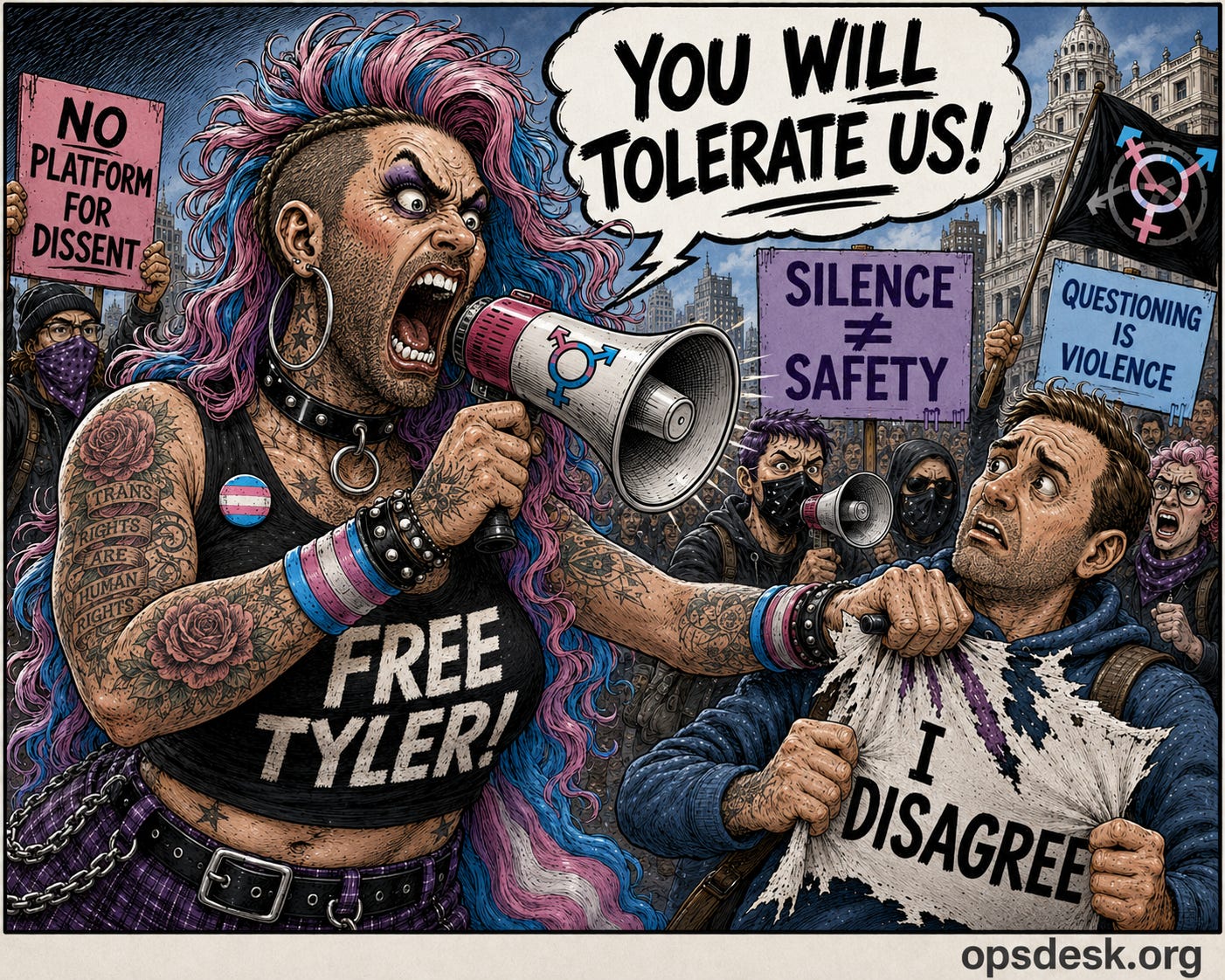
Reality. It can be just so… normative.

cant believe the clancy jury is looking hung. in a battle of the experts, the DA shud never hang her hat on just a one- on- one battle. the state can afford 3 experts , they shud hire 3 . . .or at least 2. also note the doc who testified for the people ? he looked like he was reading a lot of his testimony, , , JURIES DON'T LIKE THAT ! VERY AMATEURISH , AND IT UNDERMINED HIS CREDIBILTY,.... U HAFTA LOOK THE JURY IN THE EYE , FER GODSSAKES !!.
on the other case, this horsch animal. . grt. discussion, guys, btw . . . . but : . what a disgusting human specimen..... a total disgrace to men and mankind everywhere. those poor vics ! fake kudos to the late dad, the elder horsch, who obviously exposed his boy to all the wrong influences, ' art forms " and thought patterns. let's just hope this deft. perp doesn't hire the atty. who is doing the dance for 'wheelchair mom of the year' ms. clancy.