So at this writing, an Iran deal appears imminent. Will it hold?
More importantly: Will it matter?
First, let’s acknowledge something. If the intent of American foreign policy is indeed to prevent Iran from achieving nuclear status, then the Trump administration has taken the most realistic approach to dealing with Iran of any previous administration — full stop. Anyone who has in any way dealt with that nation, whether through the military, intelligence, or diplomatic prisms, knows their aim is to dominate the Mideast — and it’s primarily Israel and the U.S. that stands in their way. And only coercion works.
Now, for decades, Washington has searched for the magic formula that would finally stabilize the Middle East. We tried nation-building. We tried democracy promotion. We tried endless military deployments. We tried sanctions, aid packages, and diplomatic initiatives.
At this point: Is there a simpler approach? Perhaps.
First, at this point when we have Iran on the ropes and willing to accept a deal, we should seek to expand the Abraham Accords as broadly as possible. The most significant diplomatic breakthrough in the region during the last generation was not another peace conference. It was the recognition that shared economic interests, technology, security cooperation, and mutual concerns about Iran could bring former adversaries together. The Abraham Accords created a framework for normalization between Israel and Arab states that bypassed decades of diplomatic paralysis.
Expanding that framework to additional Gulf nations should be America’s top regional priority. The more countries invested in trade, investment, tourism, and security cooperation, the less attractive conflict becomes. (Note: The Trump administration has nodded to this; but as we’ve headed into the endgame of the deal, it seems to have fallen off the radar. Let’s hope it is being quietly pursued).
As the EU sought to do post-WW II, by linking the German and French economies so closely that war between them would become unthinkable… so, too, should the Abraham Accords be the goal. Sure, Gaza remains a problem. Sure, there are ancient and ongoing beefs. But this may be the first time in all our lifetimes that even the framework for some cooperation exists.
Second, America should ensure that not one barrel of oil necessary for U.S. energy security comes from the Middle East.
This is no longer a fantasy. The United States is now the world’s largest oil producer and, recently, the world’s largest oil exporter. We possess enormous reserves of oil and natural gas. Canada remains one of the most energy-rich and reliable partners on earth, despite some recent friction. Venezuela, despite years of dysfunction, is once again becoming a potential source of heavy crude for American refineries. South American nations like Guyana and Suriname offer newly significant oil fields, waiting to be further explored and commercialized.
The goal should not be isolation from the world. It should be insulation from instability.
That means, third: Pursuing an “all of the above” energy strategy. Produce American oil. Expand natural gas. Import from friendly neighbors when necessary. Build new nuclear plants aggressively. Encourage hydroelectric imports from Canada. Continue developing solar and wind where they make economic sense.
And for the greens: Emphasize a turn towards electric cars, allowing for the all-of-the-above approach to thereby power America’s beloved auto industry. Government fleets, for instance, could lead the way. Consider: electricity gleaned from abundant nuclear power could eventually power the NYPD’s roughly 10,000 vehicles, cutting emissions.
The point: Stop structuring American foreign policy around fear of energy disruption in distant deserts. This is now outdated thinking, thanks to American innovation and its abundant natural resource gifts. We have the technology, we have the available means. All we need now is the leadership.
Oil is a global commodity, and Middle Eastern turmoil will always affect world prices. But every step that reduces America’s direct dependence on that region gives Washington greater freedom of action and reduces the leverage of hostile actors. And were Israel and the major Gulf nations under the umbrella of even the possibility of the Abraham Accords, Israel — a nuclear power itself — is well-positioned to proceed with far less involvement from us.
The formula is straightforward: more Abraham Accord signatories, less energy dependence. Let the region prosper through commerce and cooperation while America secures its energy future at home and within our hemisphere.
And for anyone who thinks none of this energy will even be necessary: wise up. The data centers are coming. The AI revolution will continue. Quantum computing is imminent. We’ll need all this power to retain America’s preeminence, or watch hostile actors use versions of this exact formula to threaten us abroad and at home.
We are in an historic moment. Right now may be the closest we’ve been to a real exit strategy in the world’s most dysfunctional region, a region which has held us hostage to a resource we no longer need from them.
The time is now, if we only recognize it.
The Karmelo Anthony Case
So we have entered “fine people” territory on this case now — that is, where empirical reality is being reframed by politicians and media into a narrative they prefer to what actually happened. This time, I don’t sense it will work.
Let’s debunk a few lies currently being floated: First, it was not an “all-white jury.” It was in fact multi-ethnic, with Asians, Hispanics, and a mix of men and women. Those making all the noise about the jury now are exactly why the judge felt the jury needed to be sequestered.
Second, Anthony was not threatened, nor was he “surrounded.” Not only was all the testimony consistent on this — including the defense witnesses — but a videotape played at trial apparently bears this out.
Also consistent across all the witnesses: Karmelo was the provocateur, refusing to leave to the point that Austin Metcalf told him, “Dude, I’m not gonna fight you at a track meet.” This in response to Karmelo’s repeated warnings of, “y’all won’t do nothing” and “touch me and see what happens” — while his hand was on an opened pocket knife secreted in his backpack.
Unlike Jasmine Crockett’s preferred narrative, the knife, pictured below, was not a “Swiss Army knife.” According to the Medical Examiner’s report, it tore a two-inch gash in Metcalf’s chest, piercing viscera, bone, and the victim’s heart — with such force that it had bone fragments embedded on it.

Also uncontroverted: Karmelo stated numerous times after the incident, in way of explanation, that “he put his hands on me.”
Note that, now. He didn’t say, “He threatened to kill me.” He didn’t say, “I was terrified for my life.” No. “He put his hands on me.” A push — which was also borne out by all the testimony, including reportedly two black defense witnesses, teammates of Metcalf.
So let’s review these facts. Under Texas law, you cannot claim self-defense if you provoked the incident. Strike one.
Further, if you are threatened with force, your response must be objectively reasonable. The jury, quite rightly, found no version of the narrative that would justify what Karmelo did. It’s not even close. Strike two.
And perhaps strike three: despite evidence that seemed to cut against him at every turn, Karmelo elected not to take the stand. If there was any path to a successful self-defense strategy for Karmelo, this was likely it. It could’ve served to humanize him, perhaps elicit some sympathy or understanding — and perhaps have led to the lesser Manslaughter charge.
But after a reported three hour conference, Karmelo elected not to do that. Why?
As I stated this week on The Weekly Rap Sheet on Fox Nation, something about that, and about Karmelo’s actions here, is tugging at me. I’m getting feelings I haven’t gotten since I stopped running cases five years ago. Something is missing.
At this writing, we’ve heard next-to-nothing about Karmelo’s background, his life, his activities in the lead up to that day. Where are his social media posts? Was his phone dumped? Did he text anything relevant leading up to the incident? Was he potentially intoxicated? High? Trying to impress someone?
If the narrative of Karmelo we’ve been told is accurate — a good kid, never in trouble, did well in school, held down a job — why on Earth did he do it? Why did a kid from a good family, living a good life, with a promising future, bring a knife to a track meet, enter the opposing team’s tent with it, provoke an incident, and commit the violent murder of a stranger?
Maybe there isn’t any answer. Maybe it will remain a mystery. But I can’t help but feeling there’s a story there.
But to be clear: It’s an irrelevant story at this point. He’s convicted, and rightly so.
All that remains now is for some responsible black leader — Obama? Michelle? — to step up and tell those seeking to exploit the situation for their own purposes to knock it off.
Don’t hold your breath. It’s summer on Martha’s Vineyard, remember.
Knickerbocker Mayhem
I was in Montreal two weeks ago for a youth hockey tournament. The trip coincided with the Montreal Canadiens-Carolina Hurricanes playoff series. Not enough of a fan of either team to shell out for a ticket, we attended a watch party outside the Bell Centre in downtown Montreal.
The game was a bit of a letdown. Carolina was clearly the better team and spanked Les Habitants soundly. What surprised me was both the large police presence and the relative pacificity of the hockey-crazed Canadiens fans. The watch party and its aftermath were subdued and respectful.
That was not the case in New York, where Knicks fans were causing chaos in the streets after each game, but particularly after the Knicks were crowned NBA champions. The crowd around Madison Square Garden was a menagerie of clowns and convicts—people ripping down street signs, damaging vehicles, fighting each other, and fighting cops.

It pains me to watch such displays, partly because they reflect poorly on New York, but more significantly because they are embarrassing for the NYPD. Not to sound like an old fogey, but...well, I am. Back when the NYPD was bringing order to New York City, cops would not tolerate the behavior we’ve seen on the news and social media. If you acted blatantly disorderly in front of cops, you got put in handcuffs.
Street miscreants knew that and usually behaved—or at least had the courtesy not to act crazy right in front of the police.
Now all bets are off. A series of laws, court decisions, and weak leadership have defanged the police and made them ineffective at large gatherings.
In 2020, the City Council passed a law making it a misdemeanor for a cop to put pressure on the chest or diaphragm of a person being arrested. This scared the hell out of cops because it is almost impossible to arrest a resisting suspect without applying some pressure to the torso. The result is that officers are reluctant to put people on the ground, and it now takes half a dozen cops to make the most basic arrest.
Then came the post-George Floyd settlement that sharply restricted NYPD crowd-control tactics. The city created a byzantine four-tiered system that limits when specialized units can be deployed and makes large-scale crowd dispersals far more difficult. Instead of preventing disorder, cops are generally forced to wait until disorder is already underway before they can do a thing.
In addition, the vehemently anti-cop Civilian Complaint Review Board has expanded disciplinary powers.
Perhaps worst of all is Manhattan District Attorney Alvin Bragg. He is actively looking to prosecute cops for force he deems unnecessary. If a cop lands a punch in Manhattan, he or she can be sure Bragg’s minions will be looking to make a case.
These blows to NYPD effectiveness have brought us to where we are now. Cops stand by, unable or unwilling to stop criminal acts. They risk their safety, their jobs, and perhaps their freedom if they venture into a disorderly crowd to make an arrest.
And if they did collar some agitators, no doubt the same Alvin Bragg who would zealously prosecute a cop would drop the charges on the offender. What kind of justice is that?
These circumstances put cops behind the eight ball during crowd-control events. They cannot take a proactive approach and must essentially wait until things spiral out of control before even attempting to restore order. They can no longer corral crowds or conduct mass dispersals. Instead, they are playing whack-a-mole with offenders in a sea of people.
The architects of these “reforms” either fail to understand—or simply do not care—that it takes more force to restore order than it does to prevent disorder. That reality was evident yesterday as 63 people were arrested and numerous officers were injured.
Normal Knicks fans can no longer attend a watch party or celebrate an NBA title without concerns for their safety. These events have become places where shady characters and rabble-rousers thrive. In Montreal, I took my son to a playoff watch party and we had a great time. You couldn’t pay me to take him to a Knicks watch party. It’s a hard pass for anyone who values law and order—and their own safety.
A Lesson in Passing On Racism
Leaving a Dunkin’ Donuts several years ago, I held the door for the family exiting behind me. The father, a Black man, grabbed his son and pulled him away while exclaiming, “Don’t let that white man hold the door for you!”
Quite frankly, the incident shocked me. I was used to being the target of racist comments while working in the NYPD, but this was a coffee shop in New Jersey, and I was there with my family. It was a level of racism I had never encountered in my private life.
It points to a problem that was on full display this week during the Karmelo Anthony trial and its aftermath.
Anthony, a Black 17-year-old high school athlete, stabbed and killed a white student from another school at a track meet. The victim, Austin Metcalf, also 17, demanded Anthony leave his school’s tent. Anthony responded with a threatening remark, and when Metcalf pushed him, he retaliated by pulling a knife and plunging it into his chest, inflicting a fatal wound.
This week, Anthony was convicted of murder and sentenced to 35 years in prison. It was an open-and-shut case, with little doubt about his guilt regardless of the weak defense presented by his attorney. Anthony provoked the confrontation and answered a light shove with deadly force.
Lawyers on both sides said race had nothing to do with the case, but the actions of both families suggest otherwise.
The Anthony family’s racial grievances were on display throughout the proceedings. They hired Dominique Alexander, a race activist with several felony convictions (including child abuse), as their spokesman. Throughout the trial, Alexander and members of the Anthony family portrayed Austin Metcalf as responsible for his own death, as if murder is an appropriate response to a push. Claims of racism and bias filled the air after the verdict, with little pushback from much of the media. More than $600,000 was donated to Anthony’s defense fund, money the family reportedly used to rent a mansion. Donations continued even after the guilty verdict.
Unfortunately, these sentiments are not uncommon. They are not pervasive, but there remains deep racial resentment in segments of the Black community. Much of it stems from the legacy of slavery and discrimination, though similar resentments can be found in countries without America’s history, including the United Kingdom. Media coverage often worsens the problem by turning racially charged incidents into national spectacles.
On the Metcalf side, Austin’s father made racist comments of his own. He sarcastically referred to Anthony as a “watermelon felon” after the conviction and launched into a rant about absent Black fathers and the perceived shortcomings of parts of the Black community.
One has to wonder whether racial attitudes on both sides contributed to the confrontation between the two boys.
The United States has made enormous progress in overcoming the racist attitudes and institutions that once existed across much of the country. Yet some people refuse to see that progress or acknowledge it. They view nearly every conflict through the lens of race, whether race is relevant or not.
With that mindset, the country cannot be truly united. Rather than appeasing those who make baseless accusations of racism, we should challenge them. We should also stop rewarding media outlets that profit from inflaming racial tensions.
Several Founding Fathers, and some leaders after the Civil War, doubted that Black and white Americans could ever coexist peacefully. It is long past time to prove them wrong. Speaking out against unfounded claims of racism is a good place to start.
Weekly Pod: A Conversation With Crime Expert Rafael Mangual
Gang, join us this week for a no-holds barred discussion of the crime outlook in our cities — and who is to blame for it.
Are the numbers really getting better, as we’re being told? Are the police being “shadow-defunded”? Is there a reason even the NYPD can’t keep order after a simple basketball game? Are our blue cities — which is all our cities, over one million — ever going to return to former glory?
You’ll recognize Rafael from numerous media appearances, his writings for The Manhattan Institute (where he is a Fellow), the NY Post, and elsewhere. Paul and Rafael, both attorneys, last spoke when they testified to Congress together (and yes, there were some fireworks..!).
Everyone has an opinion on public safety. Rafael has the receipts.
So click below for a quick sizzle… and HERE for this week’s podcast!
True Crime Girl: What Is It With California And Mysterious Fires?

Spencer Pratt may have lost his bid for Los Angeles mayor, but judging by his latest video, he has no intention of fading quietly into the California sunset.
In his post-election message, Pratt declared that the campaign phase of his effort to “save Los Angeles” was over and that a new phase was beginning. His target wasn’t the election result itself. Instead, Pratt aimed squarely at what he described as the political machine that continues to run City Hall. He accused the city’s leadership class of protecting itself while Los Angeles struggles with homelessness, crime, public disorder, wildfire preparedness failures, and declining quality of life.
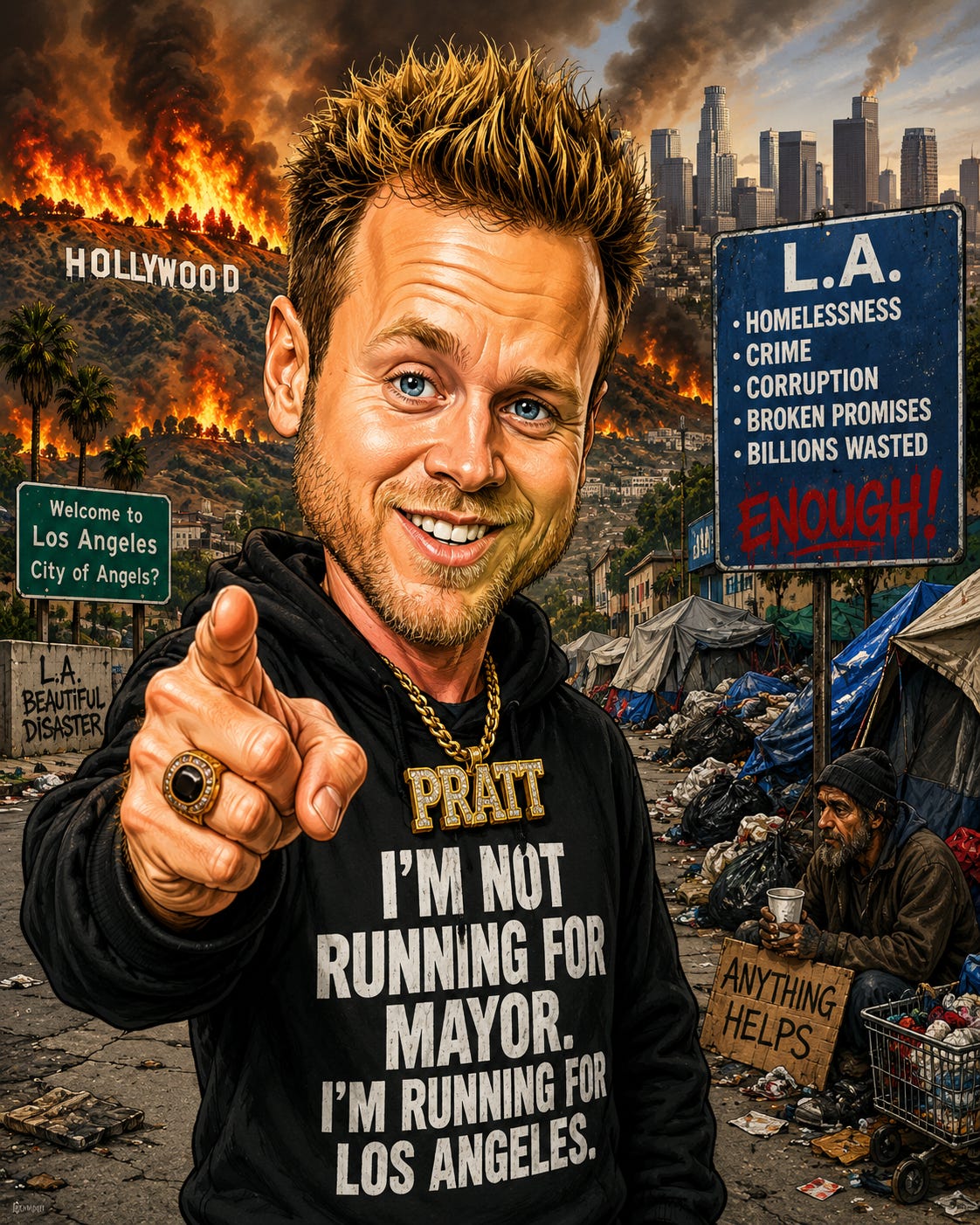
The most explosive part of the video wasn’t his criticism of Mayor Karen Bass or Councilmember Nithya Raman. It was his claim that someone connected to one of the remaining campaigns may have secretly recorded a candidate saying or doing something so damaging that it could force a resignation. Pratt suggested that either Bass or Raman should be asking themselves whether one of their own employees possesses such a recording. He has offered no evidence publicly, and neither campaign has responded to any specific allegation.
Whether Pratt is bluffing, exaggerating, or sitting on genuine evidence remains to be seen. But the accusation alone underscores the deep mistrust many Angelenos already have toward City Hall.
The larger question is what happens if another controversy emerges. Reports have circulated among Pratt supporters regarding a fire at an office associated with his political operation. If investigators were to determine that the blaze was intentionally set — the investigation is currently underway — public reaction would likely be swift and severe. Even voters who opposed Pratt politically would reasonably ask whether political intimidation played a role. There have also been allegations that ballot harvesters paid homeless people to register to vote and ballots for Pratt being rejected. Any confirmed act of arson connected to a political campaign would further erode public confidence in a city already suffering from low trust in government institutions.
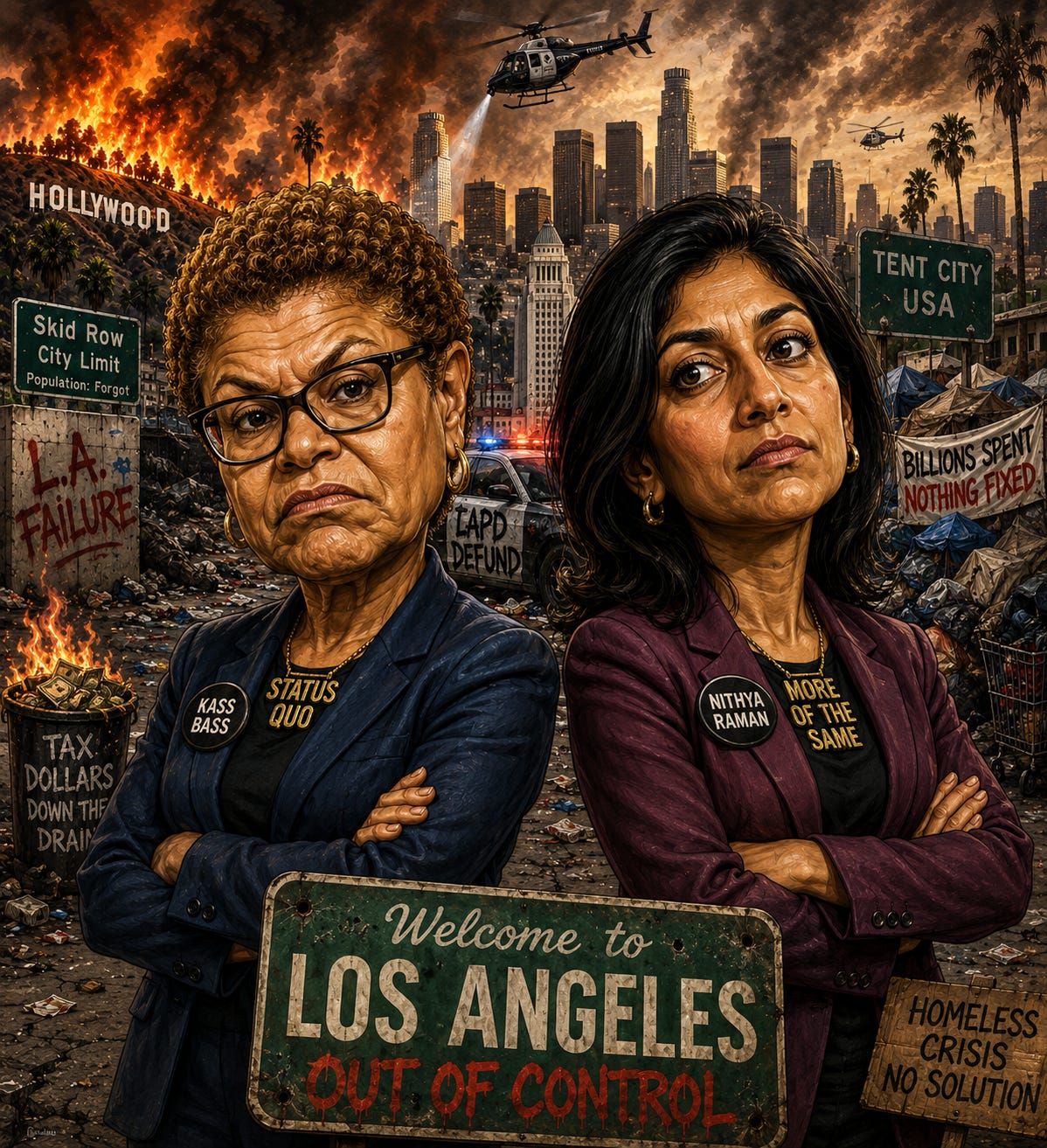
Pratt’s campaign was fueled by voters frustrated with the status quo. While he fell short of the runoff through late votes that seemed to arrive from nowhere, his message clearly resonated with a substantial portion of the electorate.
For now, Los Angeles appears headed toward a Bass-Raman showdown while Pratt promises to continue digging into what he calls a culture of corruption and insider protection.
The point? Even if the election is over for Spencer Pratt’s campaign, it isn’t over for Spencer Pratt.
That could be bad news for Bass or Raman — or both.
And hopefully: good news for Los Angeles.
From The Legal Desk
Updates: As feared, FISA Section 702 finally actually lapsed on June 12th. The good news: existing court approvals may keep parts of the surveillance system running for now. The bad news: Congress did not renew the authority going forward, and getting it fully back likely means passing a real reauthorization bill — not just issuing a memo or pretending nothing happened. Watch for lawsuits over whether the government can keep forcing phone and tech companies to cooperate under old approvals. But the fix is legislative. Mend it, don’t end it. It’s too important …
Ireland/Northern Ireland did, in fact, explode over migration last week as feared, with anti-immigration riots after a migrant knife attack - watch for a full “Law Wars” piece from us on this over the next few days. Is it a preview of what’s to come here in our blue cities? Stay tuned….
The ICC - The controversial war-crimes court America never joined - is now eating itself. Its lead prosecutor, Karim Khan, was suspended this week over sexual misconduct allegations – allegations of “non-consensual” relations with a “younger” staff member. Kahn was already sanctioned by the U.S. after his office pursued arrest warrants against Israeli leaders over Gaza, a move Washington says the court had no jurisdiction to make. Recall that New York’s Mayor Mamdani has said he would enforce that ICC warrant against Netanyahu if he came to the city (see “Law Wars” article on this here). Khan’s active cases in potential jeopardy - does this mean Netanyahu can come to the Knicks parade?
Things we’re watching: Washington: The Supreme Court is heading into the final crush of the term, with major rulings coming over the next two weeks. Birthright citizenship is the big one: Trump’s executive-order challenge could reshape the Fourteenth Amendment fight overnight. Also watch United States v. Hemani, the guns-and-drugs case over whether the government can disarm unlawful drug users, including marijuana users, under the Second Amendment… Bogotá: Colombia heads toward a June 21 presidential runoff, with a hardline law-and-order candidate facing Petro’s left-wing successor. Watch this one: crime, narco-politics, U.S. relations, and regional security are all on the ballot, and this could decide whether we wind up doing Colombia after Cuba… English Channel: The Russia sanctions war is moving from paper lists to ships. Britain just boarded a suspected Russian shadow-fleet tanker in the Channel - part of the aging, murky fleet used to move Russian oil around sanctions. If Europe keeps detaining ships and Ukraine keeps pushing to seize cargoes, the economic war will start looking a lot different - and not so great for Vladimir….
And finally…

We’re not much on election-result-denialism… but when Afghanistan’s last election was decided faster than California’s, there’s something wrong.
Maybe very wrong.