

One of the most important modern cases in the developing Anthony Fauci pardon controversy begins, improbably enough, with football legend Jim Brown.
In December 2020, Brown and his wife spoke by telephone with President Donald Trump about James Rosemond, a federal prisoner serving multiple life sentences. According to sworn declarations from the Browns, Trump told them that he had reviewed Rosemond’s case and wanted him released. They recalled Trump saying, among other things, “I want him home for Christmas.”
But Rosemond was never released. No written commutation warrant was ever issued. So, Rosemond went to federal court arguing that none was necessary because Trump had already commuted his sentence orally during the call.
In 2024, the Fourth Circuit Court of Appeals decided Rosemond v. Hudgins. Rosemond lost and he remained in prison, but the decision highlights numerous principles that could become extremely important if Dr. Fauci is indicted and raises the pardon as protection.
The Burden of Proof is on Fauci
A pardon is an affirmative defense. That means that the prosecutor can bring the case against Fauci and, as exemplified in the recent Rosemond case, it is Fauci’s obligation to raise and prove the existence and scope of the pardon. If he cannot prove that the pardon exists and that its scope covers his crime, then the pardon will not help him. The Court will most likely require that Fauci establish his right to the pardon by a preponderance of the evidence, meaning in sum that Fauci would have to prove that it is more likely than not that President Biden himself actually issued a pardon, and that the pardon covers the crimes alleged.
As detailed in a previous article, Dr. Fauci may have great difficulty relying on the pardon document itself because the written authorization was prepared through aides who were not present when Biden supposedly made the decision to pardon on January 19, 2025, and the final document was then signed by an aid using an autopen. The usual presumption of regularity should offer little help where the authorization process itself was admittedly irregular here and very poorly documented.
On the record as it stands now, there are no contemporaneous documents, memoranda, notes, or other records from the January 19, 2025 meeting establishing that President Biden actually ordered Fauci’s pardon or approved its scope. Nor has anyone who attended that meeting definitively testified under oath as to precisely what Biden ordered, if anything - with two of the participants invoking their Fifth Amendment right against self-incrimination.
Could someone from that meeting later change course and testify in an effort to rescue Fauci’s pardon? Of course. But Fauci would still face a tough row to hoe.
Fauci’s Tough Row
The scope of the written pardon is a particular problem for Fauci. What, specifically, did Joe Biden authorize? The written document purports to pardon Fauci for federal offenses arising from his government service all the way back to January 1, 2014, seven years before Biden became President, and through January 19, 2025. But where is the evidence that Biden himself selected or approved that extraordinarily broad eleven-year period?
The evidence surrounding the January 19 meeting does not tell us. The best firsthand testimony about what Biden actually said (assuming the President was actually there and meaningfully participated) points in a different direction.
Deputy Chief of Staff Bruce Reed, who alleges he was present when Biden made the Fauci decision, testified that Biden said he did not want Fauci and General Milley subjected to retaliation “for what they’d done while he was President.” That does not conclusively prove Biden intended a pardon limited to 2021 through 2025, but it is the clearest evidence presently available of the scope Biden himself may have had in mind, and it is difficult to reconcile with a written instrument reaching back to 2014. No testimony to date identifies Biden as ever approving that 2014 starting date. And Reed’s testimony points strongly in the opposite direction. So who supplied those additional seven years of protection for Fauci, and where is the evidence that Joe Biden ever authorized them?
Rosa Po, the staff aide who transmitted the final January 19 clemency summary for signature by the autopen, expressly listed January 1, 2014 as the starting date for the Biden family pardons. But the publicly released portion of her email does not show what she wrote about Fauci, so we do not yet know whether she listed that same 2014 date for him. The Congressional Report concludes that there are no contemporaneous notes or memoranda from the meeting itself. And The New York Times reported that the first written draft of Biden’s purported decision was prepared by another aide who, like Po, was not even in the room. That leaves the same basic question: who supplied the 2014 date for Fauci, and did Biden actually approve it?

And that leads to the next problem Dr. Fauci will face: the credibility of the witnesses he will need to establish that Biden actually authorized the pardon back to 2014. The January 19 meeting included five people: Bruce Reed, Steve Ricchetti, Ed Siskel, Annie Tomasini, and Anthony Bernal. All but Siskel were generally regarded as members of the small inner circle the Committee describes as Biden’s “Politburo,” a group of senior aides who helped conceal Biden’s mental state while increasingly managing the presidency.
These witnesses have a direct and significant credibility problem. They have every reason to insist that Biden was competent, understood the pardon, and personally authorized it. Any admission that he was confused, disengaged, not actually there, or not actually directing the process would strengthen the very allegation they have spent years denying: that the Politburo was exercising presidential power while concealing Biden’s decline.
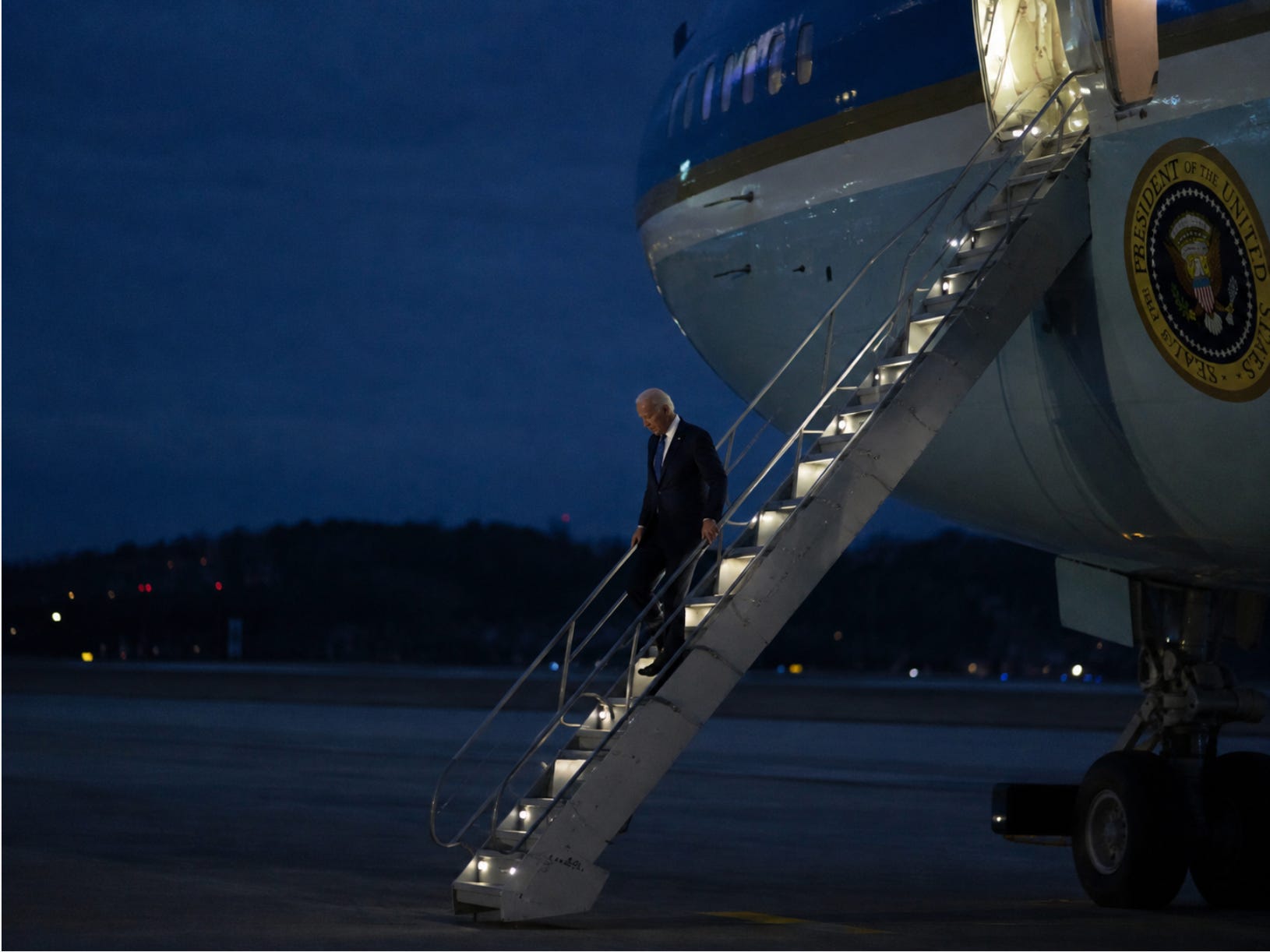
The timing of the January 19, 2025 meeting further raises questions. President Biden spent most of that day in South Carolina, leaving Washington at 8:52 a.m., attending church services and an event at the International African American Museum, and returning to the White House only at 6:47 p.m.
The President’s obvious cognitive deficiencies were widely known to worsen outside his best midday window, and travel made the problem worse. His overseas appearances made that unmistakable. Axios reported that his own aides considered him consistently reliable only until about 4 p.m. And The Washington Post reported that White House aides deliberately scheduled most high priority meetings and key events around midday, to avoid the problem. In his book Original Sin, based on interviews with more than 200 Democratic insiders, CNN’s Jake Tapper likewise reported that aides particularly avoided scheduling evening events after travel.
The chronology here places the January 19 meeting squarely in the evening. Biden did not return to the White House until 6:47 p.m., and the first written summary of the meeting was circulating shortly after 10 p.m. By then, he had already traveled and worked throughout the day. The administration’s account therefore requires believing that the 82-year-old Joe Biden, who any nonpartisan observer would reasonably conclude had difficulty coping with the ordinary demands of life, remained alert enough late that night to work through the details and scope of Dr. Fauci’s extraordinary pardon. That is very difficult to square with what the world watched throughout his presidency.
What were the President’s Exact Words?
The recent Rosemond case makes a couple of additional points very clear. First, a presidential pardon does not have to be in writing. That matters here because, as noted above, there are real evidentiary problems with the document on file. Second, the exact words spoken by a President concerning clemency can be crucial. In Rosemond, the analysis turned on the precise meaning of President Trump’s words, “I want to do this,” “I’m gonna do it,” and “Let’s get this guy home for Christmas.” The issue was whether those statements constituted a completed exercise of clemency or merely an intention to grant it. A man’s liberty hung in the balance. The Court concluded that Trump’s words did not amount to a completed grant of clemency.
The critical question for Fauci therefore becomes: What, exactly, did Joe Biden say in that meeting?
Did Biden actually say, “I pardon Anthony Fauci back to 2014”? Did he expressly approve a pardon covering eleven years of Fauci’s government service? Or did he simply agree that Fauci should be protected for the period Biden was in office, as Bruce Reed’s testimony suggests? As Rosemond demonstrates, those distinctions matter because the pardon power belongs to the President alone. Staff can carry out his specific decision, but they cannot make that Constitutional decision for him, nor can they expand the scope of a pardon on their own.
Testimony about Biden’s statements prior to January 19 does not help resolve the issue. Ron Klain testified that Biden told him in mid-December 2024 that he was “going to pardon Fauci and Milley and the Jan. 6 Committee and their staff.” Under Rosemond, that is evidence of an intention to pardon. It does not establish that Biden actually granted the pardon, much less that he approved its eleven-year scope.
Mike Donilon’s testimony goes somewhat further. He recalled attending an earlier, undated meeting at which President Biden heard the arguments concerning Fauci and then “made the decision to pardon.” But Donilon’s testimony sits uneasily with Reed and Zients’s account that the operative decision was made at the January 19, 2025 meeting. More importantly, Donilon’s testimony does not address the scope of the pardon at all.
That leaves the January 19 meeting as the critical event. With no recording of the meeting and apparently no contemporaneous notes or memorandum, the issue may ultimately come down to the memories of the people who were in the room. And, as noted above, those memories so far have been difficult to obtain.
But even if those people start talking, unless the exact words were preserved in some yet undisclosed note, memorandum, or other record, it seems unlikely that anyone will now be able to authoritatively reconstruct precisely what Joe Biden said in that room. Even the recollection of the President himself, perhaps particularly the President himself, would seem of limited value when the dispute may turn on such specific language and details – and be subject to cross examination. Dr. Fauci’s predicament would indeed be bleak if Joe Biden’s memory of that meeting was his ace in the hole.
Courts Will Be Cautious
But will the DOJ pursue this? Congress appears focused on establishing contempt against Dr. Fauci for invoking the Fifth Amendment after receiving a pardon. They have sent a contempt referral to the Department of Justice asking them to consider bringing criminal charges. If DOJ acts on that referral, however, Fauci appears to have the stronger argument. He will likely contend, rightfully, that even with the federal pardon, he still faced possible state prosecution, something a federal pardon could not eliminate. Indeed, three states are already pursuing such avenues.
There is also a larger strategic problem for the DOJ. To prosecute Fauci for contempt based on his refusal to answer questions after the pardon, the government would effectively be arguing that the pardon was valid and eliminated his federal exposure. But once DOJ takes that position, the universe of available charges narrows dramatically. If, on the other hand, DOJ takes the position that the pardon was never validly granted, then a much broader range of potential offenses comes back into play, including any false statements Fauci may have made to Congress and any criminal conduct connected to the events surrounding the Wuhan lab, and their aftermath.
Ordinarily, courts are understandably reluctant to intrude upon the President’s exclusive clemency authority. They are equally reluctant to make the kind of fact intensive determinations that require reconstructing a President’s intent from incomplete records and conflicting memories. Courts generally prefer to accept official acts for what they appear to be.
But these are not ordinary circumstances. The underlying events involved the deaths of millions of people and transformed societies around the world. The controversy also arises against the backdrop of an administration whose senior aides spent years insisting that public appearances did not reflect President Biden’s true condition. And in the end, that may be the central irony of the Fauci pardon. The same inner circle that spent years insisting Biden was fully capable of exercising presidential power may now have to prove, in court and in extraordinary detail, that he actually exercised it here.
Yes. By all means. Let's prosecute a man who serves science and his government for decades. Intelligent people change their beliefs as new evidence comes to light. That's how the COVID response worked. But even as he tried to ward off the worst of an incompetent president, one who was told the risk months earlier but didn't care, he did what he could with the evidence at hand. Keep punching up.
So, if I read this correctly, it's a dog's breakfast. Conflicting accounts of the actual process of the decision made to pardon, an unclear description of the steps taken and by whom to execute this decision, wrapped up in obscurity on the legal mechanics behind the use of the autopen. This entire morass is shoved into a burlap sack of Biden's Alzheimer's. Got it.
Yeah... if this investigation lands on someone's desk, we'll know one indisputable fact:
Everyone at the DOJ despises that person! LOL