


We’re coming to you late this week due to the Easter holiday (and we hope you all had a great one!).
We start this week with what’s coming on the prosecution front for the purveyors of the eight years of lawfare against Donald Trump. Suffice to say — it’s not good news for them.
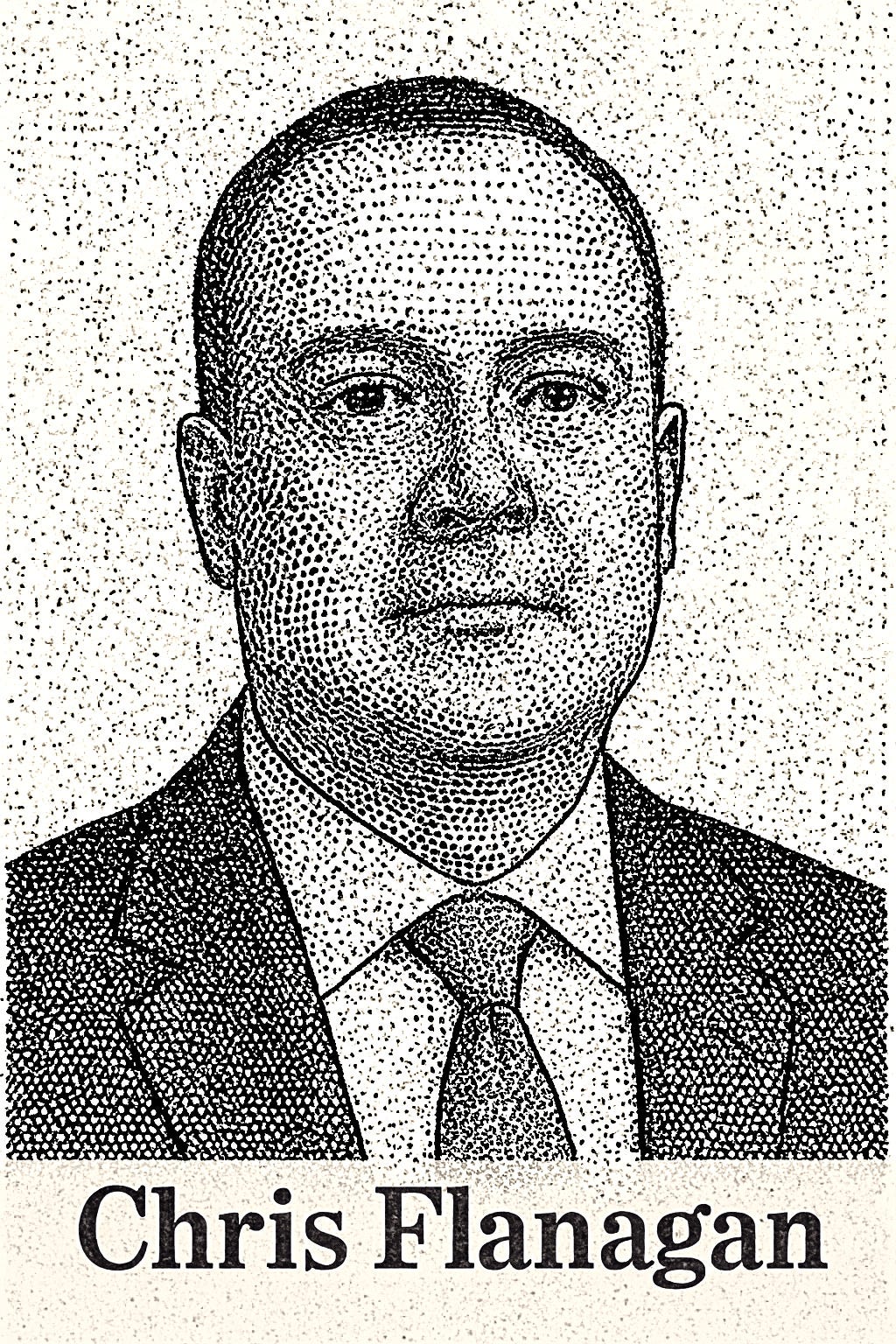
Chris then takes us through what could be the most impactful SCOTUS decision of our lifetimes, as well as short-takes on Kristy Noem’s, er, eccentric husband — and then, the tragic killing of NYPD Police Officer Jonathan Diller.
We finish with perhaps the most overlooked — and ongoing — immigration scam the Biden administration visited upon us. Will anything be done? Under a new AG?
And finally: Meet the AG candidate guaranteed to give Letitia James nightmares….
Here we go…!

The departure of Pam Bondi isn’t just another Beltway shakeup. It’s a signal flare.
Bondi didn’t fall because of policy differences or bureaucratic drift. She fell because the cases that mattered most—to Donald Trump—didn’t land. Specifically, the stalled or bungled prosecutorial efforts targeting James Comey, John Brennan, Letitia James, Adam Schiff, and others.
From Trump’s vantage point, these were not discretionary cases—they were cases designed to strike back at those Trump feels weaponized the criminal justice system against him (and he’s not wrong about that). Bondi’s failure to convert investigations into indictments—and indictments into convictions—was the one unforgivable sin for Trump 47.
So what comes next?
Expect a correction — and a sharp one.
The next Attorney General won’t be chosen for institutional stewardship or DOJ decorum. They’ll be selected for prosecutorial aggression, tolerance for political heat, and a willingness to run cases that sit at the edge of precedent. The mandate will be simple: assess the legal pressure campaign Trump faced—from Crossfire Hurricane to the post-presidency prosecutions at the state and federal levels—and figure out a way to make those responsible with they’d behaved more, well, responsibly.
Among the new AG’s first decisions: to decide on the two new criminal referrals re: NYS Attorney General Letitia James. James is far from out of the woods on her mortgage hijinks.
All this will mean a few things operationally. First, charging theories will broaden. Conspiracy, false statements, obstruction, civil rights violations—anything with a plausible hook will be explored. Expect creative uses of statutes we generally don’t hear in big media cases.
Second, tempo will increase. Grand juries won’t idle. Subpoenas will move faster. Arrest decisions—particularly in cases tied to intelligence community conduct or election-related investigations—will skew toward action over deliberation. Trump wants action — now.
Third, optics will matter. Public-facing enforcement—perp walks, early morning warrants, high-visibility filings—will be part of the strategy.
And last, expect more pressure on whoever the new AG is to keep DOJ in line — to clear out obstructionists hostile to the administration’s agenda.
The through-line here is symmetry. Trump believes lawfare was used against him not just to prosecute, but to de-legitimize and exhaust. The expectation now is reciprocity: that the same tools, intensity, and legal creativity be deployed against those he views as responsible. And to emphasize that what was done to him was unprecedented and illegal.
Now, whether all that survives judicial scrutiny is another matter. Federal courts are not political theaters, and aggressive charging without airtight evidence risks collapse—and backlash. Especially in light of the blue jurisdictions many of these cases might have to be brought in. And never mind the (seemingly ubiquitous) blue judges indifferent to being overturned on appeal when it comes to anything related to our current President.
But from our perspective, all that’s downstream. Upstream, the signal is clear: the next AG won’t be there to manage the Department of Justice.
He or she will be there to use it. Fast and hard.
Brace for impact — it’s coming….
What’s Going To Happen With Birthright Citizenship?
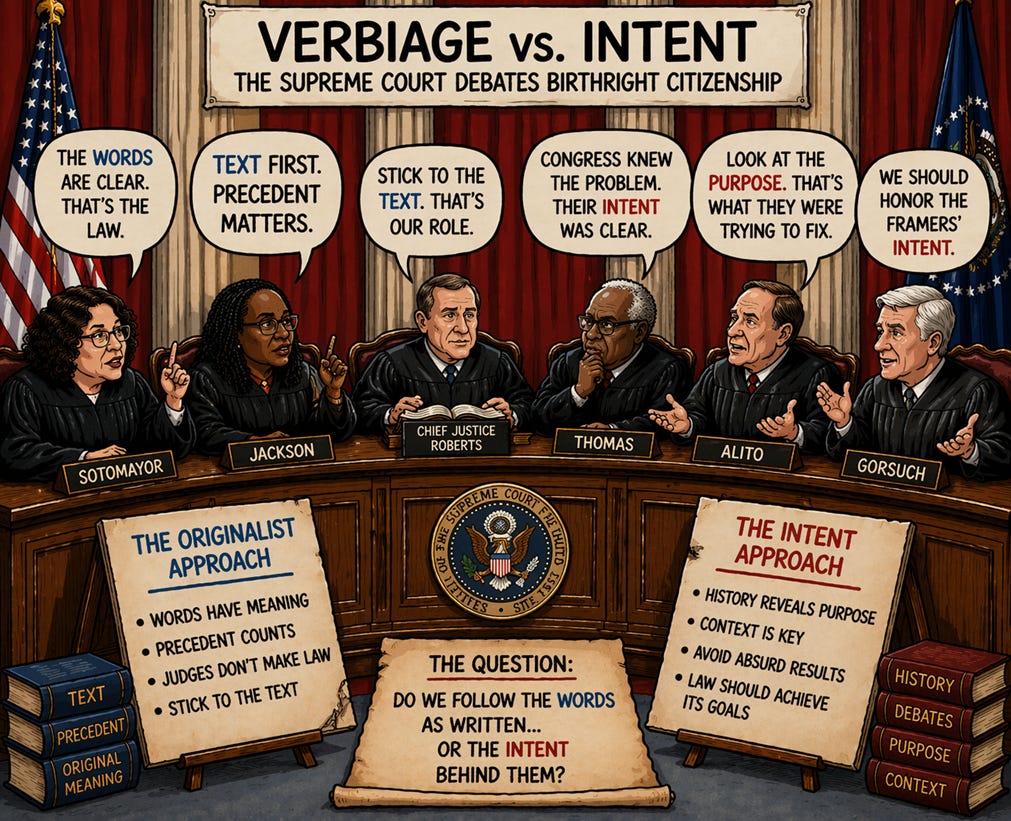
The most significant current case before the Supreme Court right now is Trump v. Barbara, addressing birthright citizenship. Oral arguments were heard April 1, with a decision expected early summer. It would be hard to conjure a more potentially explosive case.
The case examines Trump’s Executive Order 14160, which seeks to remove birthright citizenship for those born in the U.S. to illegal immigrants or to parents here on temporary visas. Lower courts struck down the order, but the Supreme Court will have the final say.
This raises questions about several authorities. The foundational legislation goes all the way back to The Civil Rights Act of 1866, which declared citizenship for those “not subject to any foreign power” — an ambiguous standard that was pointed at “temporary” immigrant labor then flooding the nation. This Act became the foundation of a constitutional amendment two years later.
That Amendment, the 14th (1868), provides that, “All persons born or naturalized in the United States, and subject to the jurisdiction thereof, are citizens….” Unfortunately, this amendment left some ambiguity in place; the phrase “subject to the jurisdiction thereof,” while clearly intended to grant citizenship to freed slaves, leaves its application to immigrants, who could theoretically be “subject” to another jurisdiction, less clear.
The debate has literally been going on since then; even Congress at the time was divided. Senator Jacob Howard (R-Mich) back then stated the Amendment would not include those born to foreigners or diplomats. Senator Lyman Trumbull (R-Ill) defined “jurisdiction” as not owing allegiance elsewhere—again, aimed largely at temporary immigrant labor.
Others disagreed. Senator John Conness (R-Calif) argued that children of all parentage born in the U.S. should be citizens. Thus, the legislative history reflects conflicting interpretations, even within a single political party.
The first major court challenge to all this came in a case called United States v. Wong Kim Ark (1898), in which the Supreme Court held that U.S.-born children of legal immigrants are citizens, even where the family has ties abroad (emphasis on legal). That precedent has been reaffirmed repeatedly.
Now that the Court must parse that precedent and the Amendment’s text relative to illegal immigrants, the question becomes: Will the individual Justices adhere to their respective interpretive philosophies — or vote their politics?
Will originalists like Clarence Thomas and Samuel Alito stick to a strict reading, or find flexibility to narrow birthright citizenship?
Conversely, will “living constitutionalists” like Sonia Sotomayor and Ketanji Brown Jackson embrace originalism if it supports their desired outcome?
Some may view modern immigration realities as requiring change—but that is for Congress. Given legislative dysfunction, the Justices may feel pressure to act in a certain way.
That would be a mistake. Originalists, in particular, must resist the temptation, and should ground their decision in interpreting original legislative intent. Liberal jurisprudence has often expanded government power by reshaping constitutional meaning; if originalists succumb to the temptation of abandoning their approach here, they risk undermining the entire originalist approach.
And basic rights depend on that approach—including those protected by the Second Amendment.
As such, the question of not only what the Court will do, but how it does it, actually enlarges the potential impact of what is already one of the major SCOTUS challenges of our lifetimes.
A Travesty of Justice in Queens
NYPD Officer Jonathan Diller was shot and killed on March 25, 2024. He and fellow officers responded to a 911 call and encountered two men in an illegally parked car.
Driver Lindy Jones and passenger Guy Rivera refused to comply and resisted officers attempting to open the doors. When Diller opened the passenger door, Rivera fired at point-blank range, striking him below his vest and causing a fatal wound. Diller disarmed Rivera before dying. Rivera then tried to shoot a Sergeant, but his gun jammed.
Both men were armed.
Rivera, a repeat offender with 21 prior arrests, had just been released from parole. Officers suspected the pair were about to commit a robbery. At the hospital, x-rays revealed Rivera had concealed a knife in his rectum—clearly intending to use it if arrested. He was not going back to prison.
Normally, killing a police officer triggers overwhelming public and legal response. Not here.
Last week, a Queens jury failed to convict Rivera of murder, instead returning a manslaughter verdict. This was unconscionable given the facts.
The defense argued the gun discharged during a struggle and lacked intent. They claimed Rivera would not knowingly shoot an officer because it would ensure his own death. But criminals often escalate confrontations, including “death by cop” scenarios. The concealed knife underscores Rivera’s mindset. Further, let’s not forget Rivera’s attempted killing of the Sergeant.
The defense also attacked police credibility, accusing officers of lying. The jury accepted it. I’ve seen juries buy such conspiracies before—especially those predisposed against police.
Ironically, the jury did convict Rivera of Attempted Murder for firing at the Sergeant—yet declined to hold him fully accountable for killing Diller. How this jury could attribute intent to the attempted shooting of the Sergeant, but not to the shooting of Diller, remains impossible to reconcile.
In a larger sense, the case reflects a broader anti-police sentiment. Many today instinctively side with offenders, malign officers, and undermine law enforcement. A verdict like this shows how prevalent that attitude has become. Even a single holdout could have forced a hung jury—but they chose Manslaughter.
They chose Manslaughter, we should recognize, after sending a note to the judge asking how long they were expected to continue deliberating (guess they had weekend plans).
Rivera, now 36, could be released in a few decades. Diller’s family will never see him again. That compounds the tragedy and delivers another blow to the NYPD — and to the morale of cops nationwide.
It’s remarkable anyone still chooses this profession. I loved being a cop. It’s hard to imagine many feel that way now.
Not the Noem Scandal We Expected
Weeks ago, we flagged concerns surrounding Kristi Noem—questionable deals, poor judgment, and possible improprieties. We criticized Donald Trump for retaining her, even in a marginal role as Special Envoy for the Shield of the Americas.
We were right—but not for the reasons we expected.
Noem’s husband has reportedly engaged in bizarre online behavior, including drag performances tied to unusual fetishes. Beyond the spectacle, this situation presents a national security risk and potential blackmail exposure.
That cannot stand.

Noem may not have known—but the optics are damaging. Trump — who reportedly was unaware of Noem’s husband’s predilections — should have acted before congressional scrutiny intensified.
Whatever the Special Envoy for the Shield of the Americas job entails: either Trump should cut Noem from the team for good, or Noem needs to quit the charade, divorce her husband, and make things with Corey Lewandowski official.
The current situation is, at best, unbecoming; at worst, dangerous.
From The Legal Desk

The Border Is Closed — But The Scam Continues
Examinations of the failed Biden border policies have generally focused on illegal crossings, encounters, and enforcement, but that focus obscures a central reality: A large portion of the migrant surge came into the United States through federal parole programs that required sponsorship as a condition of entry.
Put simply: sponsors here in America essentially invited them in.
Now as we all know, during the Biden administration the unauthorized population rose by at least 13 million people in the United States. Hundreds of thousands of this number entered through sponsorship programs like the Cuba, Haiti, Nicaragua, Venezuela (“CHNV”) program, which required migrants to secure U.S.-based sponsors before being permitted to travel into the country.
The Biden administration pushed these programs because it helped to decrease the amount of “border encounters” they had to report – all in an attempt to give America the false impression that the Administration was slowing the process.
For their part, sponsors were expected to ensure financial stability for migrants by providing housing, food, and basic support, thereby allowing the federal government to shift responsibility away from public systems and onto private actors. Sounds like a reasonable plan, right?
Not so fast. In practice those sponsors were often institutional networks, particularly faith-based organizations such as Catholic Charities USA, which have long played a major role in migrant resettlement and placement at scale. Perhaps due to this, the Biden administration failed to vet the sponsors in any meaningful way. They were just names on a piece of paper. In some cases, the oversight was so bad, the illegal aliens were sponsoring each other.
Now, these were not passive failures. In an effort to accelerate releases, the Biden administration waived fingerprint requirements and suspended background checks for sponsors, significantly weakening the very safeguards that were supposed to ensure migrants would be placed in stable and supportive environments.
The results were predictable — and we’re living with them now. There has been little meaningful follow-up to verify that sponsors actually fulfilled their obligations — or even exist — leaving open the question of whether the promised financial support was ever there to begin with.
And so at this writing millions of migrants remain in temporary or “liminal” status, with as many as four million lacking durable legal footing. Cities such as New York and Chicago have been forced to absorb enormous costs for housing, shelter, and basic services. Those costs were never intended to fall on local governments or taxpayers, yet that is precisely where the burden has landed.
The sponsorship system was the mechanism that caused this situation. And so the question now is: Who were these “sponsors,” and how purposeful were their misrepresentations?
This needs to be examined. With a new AG incoming, the Trump administration should identify exactly who these sponsors were, especially those operating at-scale, and force them to live up to their obligations. Because until that question is answered, we won’t fully understand who helped create yet another Biden-era mess we are now all paying for.
That mess that has flown under the radar far too long.
This Week’s Pod: Letitia James’ Challenger, Saritha Komatireddy
If there is one major Democrat politico vulnerable to challenge in New York State this year, it is the execrable Letitia James, who is to law enforcement what a screen door is to a submarine.
Meet Saritha Komatireddy, former U.S. Attorney, former Chief of Staff at the DEA, and Republican challenger to Letitia James for the position of Attorney General of New York. Now full disclosure, this writer had a significant case with Saritha. I can confirm, as the saying goes, that she’s forgotten more about law enforcement than Letitia James ever knew.
Add to this the fact that James faces two new criminal referrals — one to Florida, one to Illinois — over her alleged mortgage machinations, and you have an AG race that is looking like anything but a slam dunk.
But why Saritha? What will she do about fraud? New York’s sanctuary policies? Criminal statutes that the likes of Alvin Bragg have chosen to ignore?
Join us for a conversation where Saritha faces these questions head-on, with no equivocating. A refreshing take from a candidate for public office.
So meet Saritha Komatireddy, candidate for New York State Attorney General. Click below for the sizzle, or HERE for this week’s pod.
And finally….
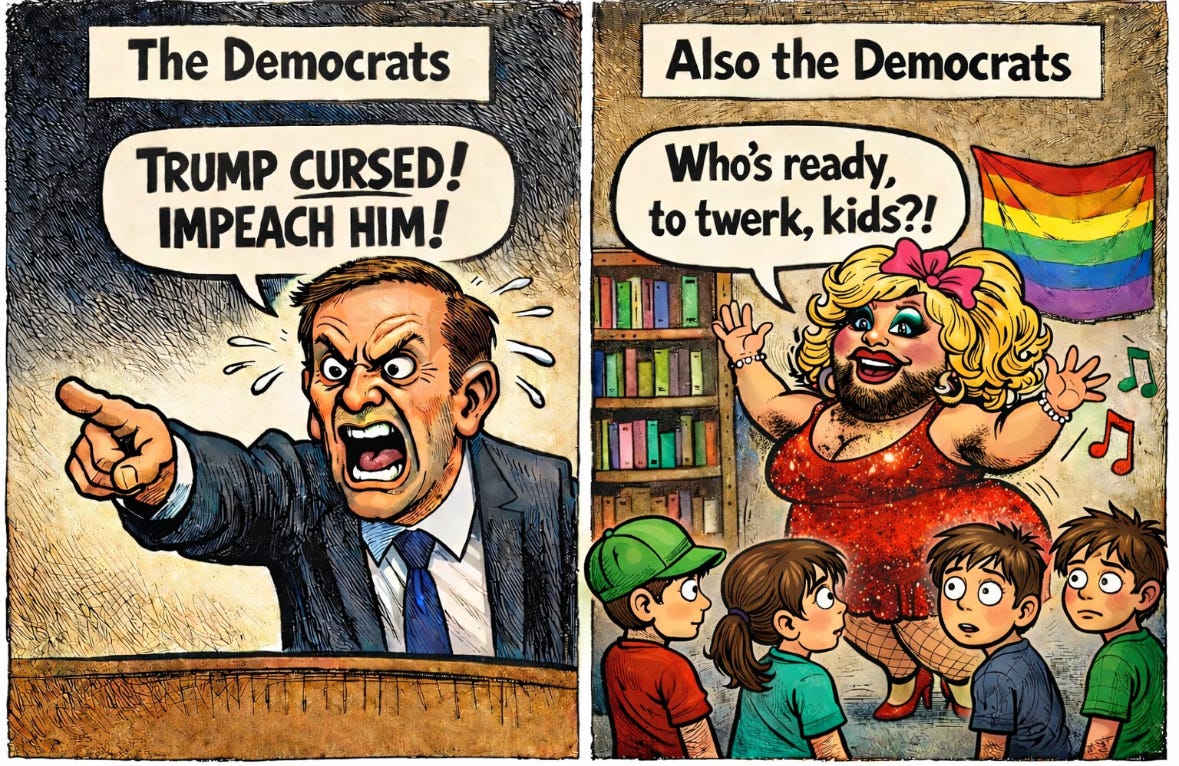
Sure, we’d prefer Donald Trump had not used the “f-word” in his latest ultimatum to the mullahs in Iran. But in light of the left’s response… let’s keep some perspective, shall we?
Priorities.

The verdict in the Officer Jonathan Diller case is an insult, and yes, the policing profession is in trouble. Several solid police and public safety bills have been introduced this session that could help change the trajectory policing is on, yet most continue to languish in Committee.
We need more people to contact their federal lawmakers, asking them to support these bills.
https://fortheblue.substack.com/p/writers-wanted-help-advance-police
Let’s be blunt—this is about restoring balance to a system that lost it. When lawfare becomes a political weapon, the only way to stop it is to turn the machinery back on the people who abused it. That’s not vengeance—that’s deterrence. Expect aggressive prosecutions, broader legal theories, and zero patience for the old “nothing to see here” routine. The next AG won’t ask permission—they’ll test limits. And yes, that makes the establishment nervous. Good. It should. Because if the rule of law only runs one way, it’s not law—it’s control. And Trump is done being controlled.