

Friends, if you want to know what America’s future under socialism might look like, you don’t need to look to Cuba, Venezuela, or the failing capitals of Western Europe.
Just take the subway in New York City.

Under Mayor Zohran Mamdani, New York has become the proving ground for America’s latest flirtation with socialism. And we’re already seeing what happens when ideological fantasies collide with reality.
The early results aren’t encouraging. Particularly when it comes to public safety.
In just the past week, Mamdani has announced two sweeping changes: the dismantling of the NYPD’s Strategic Response Group (SRG), and a plan to close Rikers Island and replace it with dramatically fewer jail beds.
The impact won’t be immediate (Mamdani conveniently pushed the Rikers plan to 2032). But the implications are enormous—as they will be if the DSA brings this agenda to your town.
Some background: The SRG was created in 2015 as a specialized police unit responding to major emergencies, violent demonstrations, and civil disorder. Anyone who witnessed the 2020 George Floyd riots understands why. Protests deteriorated into widespread looting, assaults, and destruction. Think of the 2020 Summer of Love as the DSA’s origin story.
Yet despite the SRG responding to only about 6% of NYC protests, Mamdani has eliminated it, replacing its protest-management responsibilities with an alphabet soup of units, including something called the “Community Dialogue and De-escalation Division.”
Yes, really. A civilian-led operation without weapons or arrest powers.
And if that sounds like Mamdani—arrested at least twice by the SRG himself—is simply handing out jobs to his fellow travelers… he is.
Now, the roughly 500 SRG officers will be reassigned, and Police Commissioner Jessica Tisch insists public safety won’t suffer.
Well… we’ll see. Mamdani seems to believe recruiting fellow activists into an “engagement” unit will keep protesters in line. But given that activist groups derive significant status from fighting the police and revenue from suing them… color us skeptical.
Then there’s Rikers Island. Mamdani plans to shutter the notorious jail complex by 2032, replacing it with four smaller borough facilities.
Nobody disputes Rikers has serious problems. But the solution to a badly managed jail isn’t eliminating thousands of beds—especially when thousands still need incarceration. By the numbers, New York’s jail population is approximately 6,600. The replacement system will only accommodate 4,160 inmates, plus 340 specialized therapeutic beds. That’s 4,500 total.
So do the math. The city must somehow reduce its jail population by more than 2,000. By roughly one-third.
And all this comes as New York has largely abandoned quality-of-life enforcement. The broken-windows philosophy that rescued the city from its crime-ridden past has been discarded over tortured theories of “institutional bias.” Fare evasion, aggressive disorderly conduct, public drug use, and shoplifting are barely enforced against. Cops are cowed from proactive policing.
So essentially: we don’t lock up many people here as it is. We’re now going to go down by a third?
The administration’s answer to this is to promise faster court proceedings, diversion programs, and alternatives to detention.
More nonsense. That canard has been floated before. It never works. It’s never really attempted.
So the question remains: What happens if the jail population doesn’t fall as promised?
Where do those without jail beds go?
Into our neighborhoods. Onto our streets. And inevitably, into New York’s subway system.
And it gets better.
According to a New York Post report, Mamdani also wants to expand a program paying families $500 monthly to house relatives returning from jail. The program would grow from 50 to 300 families, eventually costing $7.1 million annually.
Sensing another blue-city money pit?
New York proposes spending billions constructing smaller jails, millions housing former inmates, and hundreds of millions on additional services—all while reducing incarceration capacity. The replacement jails alone are expected to cost at least $16 billion—more than twice the original estimate (New York has a cost overrun? Shocker!).
Meanwhile, taxes rise steadily to subsidize this madness.
Now, understand: the victims of all this won’t be wealthy progressives living behind doormen or city commissioners with protection details. They’re working-class New Yorkers dependent on public transportation, living in vulnerable neighborhoods, unable to move somewhere safer.
And disproportionately: women.
So friends… all this can be yours when socialism comes to town!
Because while socialism promises compassion, government services, redistribution, and attention to the supposedly “oppressed,” it’s politicians like Mamdani—who has never held a real job—deciding where your money goes. And their lack of practical experience and obsession with giveaways is limitless. Is it any wonder that New York State already leads the nation in population loss by percentage? Only California loses more people in raw numbers.
None of that seems to matter to our enlightened leaders.
Friends, New York isn’t some isolated political curiosity. It’s America’s largest city, still its financial capital, and an enormously influential political center. Policies pioneered here migrate elsewhere.
So consider this a heads-up. Watch NYC closely. Mamdani’s DSA experiment will likely be measured in frightened commuters, deteriorating neighborhoods, departing businesses, and victims who discover government sympathy for offenders exceeds its concern for everyone else. Because when government stops enforcing the rules, the streets eventually make their own.
And if New York is America’s socialist laboratory, the rest of the country had better be paying close attention to the results.
Before America sleepwalks into a future as bleak as New York’s is starting to look.
We Get The Police We Deserve
The New York City Police Department has a problem. Actually, several. And while city officials celebrate rising recruitment numbers, disturbing revelations suggest the department may be trading quality for quantity.
For decades, the NYPD attracted thousands of applicants competing for relatively few positions. Becoming a New York City cop was a coveted opportunity, offering job security, competitive benefits, and the prestige of joining one of the world’s most respected police departments.
Are those days ending?
And is the recent murder of Katie Suarez a sign of things to come?
Some history: In March 2025, Police Commissioner Jessica Tisch acknowledged that the NYPD was experiencing a hiring crisis. Staffing had fallen from approximately 37,000 officers to 33,000. The problem wasn’t funding. The department simply wasn’t attracting enough qualified applicants.
Then came July 2025, when revelations emerged that 31 officers had been hired despite records that should have disqualified them. Recruited in 2023 and 2024, their histories included arrests, drug use, serious driving violations, dishonesty on applications, and failed psychological evaluations.
Remember that last part.
It emerged that the Police Academy’s commanding officer had allegedly overridden disqualifications to admit the recruits. He was reassigned and subsequently faced departmental charges.
The NYPD then moved to fire the officers, but the police union challenged the dismissals. In December 2025, a settlement allowed them to remain, subject to an extended three-year probationary period. The department could also consider their original psychological disqualifications in future disciplinary proceedings.
In other words, 31 officers the department determined had been improperly hired were allowed to remain cops.
Now comes the widely reported October 30 stabbing murder of 28-year-old Katie Suarez, who was jogging along Brooklyn’s Shore Parkway Greenway.
Prosecutors have charged 27-year-old former NYPD officer Sayed Mohassib with the crime. And his history raises further questions about the NYPD’s psychological screening.
Mohassib spent less than a year with the department, completing the Academy and serving roughly a month on the street before leaving to join the United States Marine Corps.
His Marine career was even shorter. He was discharged after less than a month, reportedly over psychological concerns.
So Mohassib passed NYPD psychological screening, received a gun and shield, and graduated from the Academy—but the Marines apparently spotted his issues inside a month?
Mohassib then attempted to rejoin the NYPD in 2023. This time, supervisors became concerned about his behavior, and he was taken to Bellevue Hospital for evaluation. He was not rehired.
But why was he even considered, given his Marine discharge? A discharge involving serious psychological concerns should have triggered immediate disqualification.
More troubling, Mohassib’s mother has recently described in media reports a history of psychiatric hospitalizations, including one lasting approximately two months.
Were those hospitalizations disclosed or discovered during his original NYPD screening? Did nobody recognize even a potential problem?
Understand that had they done so, the department would have sought Mohassib’s consent to obtain relevant prior medical and psychological records before appointing him.
And he likely would never have become a cop.
Now, psychology isn’t an exact science. Understood. But Mohassib seems to have had more red flags than the Chinese military.
So how could all this happen?
One possible clue comes from an August 2025 investigation by City & State New York, which revealed that the NYPD had been using psychological assessors lacking state licenses or permits.
The investigation found that 55 of 74 individuals performing assessments over the preceding decade lacked those credentials. At publication, six of the department’s 14 assessment personnel were reportedly unlicensed and unpermitted.
The NYPD defended the practice, citing a legal exemption and asserting that the assessors received appropriate supervision.
So they lacked conventional professional credentials, but at least they were supervised?
Granted, New York’s institutional failures don’t end with the NYPD. Despite his history with the police department and Marines, Mohassib was subsequently hired as a paraprofessional at a Brooklyn public elementary school.
You read that right. He was hired to work with kids.
But at least that job didn’t come with a gun, training, and the authority of the state.
Let’s recognize that Mohassib’s admittance to the NYPD didn’t occur in a vacuum. Nor did the admittance of 31 candidates who should have been disqualified.
The NYPD’s recruitment and retention issues stem from the swing back to the “defund” movement, and the vilification of the profession from the progressive left. Because cops don’t take “the Job” because of the money, that’s for sure. In the vast majority of instances, they take it because they believe in the work.
Now add to all this the increasing anti-police fervor in New York City under the DSA and Mayor Mamdani… and it’s not hard to see where all this could go.
Here in New York, and across the nation.
When fewer qualified people apply, the pressure to fill vacancies doesn’t disappear. The temptation will be to lower standards, overlook warning signs, and put people in uniform who shouldn’t be.
That’s how a recruitment crisis becomes a public-safety crisis—and breaks trust with a city.
New York doesn’t need the NYPD defunded. It needs more cops.
But above all, it needs qualified cops
As City Hall works to make the job increasingly unattractive, the pressure will build on NYPD to compromise the standards for recruits. And the ultimate victims won’t be the politicians, but the New Yorkers who depend on those officers to protect them.
New York: you’ve been warned.
NIGHTWATCH: A Conversation with Alan Dershowitz And Rich Staropoli
So what case is the DOJ very likely to make in 2027 that could create major political drama? Or is it just more lawfare, as some will claim?
And why won’t some bookstores stock Alan’s new book?
Paul talks again with Alan Dershowitz, counselor extraordinaire, on this and other issues that the nation faces. As a nation of laws, the lawyers matter--like it or not. And Alan is undeniably one of the best constitutional and litigation attorneys out there. Here’s a guy who sees what’s going on, and sees it clearly.
Then friend of Nightwatch Rich Staropoli, former U.S. Secret Service supervisory agent, comes in for his assessment of pretty much everything. His inside baseball on Hillary is alone worth the price of admission….
So join us by clicking below! (no firewall).
(And you can find Dersh's new book, Why I Quit the Dems, And So Should You on Amazon HERE (because you may not be able to find it elsewhere...).
And finally…
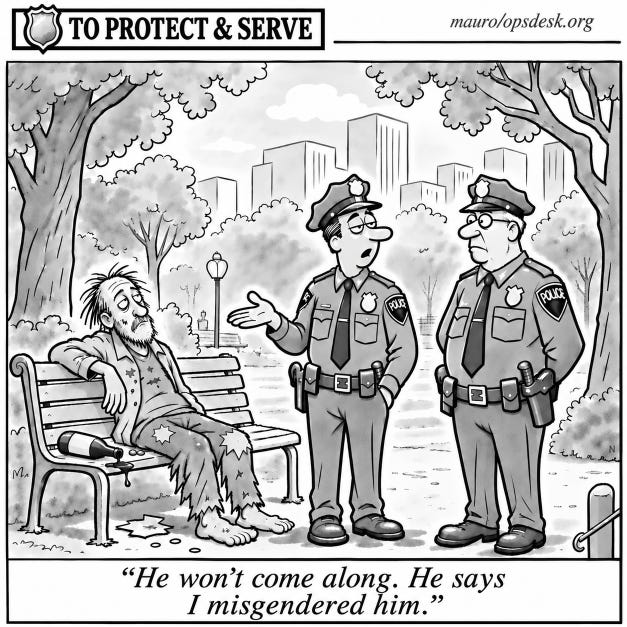
We wish it was an exaggeration…!

We live 60 miles from your blighted metropolis. The patients are now in charge of the asylum. There will come a time when NYC becomes a real-life recreation of "Escape from New York."
From where I sit, it's time to buy more ammo.
Insanity and crime spread, and none of us are immune, regardless of where one may live. Especially when you consider that elitists, who have the resources to readily move, bring their broken policies with to their new cities. Jurisdictions that were once reliably red or purple can, and do, change.